Ai Overview
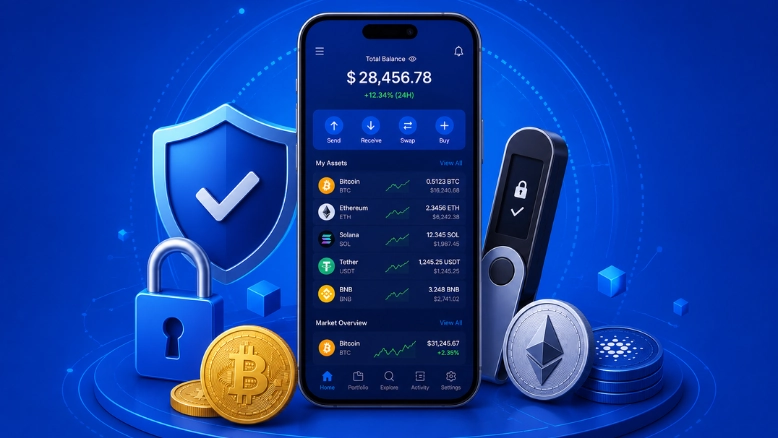
A cryptocurrency wallet is a software application or hardware device that stores the cryptographic keys needed to access, send, and receive digital assets on a blockchain network. The trading insights module of an AI based cryptocurrency wallet analyses multiple data streams simultaneously to provide users with contextually relevant investment guidance.
Key Takeaways
- An AI based cryptocurrency wallet uses machine learning and behavioral analytics to provide real-time fraud detection, automated alerts, and intelligent threat response that passive wallets cannot offer.
- Smart trading insights powered by AI analyze market conditions, portfolio composition, and user risk preferences to generate actionable buy, sell, and rebalancing recommendations in real time.
- Automation capabilities including rule-based trading, scheduled transactions, and smart notifications reduce the operational burden on crypto holders significantly compared to traditional manual wallet management.
- Machine learning, natural language processing, predictive analytics, and big data processing are the core technology layers that differentiate AI based cryptocurrency wallets from conventional alternatives.
- Multi-factor authentication combined with AI-based threat detection and biometric security creates a security architecture that adapts to new attack patterns without requiring manual updates by the user.
- AI based cryptocurrency wallets are gaining significant adoption among DeFi users, active traders, and institutional crypto holders in Singapore, UAE, and India who manage complex multi-asset portfolios.
- Future AI wallet capabilities will include voice interfaces, self-learning security models, Web3 identity integration, and fully autonomous DeFi participation agents managed by the wallet on the user’s behalf.
- The primary challenges in AI crypto wallet adoption include high infrastructure costs, data privacy concerns, AI model accuracy limitations, and evolving regulatory requirements across different jurisdictions.
- When choosing an AI based cryptocurrency wallet, users should evaluate security audit history, supported blockchain networks, AI feature depth, custodial arrangement, and regulatory compliance in their jurisdiction.
- Building a custom AI based cryptocurrency wallet requires expertise across blockchain architecture, machine learning engineering, security design, compliance, and user experience, making experienced development partners essential.
Understanding Cryptocurrency Wallets: The Basics
What is a Cryptocurrency Wallet?
A cryptocurrency wallet is a software application or hardware device that stores the cryptographic keys needed to access, send, and receive digital assets on a blockchain network. Contrary to what the word wallet implies, it does not store cryptocurrency directly. What it stores are the private keys that prove ownership of blockchain-recorded assets and the public keys that serve as the wallet’s address where others can send funds. The wallet interacts with the blockchain to sign transactions on behalf of the owner, enabling movement of assets between addresses. Without the private key, the assets associated with an address cannot be accessed by anyone, which is why secure key management is the foundation of all cryptocurrency wallet security.
Types of Crypto Wallets
Cryptocurrency wallets are broadly categorized into hot wallets and cold wallets based on their internet connectivity. Hot wallets are connected to the internet at all times, enabling instant transactions but introducing exposure to online attacks. They include browser extensions, mobile applications, and desktop software. Cold wallets store private keys entirely offline, dramatically reducing the attack surface but requiring physical access to sign transactions. Hardware devices and paper wallets are the primary cold wallet forms. The custodial versus non-custodial distinction cuts across both categories: custodial wallets are managed by a third party who holds the private keys, while non-custodial wallets give users complete control over their own keys and therefore their own assets without requiring trust in any third party for access.
Challenges in Traditional Wallets
Traditional cryptocurrency wallets suffer from three fundamental limitations that the AI based cryptocurrency wallet is specifically designed to address. Security risk is the first: conventional wallets rely entirely on the user’s vigilance to detect phishing attempts, suspicious transactions, and unauthorized access attempts. There is no active monitoring that can catch a threat the user has not personally noticed. Manual management is the second limitation: every decision about trading, portfolio rebalancing, transaction timing, and gas fee optimization must be made manually by the user, creating an enormous cognitive burden for active crypto holders managing diverse portfolios. Lack of insights is the third: traditional wallets display balances and transaction histories but provide no analytical context, no market intelligence, and no actionable guidance about what the user should do to protect and grow their holdings.
What is Artificial Intelligence in Fintech?
Artificial intelligence in financial technology refers to the application of machine learning models, pattern recognition systems, and automated decision-making algorithms to financial processes that previously required human judgement. In the fintech context, AI is not a single technology but a family of related techniques including supervised learning, unsupervised learning, reinforcement learning, and natural language processing that collectively enable systems to analyze large volumes of data, identify patterns, make predictions, and take actions without requiring explicit programming for every possible scenario. The practical result in financial applications is systems that can assess creditworthiness from thousands of data points faster than any human underwriter, detect fraudulent transactions in milliseconds by comparing them against millions of legitimate transaction patterns, and provide investment recommendations based on portfolio analysis that no human advisor could perform at equivalent scale and speed.
Role of AI in Blockchain and Crypto
In the blockchain and cryptocurrency context specifically, AI contributes across three primary dimensions. Data analysis allows AI systems to process the enormous volume of on-chain transaction data, market price data, and user behaviour data that blockchain networks generate continuously, extracting signals and patterns that inform both security and investment decisions. Automation enables AI systems to execute predefined actions in response to detected conditions without requiring human approval for routine operations, significantly reducing the latency between market event and wallet response. Security enhancement allows AI to move beyond static rule-based defenses to dynamic, self-updating threat models that recognize and respond to new attack patterns as they emerge rather than only defending against known historical threats. Together, these three contributions define what separates an AI based cryptocurrency wallet from its conventional counterpart.
What is an AI Based Cryptocurrency Wallet?
An AI based cryptocurrency wallet is a digital asset management platform that integrates artificial intelligence and machine learning systems directly into the wallet infrastructure to provide capabilities that conventional wallets cannot offer. Where a traditional wallet simply stores keys and signs transactions, an AI based cryptocurrency wallet actively monitors all wallet activity, analyses market conditions, learns from user behaviour, and takes or recommends actions to protect and optimised the user’s assets. It combines the fundamental key management and transaction signing functions of any cryptocurrency wallet with an intelligence layer that processes data continuously, identifies anomalies and opportunities, and communicates insights and alerts to the user through an interface that adapts to their preferences and usage patterns over time.
How it works involves several cooperating systems. A behavioral analysis engine continuously records and models the user’s normal transaction patterns, access methods, and portfolio management decisions. A market intelligence layer ingests price data, on-chain metrics, sentiment analysis, and macroeconomic indicators to provide contextual market insights. An automation engine executes user-defined rules and scheduled operations without requiring manual initiation. A natural language interface allows users to query their portfolio, set preferences, and request information through conversational input rather than navigating complex technical menus. All of these systems contribute to the core value proposition of the AI based cryptocurrency wallet: an intelligent financial assistant that grows more capable and more personalized with every interaction.
The popularity of AI based cryptocurrency wallets is growing rapidly in markets including India, Singapore, and UAE, where sophisticated retail and institutional crypto investors are managing increasingly complex multi-asset, multi-chain portfolios and need tools that match this complexity with equivalent intelligence. The limitations of conventional wallets become most acutely felt by exactly this user profile, making AI based cryptocurrency wallets a natural product fit for the most engaged and financially significant segment of the crypto market.
Key Features of AI Based Cryptocurrency Wallet
Intelligent Fraud Detection
The fraud detection capability of an AI based cryptocurrency wallet operates on a fundamentally different principle from the static rule sets used in conventional security systems, with Sift fintech fraud prevention used as a tool to strengthen behavioral risk detection and transaction monitoring. Rather than checking each transaction against a fixed list of prohibited patterns, the AI builds a detailed model of each individual user’s normal behaviour across dozens of dimensions: typical transaction sizes, frequency, timing, recipient address patterns, geographic access locations, device fingerprints, and interaction patterns with the wallet interface. When an incoming or outgoing transaction deviates from this personalized model in ways that suggest unauthorized access or a social engineering attempt, the AI flags it in real time and triggers a graduated response proportional to the assessed risk level. Minor anomalies generate alerts requiring user confirmation before proceeding. Significant anomalies trigger additional authentication requirements. Severe anomalies that match known attack signatures can result in automatic transaction blocking pending manual review.
Real-time alerts are delivered through push notifications, email, and in-app messaging simultaneously, ensuring the user is aware of suspicious activity through multiple channels even if one channel is compromised. The alert system also incorporates context about why a transaction was flagged, helping users quickly distinguish genuine fraud attempts from legitimate unusual transactions, such as a first-time large purchase from a trusted new exchange address, that might otherwise cause false positives.
Smart Trading Insights
The trading insights module of an AI based cryptocurrency wallet analyses multiple data streams simultaneously to provide users with contextually relevant investment guidance. Market analysis incorporates price trend data, trading volume patterns, on-chain metrics including exchange inflows and outflows, whale wallet movements, and social sentiment signals from crypto community platforms. The AI cross-references these signals against the user’s current portfolio composition and their previously expressed or inferred risk preferences to generate personalized buy, sell, and hold recommendations that account for their specific situation rather than generic market commentary. Portfolio recommendations go beyond individual asset suggestions to evaluate overall allocation balance, concentration risk, correlation between holdings, and exposure to specific market sectors or blockchain ecosystems. A user whose portfolio is heavily concentrated in a single chain or a highly correlated group of assets receives diversification suggestions tailored to their holdings and the current market environment.
Automation Capabilities
Automation in an AI based cryptocurrency wallet operates through a user-defined rule engine that allows the specification of conditions and corresponding actions without requiring programming knowledge. Auto trading rules allow users to define price triggers, time-based conditions, and portfolio allocation targets that the wallet monitors and executes automatically. A user might define a rule to automatically purchase additional ETH if its price drops below a defined threshold while their portfolio ETH allocation is below a target percentage, with the purchase executed instantly when all conditions are met without requiring any manual action. Scheduled transactions enable regular automated transfers for recurring payments, DCA strategies, and portfolio rebalancing at defined intervals. Smart notifications go beyond simple price alerts to provide contextual updates about market events specifically relevant to the user’s holdings, approaching transaction confirmation deadlines, gas fee windows optimal for pending operations, and governance events for DeFi protocols in which the user is participating.
Personalized User Experience
The personalization dimension of an AI based cryptocurrency wallet manifests across every aspect of the user interface and interaction model. An AI-powered chatbot allows users to ask natural language questions about their portfolio, request specific transaction histories, query market data, and set preferences through conversational interaction rather than navigating menus. The custom dashboard adapts based on which assets and features each user interacts with most frequently, surfacing relevant information prominently and reducing the cognitive effort of finding what matters most. User behaviour learning progressively refines the wallet’s recommendations and interface organization based on observed usage patterns, creating an experience that becomes measurably better suited to each individual user over time. A new user in Singapore managing a simple Bitcoin and Ethereum portfolio receives a very different default experience from an experienced DeFi user in UAE managing dozens of assets across multiple chains, and both experiences are better than the one-size-fits-all interface of a conventional wallet.
Benefits of AI Based Cryptocurrency Wallet
Enhanced security is the benefit that most immediately differentiates an AI based cryptocurrency wallet from conventional alternatives. The combination of behavioral anomaly detection, real-time threat monitoring, and adaptive authentication creates a security posture that actively counters threats rather than simply presenting barriers that a sufficiently motivated attacker can circumvent. This active security is particularly valuable in the current threat environment where phishing attacks, SIM swapping, and social engineering have made static security measures insufficient for protecting significant crypto holdings. Time-saving automation eliminates the repetitive manual tasks that consume disproportionate time for active crypto holders: monitoring price levels for trading opportunities, executing DCA purchases, managing gas fees, and tracking portfolio allocation drift. By automating these routine operations, AI wallets free users to focus on higher-level strategic decisions while the wallet handles execution.
Better investment decisions result from the AI’s ability to process and synthesize a volume and variety of market data that no individual investor could personally analyze. The AI’s recommendations do not replace the investor’s judgement but they inform it with a quality and completeness of market intelligence that was previously available only to institutional traders with dedicated research teams. Reduced human error is a significant practical benefit: in high-volatility crypto markets, emotionally driven decisions during market stress events frequently lead to buy-high sell-low behaviour that destroys portfolio value. AI recommendations based on data rather than emotion provide a counterweight to this behavioral tendency and help users stick to their defined investment strategy even when market conditions create psychological pressure to deviate from it.
Enhanced Security
Active AI threat monitoring adapts to new attack patterns and provides real-time protection unavailable in static wallets
Time Saving
Automated rules handle routine portfolio management and trading tasks without constant manual intervention
Better Decisions
AI-synthesised market insights inform investment decisions with data quality previously available only to institutions
Reduced Error
Data-driven recommendations counteract emotionally driven trading errors during high-volatility market conditions
Individual crypto investors benefit from AI based cryptocurrency wallets primarily through the security enhancement and the portfolio intelligence features. A retail investor in India holding Bitcoin, Ethereum, and a selection of altcoins across multiple exchanges and wallets gains a unified view of their total position with AI-powered analysis of concentration risk, rebalancing opportunities, and market timing signals that would otherwise require expensive third-party advisory services or time-consuming personal research. The fraud detection layer provides peace of mind that is particularly valuable for investors who hold significant savings in digital assets without the institutional security infrastructure that professional traders have access to, making advanced fraud detection software an essential component of this protection.
Crypto traders who execute multiple transactions daily across multiple markets benefit most from the automation and real-time insights capabilities. The AI’s ability to monitor price levels and execute predefined strategies without human monitoring removes the constraint that traders previously faced: they could only act on opportunities they personally observed. With AI automation, trading rules execute instantly at any hour, capturing opportunities that human traders operating within normal working hours would miss. Businesses and startups using crypto for treasury management, supplier payments, or customer transactions benefit from the scheduled transaction and compliance monitoring features that help them manage crypto assets with the same rigout they apply to traditional financial assets. DeFi users benefit from cross-protocol monitoring, yield optimization suggestions, and automated liquidity management that make active DeFi participation accessible without requiring constant manual attention to multiple protocol dashboards simultaneously.
Machine learning is the foundational technology layer of every AI based cryptocurrency wallet. Supervised learning models trained on historical transaction data and labelled fraud cases learn to recognize the patterns that distinguish legitimate from suspicious activity. Unsupervised learning models cluster transaction patterns to detect anomalies without requiring pre-labelled examples, enabling the detection of novel attack patterns that have not been previously categorized. Reinforcement learning models optimised trading and portfolio management strategies by learning from the outcomes of past decisions, progressively improving their recommendations as they accumulate experience with the specific market conditions and user preferences relevant to each wallet.
Natural language processing enables the conversational interface features of AI based cryptocurrency wallets, allowing users to interact with their wallet through natural language queries and instructions rather than only through structured menu interactions. NLP models process user inputs to extract intent, identify relevant entities such as specific cryptocurrencies or transaction amounts, and generate contextually appropriate responses in natural language. This capability significantly reduces the technical knowledge barrier for accessing complex wallet functions, making AI wallets more accessible to users who are sophisticated about their financial goals but not technically expert in blockchain mechanics.
Blockchain integration at the infrastructure level allows AI systems to access on-chain data directly rather than relying only on exchange-provided market data. On-chain analytics including wallet flow data, smart contract interaction patterns, token distribution changes, and network health metrics provide signals that AI models use to supplement traditional price and volume data with fundamentally different information about blockchain network conditions. Predictive analytics models forecast price ranges, volatility levels, and network congestion based on historical patterns and current conditions. Big data processing infrastructure handles the volume and velocity of data that AI wallet systems must process in real time, from continuous on-chain data streams to social media sentiment feeds to exchange order book data, without introducing latency that would degrade the timeliness of insights and alerts.
AI Wallet vs Traditional Wallet: Feature Comparison
| Feature | AI Based Wallet | Traditional Wallet |
|---|---|---|
| Fraud Detection | Real-time AI monitoring | User vigilance only |
| Trading Insights | AI-generated recommendations | None |
| Transaction Automation | Rule-based auto-execution | Manual only |
| User Interface | Adaptive personalized | Static fixed layout |
| Portfolio Analysis | Continuous AI analysis | Balance display only |
| Threat Adaptation | Self-updating AI models | Manual updates only |
Security Mechanisms in AI Wallets
Multi-factor authentication in an AI based cryptocurrency wallet goes beyond the standard combination of password and one-time code to incorporate device-specific verification, behavioral biometrics, and risk-adaptive authentication intensity. Low-risk access from a familiar device in a typical location might require only a biometric confirmation. High-risk access from a new device in an unusual location might trigger a full multi-step verification sequence including hardware key confirmation and an out-of-band verification call. This risk-adaptive approach means that the authentication burden scales with the actual risk of the specific access attempt rather than applying the same friction to every interaction regardless of context, improving both security and user experience simultaneously.
AI-based threat detection continuously analyses all wallet interactions for patterns that indicate malicious activity, including abnormal API call patterns that suggest automated attack attempts, transaction sequencing that matches known money laundering or theft patterns, and access patterns that suggest credential compromise.[1] Unlike signature-based security systems that only recognize known threats, AI threat detection can identify novel attack patterns that share structural similarities with known attacks even if the specific implementation has not been previously documented. Biometric security including facial recognition, fingerprint authentication, and behavioral biometrics such as typing rhythm and device handling patterns adds a layer of identity verification that is significantly more difficult to spoof than knowledge-based authentication factors. Encryption techniques protect private keys at rest and data in transit using current cryptographic standards, ensuring that even if an attacker gains access to the wallet’s storage, the encrypted private key material cannot be used without the correct decryption credentials.
Challenges and Limitations
High infrastructure cost is the primary barrier to building a genuinely capable AI based cryptocurrency wallet. The ML model training infrastructure, real-time data ingestion pipelines, low-latency inference systems, and the security architecture required to protect an AI wallet at scale represent a significantly higher investment than the relatively straightforward key management infrastructure of a conventional wallet. This cost differential means that AI based cryptocurrency wallets are predominantly built by well-funded teams and that the quality of AI capabilities varies significantly between platforms depending on the depth of investment in the underlying infrastructure.
Data privacy concerns arise from the fact that the behavioral modelling that makes AI based cryptocurrency wallets intelligent requires collecting and processing detailed information about user behaviour. Users who are concerned about surveillance, data breach risk, or the potential misuse of their financial behaviour data may be uncomfortable with the level of monitoring that AI wallet intelligence requires. This tension between intelligence quality and privacy is one of the most important design challenges in AI wallet architecture, and different platforms make different trade-offs between these competing values that users should understand before committing to a specific platform. AI accuracy limitations are an honest reality that any serious AI based cryptocurrency wallet provider should acknowledge: AI models are probabilistic, not deterministic. They generate recommendations and detect threats based on statistical patterns, which means they will produce both false positives, flagging legitimate activity as suspicious, and false negatives, missing genuine threats that do not match learned patterns. Regulatory uncertainty in markets including India and UAE adds compliance risk that platform operators must navigate carefully, as classification of AI wallet features under existing financial services regulations is still evolving.
Future Trends of AI Based Cryptocurrency Wallet
Web3 integration is the most significant near-term evolution for AI based cryptocurrency wallets. As decentralized applications proliferate across gaming, social media, finance, and identity management, the wallet becomes the primary interface through which users interact with the entire Web3 ecosystem. An AI layer in this wallet context does not just manage assets but acts as an intelligent agent that evaluates dApp interactions for risk, manages digital identity credentials, optimizes cross-protocol transactions, and maintains the user’s on-chain reputation and social graph. DeFi automation will become dramatically more sophisticated as AI wallets develop the capability to manage complete DeFi strategies autonomously, monitoring yield opportunities across dozens of protocols, managing liquidity positions, handling token governance votes, and rebalancing exposure as market conditions change without requiring the user to interact with individual protocol interfaces.
Voice-enabled wallet interfaces will bring AI based cryptocurrency wallets into the mainstream by making them accessible to users who find traditional app interfaces intimidating. Voice commands for portfolio queries, transaction initiation, and preference setting will significantly expand the addressable user base for AI wallets, particularly in markets like India where voice interfaces in local languages have demonstrated strong adoption for other financial services. Cross-chain compatibility is evolving from a feature to a baseline expectation: AI based cryptocurrency wallets will manage assets across dozens of blockchain networks simultaneously, with AI optimising routing, bridging, and settlement across chains to minimize cost and maximize speed for every cross-chain operation. Self-learning AI systems that continuously improve their security models, market predictions, and user experience adaptations without requiring manual model updates represent the long-term destination for the technology.
AI Wallet Feature Adoption Rate (2026 Estimates)
How to Choose the Right AI Based Cryptocurrency Wallet
Security features are the first and most important evaluation criterion when selecting an AI based cryptocurrency wallet. Verify that the platform has undergone independent security audits by recognized blockchain security firms, that the smart contract code is publicly auditable if applicable, that the platform maintains a bug bounty programmer, and that the custody arrangement clearly defines whether you or the platform holds the private keys. The track record of the platform’s security incidents and its response to past vulnerabilities is more informative than any marketing claim about security capabilities. Non-custodial wallets that keep your private keys under your own control are generally preferable for users with significant holdings who cannot afford to be dependent on a third party’s continued financial health or operational integrity.
Supported cryptocurrencies and blockchain networks determine whether a platform can actually serve your full portfolio. A platform that supports only Ethereum-based assets will not serve a user who holds Solana, Bitcoin, or Avalanche assets, regardless of how sophisticated its AI features are for the supported assets. Ease of use matters particularly for users who are sophisticated about finance but not deeply technical about blockchain mechanics: an AI wallet that presents its intelligence through a confusing interface fails its users even if the underlying AI is excellent. AI capabilities themselves deserve careful evaluation: look for platforms that publish documentation about their AI models, provide transparency about the data sources informing their recommendations, and allow users to understand the reasoning behind specific suggestions rather than presenting AI outputs as black box conclusions. Reputation and independent reviews from users in your specific market, whether India, UAE, or Singapore, provide the most reliable signal about real-world performance.
AI Wallet Selection Checklist
| Criterion | What to Look For | Priority |
|---|---|---|
| Security Audit | Published report from named reputable security firm, recent and covering AI and smart contract layers | Critical |
| Custody Model | Non-custodial preferred for full asset control. If custodial, verify insurance and regulatory licence. | Critical |
| Chain Support | All blockchains relevant to current and planned portfolio. Multi-chain bridging capabilities preferred. | High |
| AI Transparency | Explainable recommendations with data sources disclosed. Not a black box producing unexplained outputs. | High |
| Regulatory Status | Verified compliance with applicable regulations in India, UAE, or Singapore as relevant to your location. | High |
Final Thoughts
The AI based cryptocurrency wallet represents a genuine step change in how digital assets are managed, protected, and grown. By bringing machine learning-powered fraud detection, AI-driven market insights, and intelligent automation into the wallet layer, these platforms address the three most significant limitations of traditional cryptocurrency wallets in a way that makes a measurable practical difference to the security and financial outcomes of everyone who uses them. The technology is no longer in its infancy. Multiple production platforms are operating with real users in India, UAE, Singapore, and globally, demonstrating that AI wallet capabilities work reliably at scale under real-world conditions rather than only in controlled demonstrations.
The importance of AI in crypto wallets will only grow as the asset class matures, regulatory frameworks evolve, and the complexity of the DeFi and Web3 ecosystem increases. Investors and businesses that adopt AI based cryptocurrency wallets early gain the dual advantage of better asset protection during the current period of elevated crypto market risk and better positioning to benefit from the more sophisticated AI capabilities that will characterise next-generation platforms within the next two to three years. The future potential of AI wallets extends well beyond current capabilities toward fully autonomous financial agents that manage every dimension of a user’s digital asset strategy with the intelligence of a professional advisor and the speed and precision of automated systems. Building that future starts with the AI based cryptocurrency wallet infrastructure being deployed today.
Frequently Asked Questions
Q1.What is an AI based cryptocurrency wallet?
An AI based cryptocurrency wallet is an advanced digital wallet that integrates artificial intelligence and machine learning technologies to enhance how users store, manage, and transact cryptocurrencies. Unlike traditional wallets, it can analyze user behavior, detect potential risks, and provide intelligent insights. These wallets not only store crypto assets securely but also act as smart assistants by offering automated features, predictive analytics, and real-time decision-making support.
Q2.How does AI improve cryptocurrency wallet security?
AI significantly enhances security by continuously monitoring user activity and identifying unusual patterns. It uses behavioral analysis to understand how a user typically interacts with their wallet and flags any deviation, such as login attempts from unknown devices or sudden large transactions. AI also performs real-time fraud detection, blocks suspicious activities instantly, and can trigger additional verification steps like multi-factor authentication. This proactive approach helps prevent hacking, phishing, and unauthorized access.
Q3.Is an AI based cryptocurrency wallet safe to use?
Yes, AI based cryptocurrency wallets are considered highly secure when built with proper technologies. They combine traditional security measures like encryption and private keys with advanced AI capabilities such as anomaly detection and predictive threat analysis. This layered security approach makes it much harder for cybercriminals to exploit vulnerabilities. However, users should still follow best practices like using strong passwords and enabling all security features provided by the wallet.
Q4.Can AI help in crypto trading?
AI plays a crucial role in improving crypto trading decisions by analyzing vast amounts of market data in real time. It evaluates historical price trends, market sentiment, and trading patterns to provide accurate insights. AI-based wallets can suggest optimal buying or selling opportunities, help users diversify their portfolios, and reduce emotional decision-making. This makes trading more strategic, especially for beginners who may lack deep market knowledge.
Q5.What features should an AI based cryptocurrency wallet have?
A high-quality AI based cryptocurrency wallet should include features like intelligent fraud detection, automated trading options, real-time alerts, and portfolio management tools. It should also offer predictive analytics for market trends, user-friendly dashboards, and secure authentication methods such as biometric login or multi-factor authentication. Additionally, integration with DeFi platforms and support for multiple cryptocurrencies are important for a complete user experience.
Q6.How does fraud detection work in AI crypto wallets?
Fraud detection in AI crypto wallets works through advanced algorithms that analyze transaction patterns and user behavior. The system creates a baseline of normal activity and continuously compares new actions against it. If any anomaly is detected such as a transaction from a new location, unusual timing, or abnormal transaction size the AI system immediately flags it. In many cases, it can temporarily block the transaction or notify the user for confirmation, preventing potential fraud before it occurs.
Q7.Are AI based cryptocurrency wallets suitable for beginners?
Yes, AI based cryptocurrency wallets are highly suitable for beginners because they simplify complex processes. AI-driven interfaces provide step-by-step guidance, smart recommendations, and automated features that reduce the need for technical knowledge. Beginners can benefit from features like auto trading, portfolio suggestions, and real-time alerts, which help them make informed decisions without needing deep expertise in blockchain or crypto markets.
Q8.What is the difference between traditional and AI crypto wallets?
Traditional cryptocurrency wallets mainly focus on storing and transferring digital assets, offering limited functionality beyond basic security. In contrast, AI based cryptocurrency wallets provide a more advanced and intelligent experience. They include features like fraud detection, predictive analytics, automated transactions, and personalized recommendations. This makes AI wallets more efficient, secure, and user-friendly compared to traditional wallets.
Q9.Can AI automate cryptocurrency transactions?
Yes, AI can automate cryptocurrency transactions based on predefined rules and conditions set by the user. For example, users can configure the wallet to automatically buy a specific cryptocurrency when its price drops to a certain level or sell when it reaches a target profit. AI ensures these actions are executed instantly without manual intervention, helping users take advantage of market opportunities even when they are not actively monitoring the market.
Q10.What is the future of AI based cryptocurrency wallets?
The future of AI based cryptocurrency wallets looks highly promising, with continuous advancements in both AI and blockchain technology. Upcoming developments include deeper integration with Web3 ecosystems, decentralized finance (DeFi) platforms, and cross-chain compatibility. AI will become more sophisticated, enabling self-learning systems that adapt to user behavior and market conditions. Features like voice-enabled commands, advanced biometric security, and fully automated portfolio management are expected to become standard in the coming years.
Explore Services
Related Services
Reviewed by

Aman Vaths
Founder of Nadcab Labs
Aman Vaths is the Founder & CTO of Nadcab Labs, a global digital engineering company delivering enterprise-grade solutions across AI, Web3, Blockchain, Big Data, Cloud, Cybersecurity, and Modern Application Development. With deep technical leadership and product innovation experience, Aman has positioned Nadcab Labs as one of the most advanced engineering companies driving the next era of intelligent, secure, and scalable software systems. Under his leadership, Nadcab Labs has built 2,000+ global projects across sectors including fintech, banking, healthcare, real estate, logistics, gaming, manufacturing, and next-generation DePIN networks. Aman’s strength lies in architecting high-performance systems, end-to-end platform engineering, and designing enterprise solutions that operate at global scale.