Blockchain Infrastructure for AI-Driven Finance
Nexus is an EVM-compatible Layer-1 blockchain built for verifiable finance, AI agents, and high-performance on-chain applications. It combines smart contracts, zero-knowledge proofs, distributed computing, and specialized financial execution. The ecosystem includes Nexus Layer 1, Nexus Exchange, and USDX, creating a unified environment for programmable markets, automated transactions, and machine-driven financial activity.
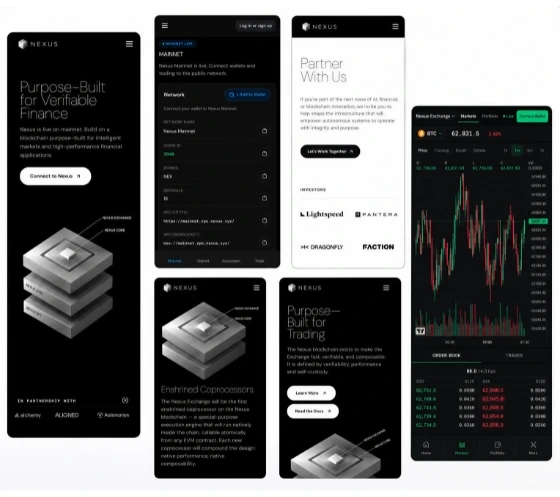
Get Started with Nexus
NexusEVM supports Ethereum bytecode, Solidity smart contracts, and common EVM tools, allowing developers to build and deploy decentralized applications without changing their familiar development workflow.
Nexus integrates its zkVM with a distributed Compute Network to generate cryptographic proofs, helping complex blockchain operations remain independently verifiable without requiring every node to repeat the full computation.
Nexus combines NexusEVM for general-purpose smart contracts with NexusCore for high-performance financial execution, separating flexible application development from speed-sensitive operations such as settlement and risk processing.
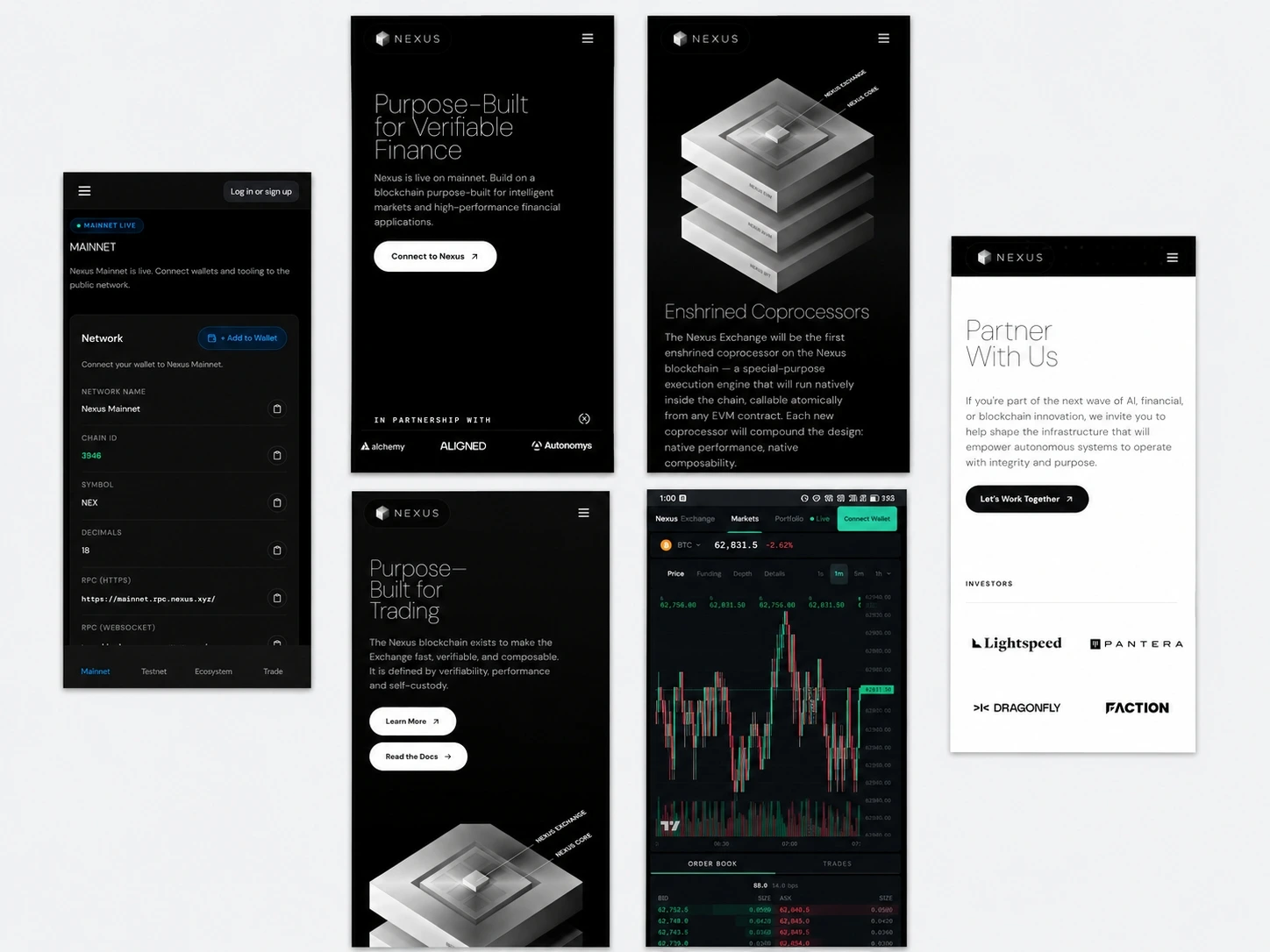
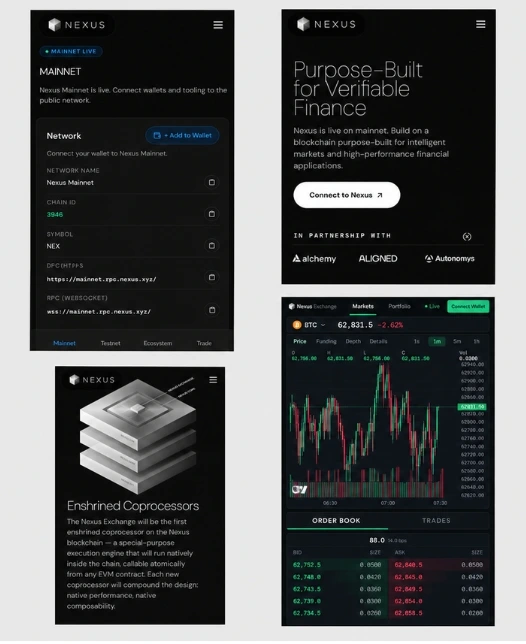
NexusCore supports protocol-level coprocessors optimized for specialized financial functions, including order matching, liquidations, risk calculations, and settlement, helping the network handle latency-sensitive operations more efficiently.
NexusBFT uses Byzantine Fault Tolerant consensus to order transactions and finalize blocks within a single slot, reducing confirmation uncertainty and providing more predictable settlement for financial applications and automated systems.
The Nexus Compute Network coordinates distributed computing resources for zero-knowledge proof generation, supporting verifiable execution across NexusEVM and, as the architecture expands, specialized NexusCore operations.
Nexus required a blockchain architecture capable of supporting financial applications that demand greater speed, verifiability, and execution efficiency than conventional smart-contract environments commonly provide.
A core requirement was maintaining compatibility with Ethereum development tools while expanding the network’s ability to process specialized financial operations. This led to a dual-execution design combining the flexibility of NexusEVM with the performance-oriented NexusCore runtime.
The project also needed a verification system capable of proving increasingly complex computation at scale. Nexus addressed this requirement through its zkVM and distributed Compute Network, which are designed to generate and aggregate cryptographic proofs of correct execution.
Another important requirement was preparing the blockchain for autonomous economic activity. As AI agents begin monitoring markets, managing capital, and submitting transactions programmatically, the network must support higher transaction frequency, machine-native access, and independently verifiable outcomes.
Nexus uses NexusBFT, a custom Byzantine Fault Tolerant consensus protocol responsible for ordering transactions, committing blocks, coordinating validators, and providing finality.
The consensus system is designed to finalize transactions within a single block slot. This reduces confirmation uncertainty and can provide a more predictable environment for financial applications.
The Nexus blockchain is secured by validators participating in NexusBFT consensus. The validator set was permissioned at mainnet launch, with the project planning to expand network participation progressively.
NexusBFT currently commits NexusEVM blocks. As NexusCore and its coprocessor framework are deployed, the consensus layer is intended to coordinate commitments across both execution environments.
The Compute Network complements consensus by generating zero-knowledge proofs for network execution. Consensus establishes the accepted blockchain state, while cryptographic proofs are designed to demonstrate that the underlying computation was performed correctly.
At mainnet launch, Nexus operated with a permissioned validator set, while the project planned to gradually expand participation and improve network decentralization.
Visual identity and design elements
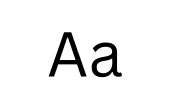
Primary font family and usage
Brand colors
#ffffff
#000000
#a7a7a7
Nexus began with zero-knowledge research focused on proving arbitrary computation efficiently. Rather than remaining a standalone proving tool, the project expanded its zkVM into a broader blockchain and distributed compute architecture. Public testnets were then used to evaluate proof generation, node participation, smart-contract activity, developer tooling, and integration between the Compute Network and Nexus Layer 1.
The project later introduced a dual-execution model. NexusEVM supports general-purpose applications using familiar Ethereum tools, while NexusCore is designed for specialized financial operations through enshrined coprocessors. Nexus also developed an integrated model connecting Layer 1, Nexus Exchange, and USDX. On May 20, 2026, the network moved from testnet to a live EVM-compatible mainnet.
Nexus successfully progressed from zkVM research and early network prototypes to a functioning Layer-1 mainnet. Developers can now deploy EVM-compatible smart contracts using familiar Ethereum tooling. The project also reported strong testnet participation, with Testnet II attracting more than 2.1 million users and connecting millions of nodes across its distributed proving environment.
The launch of NEX established the network’s native economic asset for transaction fees, smart-contract execution, consensus, and compute interactions. Nexus also created the foundation for a wider financial ecosystem involving NexusCore, coprocessors, Nexus Exchange, and USDX. However, long-term success will still depend on production performance, decentralization, liquidity growth, developer adoption, and delivery of planned components.
Nexus is still a newly launched mainnet with limited production history. Its long-term security, network stability, real-world usage, and economic sustainability must be proven as transaction volume and ecosystem activity grow.
The validator set was permissioned at launch, which limits decentralization. Nexus must gradually expand validator participation to reduce dependence on a small operator group and strengthen network resilience and governance.
Nexus combines NexusEVM, NexusCore, NexusBFT, coprocessors, zkVM, and a distributed Compute Network. Securely coordinating these interconnected components creates major engineering, testing, and operational challenges.
Zero-knowledge proof generation requires substantial computing resources. Nexus must improve proving efficiency while maintaining reliable performance and sustainable rewards for compute providers as network activity increases.
Nexus needs developers, applications, users, validators, and liquidity providers to build a sustainable ecosystem. Nexus Exchange and USDX will also require deep liquidity, active markets, and effective risk controls.
Nexus must deliver NexusCore, coprocessors, USDX, and its exchange while adapting to changing regulations. It must also protect AI-controlled funds from faulty automation, compromised access, manipulated data, and contract risks.

Nexus uses an EVM-compatible Layer-1 blockchain, Ethereum bytecode, Solidity smart contracts, NexusBFT consensus, Nexus zkVM, RISC-V-based verifiable computation, distributed zero-knowledge proof generation, NexusEVM, NexusCore, protocol-level coprocessors, validator infrastructure, and Web3 wallet integrations to create a programmable and verifiable financial ecosystem.