Ai Overview
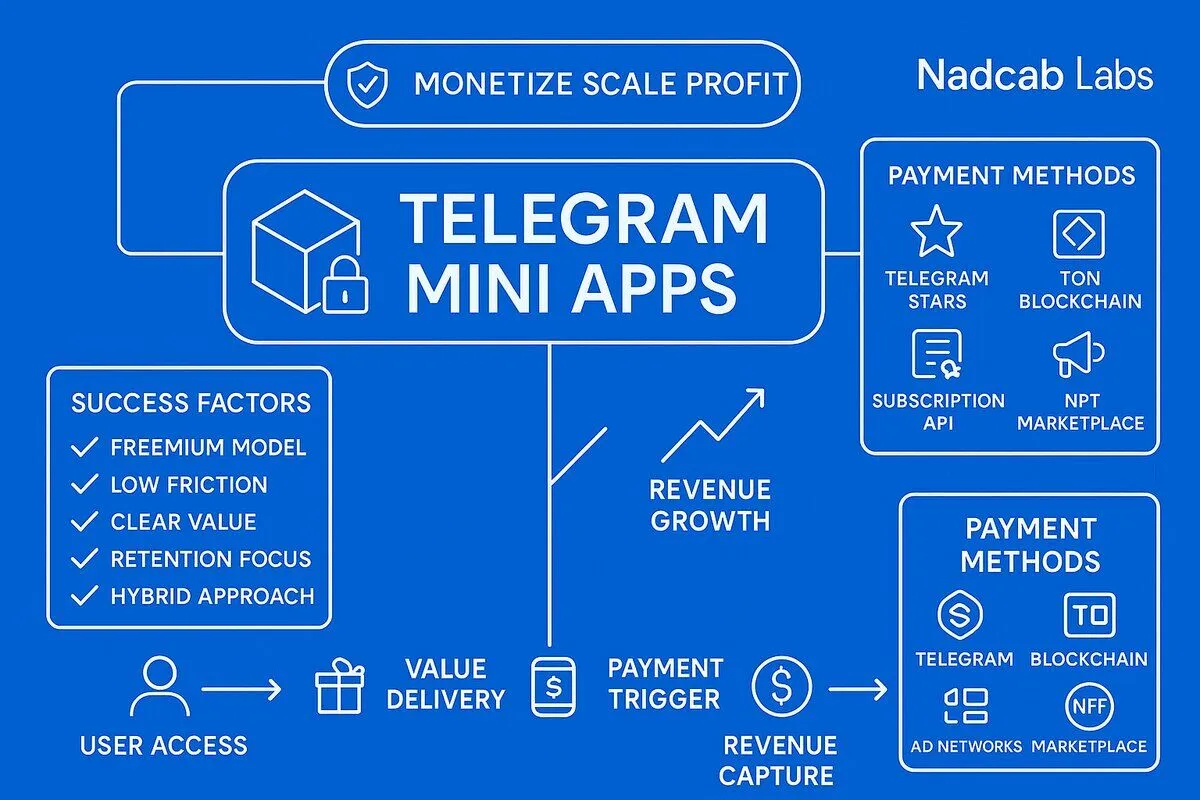
Ecosystem Not Feature: Mini Apps create a platform economy where Telegram distributes, developers build, and value flows. Zero Distribution Cost: Telegram replaces app stores with in-chat sharing, avoiding $10–$50 acquisition costs per user. Inherited Identity Advantage: Users are pre-authenticated via Telegram, removing signup friction that drops 60–80% of users. Bot–Mini App Symbiosis: Bots automate and notify; Mini Apps deliver UI—successful products orchestrate both together strategically.
Key Takeaways: Telegram Mini Apps Ecosystem
- Ecosystem Not Feature:
Mini Apps create a platform economy where Telegram distributes, developers build, and value flows. - Zero Distribution Cost:
Telegram replaces app stores with in-chat sharing, avoiding $10–$50 acquisition costs per user. - Inherited Identity Advantage:
Users are pre-authenticated via Telegram, removing signup friction that drops 60–80% of users. - Bot–Mini App Symbiosis:
Bots automate and notify; Mini Apps deliver UI—successful products orchestrate both together strategically. - Viral Growth Mechanics:
Sharing and group amplification drive exponential growth through networks, not paid advertising campaigns. - Platform Dependency Tradeoff:
Instant access and zero distribution require accepting Telegram policies, constraints, and platform control. - Session-Based Design Requirement:
WebView backgrounding demands state persistence and graceful recovery from frequent session interruptions. - Product Surface Mindset:
Telegram is an environment to inhabit—build conversation enhancements, not isolated standalone apps.
1. Why Telegram Mini Apps Are an Ecosystem, Not Just a Feature
Ecosystem vs Feature Distinction:
- Distribution Layer: Telegram replaces app stores with in-chat discovery and viral sharing
- Identity Layer: No signup forms—user identity inherited from Telegram account
- Payment Layer: Telegram payments or integrated gateways handle monetization
- Social Graph: Access to groups, channels, and contact networks for growth
- Platform Economics: Telegram provides infrastructure; developers don’t pay for distribution or authentication
- Network Effects: Each Mini App makes Telegram more valuable, attracting more users and developers
- Mutual Dependency: Success requires understanding platform constraints and opportunities simultaneously
- Value Distribution: Unlike standalone apps, value flows between platform, developers, and users continuously
2. Core Components of the Telegram Mini Apps Ecosystem
| Component | Primary Role | Key Constraint |
|---|---|---|
| Telegram Client | Distribution, identity, session management | Platform policies, UI boundaries |
| Bot | Automation, notifications, lightweight UI | Limited rich UI, sequential interaction |
| Mini App Frontend | Rich UI, user interaction, presentation | Session-bound, no local persistence |
| Backend Services | Business logic, data storage, state | Must handle Telegram webhooks/callbacks |
| External Systems | Payments, analytics, third-party integrations | Integration complexity, data sync |
Component Interaction Patterns:
- User → Bot → Mini App: Bot serves as entry point, Mini App provides rich experience
- Mini App → Backend → External: Frontend calls backend, backend integrates external services
- Telegram → Backend → Bot: Telegram webhooks trigger backend logic, backend controls bot responses
- Backend → Mini App → User: Backend pushes state changes, Mini App updates UI
- Telegram Client: Provides WebView container, manages session lifecycle, enforces platform policies
- Bot Layer: Handles commands, notifications, inline keyboards, and lightweight automation
- Frontend Layer: React, Vue, or vanilla JS running inside Telegram’s WebView with API access
- Backend Layer: Node, Python, Go services handling business logic and Telegram Bot API
3. Role of Telegram as the Distribution Layer
Distribution Layer Replacement:
- App Store → In-Chat Links: No submission, review, or approval process for basic functionality
- Installation → Instant Launch: Web-based loading eliminates download and install steps
- Updates → Transparent Deployment: Deploy backend and frontend updates without user action
- Login Systems → Inherited Identity: User already authenticated through Telegram account
| Distribution Aspect | Traditional Apps | Telegram Mini Apps |
|---|---|---|
| Discovery | Paid ads, ASO, organic search | Links in chats, groups, channels |
| Acquisition Cost | $10-$50 per user | $0 (organic viral growth) |
| Time to Launch | 1-2 weeks review | Instant (if policy-compliant) |
| Platform Fee | 30% of revenue | Varies by payment method |
| User Friction | Download + Install + Signup | Click link (already logged in) |
- Link-Based Distribution: Mini Apps launch from URLs shared in any chat context
- Social Amplification: Users share Mini Apps in groups and channels, creating viral loops
- Zero Installation Friction: Instant launch eliminates the download-install-signup funnel
- Contextual Discovery: Users find Mini Apps through conversations, not search or ads
4. Bots vs Mini Apps: Different Roles Inside the Ecosystem
Bot vs Mini App Decision Framework:
- Use Bots For: Notifications, simple commands, linear Q&A, automation triggers, status updates
- Use Mini Apps For: Rich UI, complex forms, dashboards, multi-step workflows, visual content
- Use Both Together: Bot as entry point, Mini App for complex interaction, bot for follow-up
- Integration Pattern: Shared backend, bot triggers Mini App launch, Mini App updates bot state
| Capability | Bots | Mini Apps |
|---|---|---|
| UI Complexity | Inline keyboards, simple buttons | Full HTML/CSS/JS, rich components |
| Interaction Model | Sequential, command-based | Non-linear, app-like |
| Notifications | Native, push to chat | Through bot integration |
| Automation | Excellent | Requires user session |
| Development Complexity | Lower | Higher |
- Bot Strengths: Always-on automation, proactive notifications, simple command handling, group administration
- Mini App Strengths: Complex UI, real-time updates, rich media, multi-step workflows, stateful sessions
- Hybrid Pattern: Bot handles discovery and notifications, Mini App handles complex interaction
- Shared Backend: Both bot and Mini App connect to same backend for consistent state
5. Entry Points Into the Mini Apps Ecosystem
Entry Point Characteristics:
- Chat Menu Button: Persistent access for habitual use, requires bot interaction first
- Inline Keyboard: Contextual action within conversation flow, high conversion but limited visibility
- Deep Links: Shareable URLs with parameters, enables referral tracking and viral growth
- Channel/Group Posts: Broadcast to large audiences, creates initial surge but requires retention strategy
| Entry Point | Best For | Growth Pattern |
|---|---|---|
| Chat Menu Button | Daily use tools, utilities | Slow, high retention |
| Inline Keyboard | Contextual actions, workflows | Linear, task-driven |
| Deep Links | Viral features, referrals | Exponential if designed well |
| Group/Channel Posts | Launch campaigns, events | Spike then decay |
| Direct URL | External marketing, QR codes | Depends on external traffic |
- Multi-Entry Strategy: Successful Mini Apps use 3-5 entry points simultaneously for different use cases
- Referral Mechanics: Deep links with user IDs enable tracking and incentivizing viral sharing
- Context Preservation: Entry points can pass parameters maintaining user context and intent
- Discovery Friction: Each entry point has different friction levels affecting conversion rates
6. User Identity and Session Context in Telegram Mini Apps
Identity Model Components:
- User ID: Unique Telegram identifier, stable across sessions and devices
- Profile Data: First name, last name, username (optional), language code
- Session Context: Query ID, auth date, hash for validation
- Trust Inheritance: Telegram validates user identity; you validate session data
- Zero Onboarding Friction: Users start interacting immediately without signup flow
- No Email Required: Identity based on Telegram account, not email address
- Session Validation: Backend must validate init data hash to prevent spoofing
- Account Recovery: No password resets—user identity tied to Telegram account access
7. Payments and Monetization Infrastructure
Monetization Options:
- Telegram Payments: Native integration, seamless UX, supported providers vary by region
- Third-Party Gateways: Stripe, PayPal, crypto—more options but external checkout flow
- Subscriptions: Recurring billing through webhooks and backend subscription management
- In-App Purchases: Virtual goods, premium features, unlockable content
| Payment Method | UX Quality | Integration Complexity | Fees |
|---|---|---|---|
| Telegram Native | Excellent | Low | Provider-dependent |
| Stripe Integration | Good (external) | Medium | 2.9% + $0.30 |
| Cryptocurrency | Variable | High | Network fees only |
| Hybrid (Both) | Best of both | High | Blended |
- Payment UX: Telegram payments complete within app; third-party requires redirect and return flow
- Regional Support: Payment provider availability varies significantly by user geography
- Transaction Limits: Some providers have minimum transaction amounts or daily limits
- Refund Handling: Backend must handle payment webhooks for refunds and disputes
8. Data Flow Between Telegram, Mini Apps, and Backends
Data Flow Patterns:
- User Action → Mini App → Backend: Frontend captures interaction, sends to backend API
- Telegram → Backend Webhook → State Update: Platform events trigger backend processing
- Backend → Mini App Update: Polling or WebSocket pushes state changes to frontend
- Backend → Bot → User Notification: Backend triggers bot to notify user in chat
| Data Flow | Mechanism | Latency |
|---|---|---|
| User → Mini App | Direct DOM interaction | Instant |
| Mini App → Backend | HTTP/HTTPS API calls | 100-500ms |
| Telegram → Backend | Webhooks (POST) | 1-5 seconds |
| Backend → Bot | Telegram Bot API | 100-300ms |
| Backend → Mini App | Polling or WebSocket | Variable |
- Event-Driven Architecture: Telegram delivers events via webhooks; backend processes asynchronously
- Session State: Mini App receives initial state from Telegram; backend maintains authoritative state
- Eventual Consistency: Frontend and backend may be temporarily out of sync; design for it
- Callback Handling: Payment results, bot interactions arrive via callbacks requiring idempotent processing
9. Security and Trust Model of the Ecosystem
Security Responsibilities:
- Telegram Provides: User authentication, encrypted communication, platform sandboxing
- Developer Implements: Init data validation, API authorization, data encryption, input sanitization
- Shared Concerns: Payment security (Telegram + provider), privacy compliance (platform + app)
- Trust Inheritance: Users trust Telegram; your Mini App inherits that trust but must maintain it
- Init Data Validation: Backend must verify hash using bot token to prevent user ID spoofing
- Authorization Checks: Verify user can access requested resources, not just that they’re authenticated
- Data Sanitization: Mini App frontend is untrusted—validate all inputs on backend
- Privacy Protection: Handle user data per GDPR, store only necessary information, provide data export/deletion
10. Mini Apps Lifecycle Inside Telegram
Lifecycle States:
- Launch: User clicks entry point, WebView loads, init data passed to frontend
- Active Session: User interacts, frontend maintains UI state, backend syncs as needed
- Backgrounded: User switches to chat/app, Mini App paused but may remain in memory
- Re-entry: User returns, app should restore state or fetch current state from backend
- Expiration: Long inactivity or memory pressure terminates session, requiring full reload
| Lifecycle Event | Developer Action Required | Risk if Ignored |
|---|---|---|
| Launch | Initialize UI, validate init data, load user state | Security bypass, wrong user data |
| Backgrounded | Save critical state to backend | Data loss on memory eviction |
| Re-entry | Check if state stale, refresh if needed | Showing outdated data |
| Network Loss | Queue actions, show offline indicator | Failed operations, user confusion |
| Session Expiration | Graceful degradation or relaunch | Broken UI, lost work |
- State Persistence: Store critical state in backend, not just frontend memory or localStorage
- Progressive Saving: Save user work incrementally, not only on explicit save action
- Resume Behavior: Design re-entry to feel natural, not like starting over
- Timeout Handling: Handle long-running operations gracefully across session interruptions
11. Discovery and Growth Mechanics
Growth Mechanisms:
- Organic Sharing: Users share results, achievements, or content because it has social value
- Viral Loops: Product generates shares as byproduct of use (leaderboards, challenges, rewards)
- Group Amplification: Post in group reaches hundreds/thousands instantly, accelerating discovery
- Channel Distribution: Channel posts from admins provide concentrated traffic spikes
| Growth Mechanic | Activation Trigger | Growth Velocity |
|---|---|---|
| Referral Links | User shares personalized link | 1.3-2.5x per user |
| Group Sharing | Share to Telegram group | 100-1000x reach per share |
| Channel Posts | Admin posts to channel | 5-15% click rate of followers |
| Leaderboards | Competitive ranking display | 1.8-3x from status sharing |
| Collaborative Features | Multiple users needed | 2-5x per collaborative action |
- Shareable Moments: Design product around moments users want to share—achievements, results, content
- Frictionless Sharing: One-tap share to any chat with rich preview showing value proposition
- Incentive Alignment: Make sharing mutually beneficial—referrer and referee both gain value
- Tracking & Attribution: Deep links with user IDs enable measuring which shares drive growth
12. Platform Constraints That Shape Mini App Design
Key Platform Constraints:
- Session Limits: Extended inactivity or memory pressure terminates sessions
- UI Boundaries: WebView runs in constrained viewport, limited to Telegram’s window
- Performance Expectations: Must load quickly, work on low-end devices, minimize data usage
- Policy Constraints: Prohibited content, payment restrictions, data usage policies
| Constraint Type | Limitation | Design Implication |
|---|---|---|
| Session Duration | No guaranteed persistence | Backend state, progressive save |
| Viewport Size | Limited screen real estate | Mobile-first, responsive design |
| Loading Time | Users expect instant launch | Aggressive optimization, lazy loading |
| Data Usage | Many users on limited data | Minimize assets, compress data |
| Policy Compliance | Platform rules enforced | Design within guidelines |
- Mobile-First Requirement: Most users on mobile; desktop is secondary consideration
- Network Variability: Must work on 3G, gracefully degrade on poor connections
- Resource Constraints: Low-end Android devices common in many markets
- Platform Guidelines: Telegram can remove Mini Apps violating policies without warning
13. Ecosystem Players: Developers, Businesses, Users, Telegram
Player Incentives:
- Developers: Sustainable business model, platform stability, distribution access, technical capabilities
- Businesses: Customer acquisition, retention, payment processing, brand presence, data insights
- Users: Valuable experiences, convenience, privacy, trust, seamless integration with chat
- Telegram: Platform engagement, strategic positioning, ecosystem quality, competitive differentiation
| Player | Provides to Ecosystem | Extracts from Ecosystem |
|---|---|---|
| Developers | Apps, experiences, innovation | Revenue, users, distribution |
| Businesses | Services, content, value | Customers, transactions, insights |
| Users | Attention, data, payment | Utility, entertainment, convenience |
| Telegram | Platform, distribution, identity | Engagement, data, strategic position |
- Value Exchange: Each player gives something to get something; misalignment creates ecosystem tension
- Power Dynamics: Telegram controls access and rules; developers and businesses depend on platform
- User Protection: Platform prioritizes user experience to maintain trust and engagement
- Network Effects: Each successful Mini App attracts more users, developers, and businesses
14. Mini Apps vs Traditional Mobile Apps in Ecosystem Terms
| Dimension | Traditional Mobile Apps | Telegram Mini Apps |
|---|---|---|
| Distribution | App stores, paid acquisition | Social sharing, organic growth |
| Acquisition Cost | $10-50 per user | $0-2 per user |
| User Friction | Download + Install + Signup | One click (pre-authenticated) |
| Development Time | 3-6 months (iOS + Android) | 2-8 weeks (web-based) |
| Platform Fee | 30% of revenue | Payment provider fees only |
| Capabilities | Full device access | WebView-constrained |
| Retention | Higher for committed users | Lower barrier, easier churn |
| Platform Risk | App store policies | Telegram policy changes |
Strategic Decision Framework:
- Choose Mini Apps When: Distribution cost is primary constraint, audience on Telegram, rapid iteration needed
- Choose Traditional When: Need offline capability, require platform APIs, building for non-Telegram audience
- Use Both When: Mini App for acquisition, traditional app for retention and power features
- Hybrid Strategy: Mini App drives discovery; converts engaged users to full app
- Economics: Mini Apps dramatically reduce customer acquisition cost but increase platform dependency
- Control: Traditional apps provide independence; Mini Apps trade control for distribution
- Time-to-Market: Mini Apps enable rapid testing and iteration versus months of development
- User Base: Mini Apps access Telegram’s 900M users; traditional apps must build audience
15. Enterprise Use of the Telegram Mini Apps Ecosystem
Enterprise Use Cases:
- Internal Tools: Expense reporting, time tracking, timesheets, inventory management, field service
- Workflow Automation: Approval flows, status updates, task management, notifications
- Customer Support: Ticket systems, knowledge bases, live chat integration
- Controlled Deployment: Private groups, access by employee ID, integration with SSO systems
| Enterprise Requirement | Traditional Software | Telegram Mini Apps |
|---|---|---|
| Deployment Time | 3-12 months | Days to weeks |
| Mobile Access | Separate mobile app | Built-in (Telegram app) |
| User Training | Extensive required | Minimal (familiar interface) |
| Access Control | Complex permission systems | Group/user ID based |
| Cost | $50K-500K+ license/dev | Development only |
- Rapid Deployment: Internal tools deployed in days versus traditional enterprise software procurement cycles
- Mobile-First: Workers already using Telegram on mobile; no additional app installation required
- Access Control: Restrict by Telegram user ID, group membership, or domain validation
- System Integration: Backend connects to existing ERP, CRM, HRIS systems via APIs
16. Automation, AI, and Workflow Apps Inside Telegram
Automation & AI Use Cases:
- Alert-Based Workflows: System detects event, bot notifies user, Mini App provides action interface
- AI Assistants: Bot handles Q&A, Mini App shows detailed results, AI processes queries
- Approval Flows: Bot requests approval, Mini App shows details, backend enforces rules
- Monitoring Dashboards: AI analyzes data, bot alerts anomalies, Mini App visualizes metrics
- Bot Automation: Handles scheduled tasks, event triggers, status notifications without user initiation
- AI Integration: Backend AI services process requests, bots and Mini Apps provide interfaces
- Hybrid Workflows: Automation handles routine tasks, escalates to humans via Mini App when needed
- Context Preservation: Automated notifications carry context enabling informed decisions in Mini App
17. Ecosystem Risks and Limitations
Key Ecosystem Risks:
- Platform Dependency: Business model relies on Telegram’s continued support and policies
- Policy Changes: Payment rules, content restrictions, technical capabilities can change
- Scalability Limits: WebView performance, session constraints, technical capabilities have ceilings
- UX Constraints: Bounded by platform UI, can’t access native APIs, limited offline capability
| Risk Category | Specific Risk | Mitigation Strategy |
|---|---|---|
| Platform Control | Telegram can remove Mini Apps | Maintain policy compliance, have fallback |
| Policy Evolution | Payment or content rules change | Diversify monetization, stay flexible |
| Technical Limits | Performance ceilings, capability gaps | Design within constraints, hybrid approach |
| Competitive Position | Telegram could build competing features | Focus on differentiation, not commodity |
| Data Access | Limited user data, can’t export | Build value beyond data lock-in |
- Dependency Risk: Business success tied to platform decisions you don’t influence
- Feature Gaps: Some capabilities (offline-first, native APIs, background processing) unavailable
- Market Risk: If Telegram’s user growth slows, ecosystem growth slows
- Competition: Low barriers mean competitive features can be copied quickly
18. Governance, Policies, and Platform Control
Governance Mechanisms:
- Content Moderation: Prohibited content (illegal, harmful, spam) enforced through reporting and review
- Payment Policies: Allowed transaction types, provider restrictions, compliance requirements
- Data Access: Limits on user data collection, storage requirements, privacy protections
- Technical Policies: Rate limiting, bot behavior rules, API usage guidelines
- Enforcement: Telegram can restrict, suspend, or remove Mini Apps violating policies
- Policy Evolution: Rules change to address new use cases, abuse patterns, or strategic priorities
- Appeals Process: Limited recourse for policy enforcement decisions
- Transparency: Not all policies publicly documented; some discovered through enforcement
19. How the Ecosystem Is Evolving
Evolution Signals:
- Commerce Focus: Enhanced payment APIs, subscription support, merchant tools
- Gaming Expansion: Leaderboards, viral mechanics, monetization features for games
- Financial Services: Crypto wallets, trading integrations, payment flexibility
- Productivity Tools: Business features, team collaboration, workflow automation
- Super-App Direction: All-in-one platform for messaging, commerce, payments, productivity
- Developer Tools: Better analytics, testing environments, monetization options being added
- Regional Growth: Ecosystem adoption varying by geography based on Telegram penetration
- Platform Competition: Responses to WeChat, LINE, WhatsApp Business strategies
20. When Telegram Mini Apps Are the Right Ecosystem Choice
Ideal Fit Criteria:
- Audience on Telegram: Target users already active in ecosystem
- Acquisition Cost Constraint: Traditional channels too expensive for unit economics
- Session-Based Usage: Short, frequent interactions rather than long sessions
- Social Sharing Value: Product benefits from network effects and viral growth
- Rapid Iteration Needed: Testing hypotheses quickly more valuable than perfect polish
| Success Factor | Why It Matters | Example Use Cases |
|---|---|---|
| Telegram Audience | No value if users aren’t on platform | Crypto services, MENA region apps |
| Low CAC Need | Organic growth vs paid acquisition | SMB tools, community features |
| Viral Mechanics | Sharing drives exponential growth | Games, social tools, challenges |
| Short Sessions | Quick in-and-out matches ecosystem | Utilities, on-demand services |
| Speed to Market | Test hypotheses in weeks | MVPs, experimental features |
- Geographic Fit: Strong in Russia, MENA, Southeast Asia, parts of Europe and Latin America
- Demographic Fit: Tech-savvy users, crypto community, privacy-conscious audiences
- Use Case Fit: E-commerce, games, utilities, community features, customer support
- Business Model Fit: Transaction-based, subscription, freemium with viral growth
21. When Telegram Mini Apps Are the Wrong Choice
Wrong Fit Scenarios:
- Long-Session Apps: Video editing, document creation, deep work requiring sustained focus
- Heavy Computation: 3D rendering, ML model training, complex simulations
- Offline-First: Primary use case without internet connectivity
- Native APIs: Bluetooth, NFC, advanced camera features, background processing
- Audience Mismatch: Target users not on Telegram (e.g., enterprise in US)
| Limitation | Impact | Alternative |
|---|---|---|
| Session Duration | Unsuited for multi-hour workflows | Desktop/mobile app |
| Offline Access | Requires connectivity for all features | Native app with local storage |
| Processing Power | WebView performance limits | Native app or desktop software |
| Device APIs | No Bluetooth, NFC, background tasks | Native mobile app |
| File Management | Limited local file access | Desktop or cloud-based app |
- Professional Tools: CAD, video editing, development environments—need full desktop capability
- Background Operations: Fitness tracking, location logging, continuous monitoring require native
- Hardware Integration: IoT device control via Bluetooth, smart home requiring local network
- High-Fidelity Media: Professional photo editing, audio production, video streaming requiring quality
22. Ecosystem Design Patterns Seen in Successful Mini Apps
Common Success Patterns:
- Bot → Mini App Flow: Discover via bot, transition to Mini App for complex interaction
- Viral by Design: Sharing creates value for sharer and recipient, drives organic growth
- Progressive Complexity: Simple initial experience, reveal features as users engage
- Social Proof: Leaderboards, achievements, shared results create status and competition
- Value-First Monetization: Free tier delivers value, paid unlocks more
| Pattern | Implementation | Benefit |
|---|---|---|
| Hybrid Bot/Mini App | Bot for notifications, Mini App for interaction | Best of both worlds |
| Referral Incentives | Both referrer and referee get rewards | Exponential growth |
| Onboarding Simplicity | One-screen welcome, immediate value | Low drop-off |
| Group Integration | Works better in groups than solo | Natural distribution |
| Freemium Model | Free value, paid for premium/advanced | Wide adoption, monetize engaged |
- Instant Gratification: Show value in first 10 seconds, not after setup
- Shareable Moments: Create specific moments users want to share (achievements, results, content)
- Session Respect: Design for interruption, auto-save progress, resume gracefully
- Social Integration: Groups and channels enhance experience, not just distribution
23. Final Perspective: Telegram as a Product Surface, Not a Platform API
Product Surface Mindset:
- Context Integration: Your product lives in conversations, not isolation
- Value Alignment: Enhance communication, don’t compete with it
- Ecosystem Participation: You’re part of Telegram’s value proposition to users
- Constraint Acceptance: Work within ecosystem, not against it
- Native Feel: Successful Mini Apps feel like Telegram features, not external apps
- Conversation Enhancement: Best products make chatting with friends better, not distract from it
- Ecosystem Value: Your success depends on Telegram’s success; alignment is strategy
- Long-term Thinking: Build for ecosystem evolution, not current API capabilities
FAQ : Telegram Mini App Ecosystem
Q1.How do Telegram Mini Apps differ fundamentally from traditional mobile apps in business terms?
Traditional apps require $10-50 per user acquisition, app store approval, installation friction, and separate authentication systems. Mini Apps have zero distribution cost through social sharing, instant launch without installation, and inherited user identity from Telegram accounts. The economic model shifts from paid acquisition to organic viral growth. However, traditional apps provide platform independence and full device capabilities, while Mini Apps accept platform dependency for distribution advantages. The choice is strategic: Mini Apps optimize for customer acquisition economics; traditional apps optimize for control and capabilities. Most successful strategies use both—Mini Apps for discovery and light engagement, traditional apps for power users requiring native features or offline access.
Q2.What makes bots and Mini Apps complementary rather than competing technologies?
Bots and Mini Apps serve different interaction models within the same ecosystem. Bots excel at automation, proactive notifications, simple command-based workflows, and always-on availability. Mini Apps excel at rich UI, complex multi-step processes, stateful sessions, and app-like experiences. The power comes from orchestrating both: bot handles automated notifications and simple queries, Mini App provides rich interface for complex interactions, and both share the same backend state. For example, a food delivery bot notifies “Your order is ready” and launches the Mini App for rating. The bot brings users back proactively; the Mini App handles rich interaction. Using both together creates better experiences than either alone.
Q3.How does user identity work in Telegram Mini Apps without traditional signup?
Telegram Mini Apps receive authenticated user identity directly from the Telegram platform—user ID, profile data, and session context—without requiring signup forms, email verification, or password management. This eliminates onboarding friction that causes 60-80% drop-off in traditional apps. However, identity is bound to Telegram accounts, not email addresses. You cannot send password resets or verification emails. Backend must validate init data hash to prevent user ID spoofing. Account recovery depends on users maintaining Telegram account access. The architecture requires designing storage, multi-device access, and data recovery around Telegram’s identity model rather than traditional email-based accounts. This inheritance removes friction but requires different thinking about account management.
Q4.What are the realistic platform dependency risks of building on Telegram?
Platform dependency means your business success relies on Telegram’s policies, technical capabilities, and platform evolution—decisions you don’t control. Specific risks include: Telegram can change payment policies affecting monetization, restrict certain business models through policy updates, modify technical capabilities breaking features, or adjust rate limits impacting scale. We’ve seen payment policy changes reduce conversion 30% overnight, requiring business model pivots. The mitigation isn’t eliminating dependency—it’s understanding whether distribution economics justify the risk for your specific use case. For audiences already on Telegram, the $0 acquisition cost versus $30-50 traditional channels often outweighs platform risk. For use cases requiring platform independence, traditional apps are better despite higher acquisition costs. Know the tradeoff you’re accepting.
Q5.What technical constraints shape Mini App design most significantly?
Session duration limits prevent assuming infinite user engagement—design for interruption with progressive auto-save. WebView performance constraints require aggressive optimization, lazy loading, and mobile-first design for low-end devices. Network variability means gracefully degrading on 3G, minimizing data usage, and assuming poor connectivity. No guaranteed offline capability requires cloud-based state and connectivity for core features. Limited native API access prevents using Bluetooth, NFC, background processing, or advanced camera features. Viewport boundaries restrict UI to Telegram’s window without fullscreen options. These aren’t bugs to work around—they’re the design space. Products fighting constraints fail; products embracing them by designing session-based, network-aware, mobile-optimized experiences succeed within ecosystem realities.
Q6.When should businesses choose Mini Apps over traditional mobile apps?
Choose Mini Apps when: (1) target audience actively uses Telegram, (2) customer acquisition cost in traditional channels exceeds lifetime value, (3) rapid iteration matters more than perfect polish, (4) social sharing drives growth, (5) session-based usage patterns fit WebView constraints. Choose traditional apps when: (1) need offline-first capability, (2) require native device APIs, (3) building for audiences not on Telegram, (4) long-session workflows need sustained focus, (5) platform independence is strategic requirement. Best approach: use both—Mini App for top-of-funnel discovery and light engagement, traditional app for power users and advanced features. The decision is economic (acquisition cost vs. platform risk) and strategic (audience fit vs. capability requirements), not purely technical.
Q7.How do successful Mini Apps achieve viral growth without paid marketing?
Viral growth comes from designing shareability into core product mechanics, not adding share buttons as afterthought. Successful patterns include: creating shareable moments users want to broadcast (achievements, results, competitive rankings), making sharing mutually valuable for both sharer and recipient (referral rewards, collaborative features), leveraging group and channel amplification where single post reaches hundreds, and using deep links with user IDs enabling attribution and incentive tracking. A fitness app generated 60% new users from share-after-workout results. A quiz app grew through competitive leaderboards users shared to prove knowledge. The pattern: identify moments with social value, reduce sharing friction to one tap, ensure shared content has clear value proposition for recipients. Viral loops are product features, not marketing tactics.
Explore Services
Related Services
Reviewed by

Aman Vaths
Founder of Nadcab Labs
Aman Vaths is the Founder & CTO of Nadcab Labs, a global digital engineering company delivering enterprise-grade solutions across AI, Web3, Blockchain, Big Data, Cloud, Cybersecurity, and Modern Application Development. With deep technical leadership and product innovation experience, Aman has positioned Nadcab Labs as one of the most advanced engineering companies driving the next era of intelligent, secure, and scalable software systems. Under his leadership, Nadcab Labs has built 2,000+ global projects across sectors including fintech, banking, healthcare, real estate, logistics, gaming, manufacturing, and next-generation DePIN networks. Aman’s strength lies in architecting high-performance systems, end-to-end platform engineering, and designing enterprise solutions that operate at global scale.