Ai Overview
Telegram Mini Apps represent a fundamentally different application paradigm compared to traditional mobile apps distributed through Apple App Store or Google Play. Understanding this architectural distinction is essential for making appropriate technology decisions that leverage platform strengths while working within inherent constraints across markets from London to Dubai to New York. At its core, a Telegram Mini App is a web application rendered inside Telegram’s native WebView component.
Key Takeaways
Mini Apps combine web frontend, Telegram bot backend, and API layer into unified architecture.
React, Vue, and Svelte dominate frontend development with Telegram WebApp SDK integration essential.
Node.js and Python backends handle most Mini App requirements with excellent ecosystem support.
Cryptographic validation of Telegram initData is mandatory for secure user authentication flows.
PostgreSQL plus Redis provides robust foundation for most production Mini App data requirements.
Telegram Payments API and crypto gateways enable monetization without app store commissions.
Web3 integration via TON Connect and WalletConnect unlocks DeFi and NFT use cases.
CDN-hosted frontends with separate API backends enable optimal performance and scaling flexibility.
Security stack must include signature verification, rate limiting, and encrypted data transmission.
Horizontal scaling with message queues prepares architecture for viral growth within Telegram ecosystem.
Telegram Mini Apps have emerged as one of the most compelling distribution channels for Web3 applications, fintech products, and consumer utilities across global markets. With over 900 million monthly active users spanning North America, Europe, Middle East, and Asia-Pacific regions, Telegram provides instant access to a worldwide audience without app store gatekeeping, lengthy approval processes, or platform fees that erode margins. However, building production-ready Mini Apps demands careful technology selection across frontend frameworks, backend infrastructure, authentication systems, payment processing, and blockchain integration layers. This comprehensive guide examines the complete tech stack required for Telegram Mini App development, providing enterprise buyers, Web3 founders, and product teams with architectural clarity for building scalable, secure applications.
What Is a Telegram Mini App (TMA) Architecture
Telegram Mini Apps represent a fundamentally different application paradigm compared to traditional mobile apps distributed through Apple App Store or Google Play. Understanding this architectural distinction is essential for making appropriate technology decisions that leverage platform strengths while working within inherent constraints across markets from London to Dubai to New York.
Core Architecture Components
Client-Side Web App Inside Telegram
At its core, a Telegram Mini App is a web application rendered inside Telegram’s native WebView component. Users never leave the Telegram interface—the Mini App appears as an embedded experience within chats, bot interactions, or dedicated Mini App tabs. This architecture provides several distinct advantages for businesses serving customers across the United Kingdom, United States, UAE, Saudi Arabia, and broader MENA region: zero installation friction since users don’t download separate apps, instant updates without app store review cycles, and seamless integration with Telegram’s social features including sharing, groups, and channels.
The WebView container provides access to device capabilities through Telegram’s JavaScript bridge rather than direct native APIs. This bridge exposes haptic feedback, theme detection, viewport management, and biometric authentication while maintaining security boundaries that protect user data. Developers accustomed to React Native or Flutter must adjust expectations—Mini Apps cannot access arbitrary device features, but the available capabilities suffice for most application categories from gaming to DeFi dashboards serving users from Singapore to London.
How TMA Differs from Traditional Mobile Apps
Frontend Stack for Telegram Mini Apps
The frontend stack determines user experience quality, development velocity, and long-term maintainability. While Mini Apps technically support any web technology, certain frameworks align better with the unique constraints and opportunities of Telegram’s WebView environment. For comprehensive architecture patterns, refer to our detailed Telegram Mini Apps development guide.
Telegram WebApp JS SDK Integration
The official Telegram WebApp JavaScript SDK provides the bridge between your web application and Telegram’s native capabilities. This SDK exposes critical functionality: user data from the authenticated Telegram session, theme colors matching the user’s Telegram settings, viewport dimensions accounting for system UI, haptic feedback for tactile interactions, and the main button that appears at the screen bottom for primary actions.
WebApp SDK Key Features
Backend Technologies for Mini App Logic
Backend technology choices significantly impact development velocity, operational costs, and scalability ceiling. The right choice depends on team expertise, application requirements, and expected scale—there’s no universally correct answer, but certain technologies align better with Mini App characteristics for enterprises across USA, UK, Germany, UAE, and Singapore markets.
Mini App Development Lifecycle
Successful Telegram Mini App development follows a structured lifecycle that ensures quality, security, and scalability from initial concept through production deployment and ongoing maintenance.
Development Lifecycle Stages
Tech stack selection
Architecture design
Prototype creation
User flow mapping
Backend APIs
Bot integration
Performance testing
UAT validation
Monitoring setup
User onboarding
Total Timeline: 10-17 weeks for production-ready Mini App
Authentication & User Identity Stack
Mini Apps benefit from Telegram’s built-in authentication, eliminating traditional signup flows that create user acquisition friction. However, properly implementing this authentication requires understanding Telegram’s trust model and integrating it with your application’s identity system.
Authentication Flow Architecture
Security Checklist for Authentication:
Database and Storage Layer
Data persistence choices significantly impact application capabilities, performance characteristics, and operational complexity. Mini Apps typically require multiple storage technologies optimised for different data access patterns across global deployments serving users from London to Dubai to Singapore.
Payments and Monetisation Stack
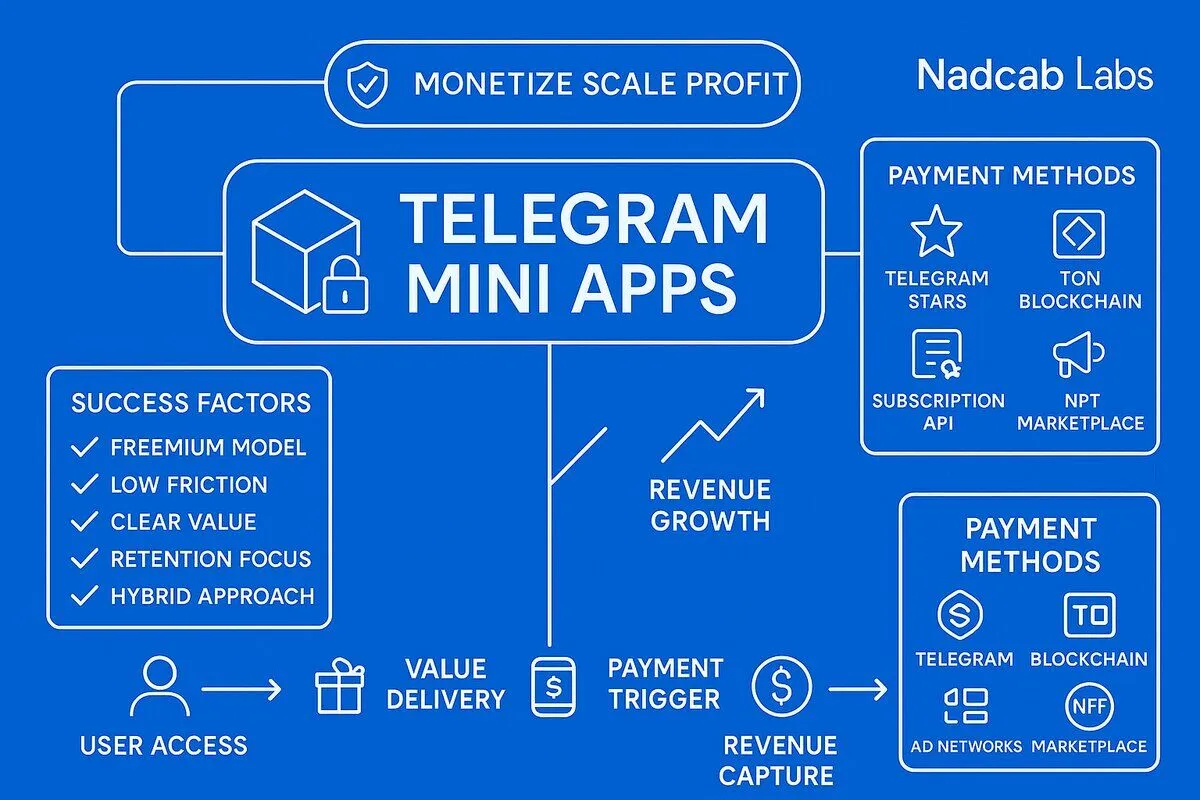
Monetisation distinguishes sustainable products from hobbyist projects. Mini Apps enjoy significant payment flexibility compared to app store environments, supporting traditional payment gateways, cryptocurrency transactions, and Telegram’s native payment system without platform commissions consuming 30% of revenue.
Web3 & Blockchain Integration
Telegram’s user base skews heavily toward cryptocurrency enthusiasts, making Web3 features valuable differentiators for Mini Apps serving markets from Dubai’s crypto hub to London’s fintech ecosystem. Integration complexity varies from simple wallet connections to sophisticated on-chain interactions.
Native integration for TON blockchain wallets like Tonkeeper. Deepest Telegram ecosystem integration.
Cross-chain wallet connections supporting MetaMask, Rainbow, Trust Wallet, and 300+ others.
High-performance Solana blockchain integration with Phantom, Solflare wallet support.
⚠️ Critical Security Warning:
Never store user private keys. Never request seed phrases. Never implement custom wallet solutions without extensive security audit. A single key compromise can result in total fund loss with no recovery possibility. Professional Telegram Mini App development teams implement security-first architectures that protect user assets.
Hosting, Deployment, and CDN Architecture
Infrastructure choices impact application performance, operational costs, and team productivity. Modern deployment options range from fully managed platforms to self-administered cloud infrastructure, with different trade-offs suiting different project stages and team capabilities.
Security Stack for Telegram Mini Apps
Security vulnerabilities can destroy user trust, expose sensitive data, and enable financial theft—especially critical for Mini Apps handling payments or cryptocurrency. Defence-in-depth with multiple security layers protects against diverse attack vectors.
Security Layer Architecture
HMAC-SHA256 signatures
JWT tokens
Input validation
CORS policies
At-rest encryption
Key management
Audit logging
Alerting
Scalability & Performance Benchmarks
Mini Apps can experience explosive growth when they go viral within Telegram’s network effects. Architecture must accommodate order-of-magnitude traffic increases without requiring emergency rewrites during critical growth periods.
Industry Use Cases for Telegram Mini Apps
Crypto Trading & DeFi
Portfolio tracking, swap interfaces, automated trading bots, yield farming dashboards. Popular in UAE, UK, Singapore markets.
Gaming & Play-to-Earn
Casual games, multiplayer competitions, NFT-based rewards, leaderboards. High engagement across global markets.
Loyalty & Rewards
Points accumulation, referral programs, discount redemption, brand engagement. Strong in retail and FMCG sectors.
E-Commerce & Booking
Product catalogues, appointment booking, food ordering, event ticketing. Growing rapidly in MENA region.
Common Tech Mistakes to Avoid
How to Choose the Right Tech Stack
Stack Selection Decision Matrix
| Requirement | Startup MVP | Growth Stage | Enterprise |
|---|---|---|---|
| Frontend | Vue / Svelte | React | React + TypeScript |
| Backend | Express / FastAPI | NestJS | NestJS / Go |
| Database | Firebase / MongoDB | PostgreSQL + Redis | PostgreSQL + Redis + DW |
| Hosting | Vercel + Railway | Vercel + DigitalOcean | AWS / GCP |
| Budget Range | $15K-$40K | $40K-$100K | $100K-$300K+ |
Ready to Build Your Telegram Mini App?
Partner with Nadcab Labs for expert Telegram Mini App development. Our team delivers production-ready Mini Apps with secure authentication, scalable infrastructure, Web3 integration, and payment processing for enterprises and Web3 founders across USA, UK, Germany, UAE, Saudi Arabia, Qatar, and Singapore.
Consultations available across all time zones: EST, GMT, CET, GST, SGT
Building successful Telegram Mini Apps requires thoughtful technology selection across frontend frameworks, backend services, authentication, payments, and infrastructure. The stack must balance development velocity against performance requirements, current capabilities against future scalability, and team expertise against optimal technical choices. Nadcab Labs brings comprehensive expertise across the complete Mini App technology stack, helping enterprise buyers, Web3 founders, and product teams navigate these decisions to deliver Mini Apps that succeed in Telegram’s unique ecosystem. Explore our comprehensive architecture and development guide for detailed implementation strategies, or connect with our team to discuss your specific requirements across USA, United Kingdom, European Union, UAE, Saudi Arabia, and broader MENA region.
Frequently Asked Questions
Q1.What frontend framework is best for Telegram Mini App development?
React dominates Telegram Mini App development due to extensive ecosystem support, component libraries, and developer availability worldwide. Vue offers simpler learning curve with smaller bundle sizes improving load performance. Svelte compiles to vanilla JavaScript producing smallest bundles with fastest runtime execution but has smaller ecosystem. Choice depends on team expertise and project requirements. Most enterprise applications choose React for ecosystem maturity while startups often prefer Vue or Svelte for development speed. All three integrate well with Telegram WebApp JavaScript SDK providing access to platform capabilities, theme detection, and user authentication data.
Q2.How do I authenticate users in a Telegram Mini App?
Telegram provides authentication automatically through initData passed when users open Mini Apps containing user ID, username, and profile information signed cryptographically. Backend must validate this signature using HMAC-SHA256 with key derived from bot token before trusting user identity. After validation, issue application-specific session tokens like JWT for subsequent API requests. Never trust initData without cryptographic verification as attackers can forge fake data. Map Telegram user IDs to internal user records storing application-specific data like preferences, transaction history, or wallet addresses while maintaining privacy compliance for user information.
Q3.Should I use Node.js or Python for Mini App backend?
Node.js suits most Mini Apps offering JavaScript uniformity across frontend and backend, excellent async performance for IO-bound API workloads, and comprehensive Telegram Bot API libraries like telegraf. Python excels when integrating machine learning, data analytics, or blockchain processing where Python ecosystem provides superior library support. FastAPI delivers modern Python backend with automatic documentation and performance matching Node.js. PHP with Laravel works for teams with existing expertise building CRUD-heavy applications. Consider team skills, integration requirements, and concurrency needs when choosing. Node.js handles WebSocket real-time features naturally while Python offers stronger data science capabilities.
Q4.What database should I use for Telegram Mini Apps?
PostgreSQL provides best general-purpose choice offering relational integrity for complex data relationships, JSON columns for flexible schema portions, and excellent performance with proper indexing. MySQL works comparably for simpler schemas with strong hosting availability. MongoDB suits Mini Apps with evolving schemas or document-oriented data like game state or NFT metadata. Redis serves critical role for session storage, caching frequently-accessed data, and real-time features through pub/sub. Most production Mini Apps combine PostgreSQL for persistent data with Redis for caching and sessions, achieving both data integrity and performance requirements effectively.
Q5.How do I accept payments in a Telegram Mini App?
Telegram Payments API enables credit card acceptance directly within Telegram interface with zero platform commission through supported providers like Stripe. Implementation involves sending invoice messages via Bot API, handling pre-checkout queries for order validation, and processing successful payment callbacks. Telegram Stars provide virtual currency option for smaller digital purchases. Third-party gateways like Stripe, Razorpay, or PayPal integrate through embedded checkout flows. Cryptocurrency payments suit Telegram’s crypto-native audience via TON Connect for TON blockchain or WalletConnect for EVM wallets enabling direct on-chain transactions without traditional payment processing overhead.
Q6.How do I integrate Web3 wallets into my Mini App?
TON Connect provides native integration for TON blockchain wallets like Tonkeeper commonly used by Telegram users. WalletConnect enables connections to EVM-compatible wallets including MetaMask, Rainbow, and Trust Wallet through QR codes or mobile deep links. Implementation requires handling connection flows within Telegram WebView constraints where some desktop-oriented patterns need adaptation. After connection, request transaction signatures for token transfers, NFT interactions, or smart contract calls with users approving each transaction in their wallet app. Never request private keys or seed phrases under any circumstances as this creates critical security vulnerabilities.
Explore Services
Related Services
Reviewed by

Aman Vaths
Founder of Nadcab Labs
Aman Vaths is the Founder & CTO of Nadcab Labs, a global digital engineering company delivering enterprise-grade solutions across AI, Web3, Blockchain, Big Data, Cloud, Cybersecurity, and Modern Application Development. With deep technical leadership and product innovation experience, Aman has positioned Nadcab Labs as one of the most advanced engineering companies driving the next era of intelligent, secure, and scalable software systems. Under his leadership, Nadcab Labs has built 2,000+ global projects across sectors including fintech, banking, healthcare, real estate, logistics, gaming, manufacturing, and next-generation DePIN networks. Aman’s strength lies in architecting high-performance systems, end-to-end platform engineering, and designing enterprise solutions that operate at global scale.