Ai Overview
Synthetic commodities represent a transformative innovation in how traditional assets can be accessed and traded through blockchain technology. Synthetic commodities are blockchain-based tokens designed to track and mirror the price movements of real-world commodities without requiring actual physical ownership. Typical ratios range from 150-400%, providing buffer against price volatility.
Key Takeaways
- Synthetic Commodities are blockchain-based tokens that track real-world commodity prices, enabling on-chain commodity trading without physical ownership or delivery logistics.
- Synthetic Assets on DEX platforms operate through smart contract-based commodities that use overcollateralization and price oracles to maintain accurate price tracking.
- DeFi Synthetic Assets like synthetic gold and silver tokens provide 24/7 global access to commodity markets through decentralized commodity markets without traditional intermediaries.
- Blockchain-based commodities offer benefits including permissionless access, instant settlement, fractional ownership, and elimination of storage costs compared to physical commodities.
- Commodity-backed synthetic tokens require careful risk management due to smart contract vulnerabilities, oracle dependencies, and potential liquidation during market volatility.
- Tokenized commodities on blockchain serve multiple use cases including portfolio hedging, yield generation through DeFi protocols, and diversification away from cryptocurrency-only exposure.
- DeFi commodity trading platforms continue evolving with improved oracle technology, cross-chain capabilities, and institutional-grade features driving mainstream adoption.
- Crypto commodities on DEX represent a growing market segment that bridges traditional finance with decentralized finance through innovative synthetic asset mechanisms.
The convergence of traditional commodity markets with decentralized finance has created new opportunities for traders and investors seeking diversified exposure without the complexities of physical asset ownership. Synthetic commodities represent one of the most innovative applications of blockchain technology, enabling anyone with an internet connection to trade gold, silver, oil, and agricultural products through permissionless decentralized exchanges.
Introduction to Synthetic Commodities in Decentralized Finance
Synthetic commodities represent a transformative innovation in how traditional assets can be accessed and traded through blockchain technology. By creating tokenized representations of physical commodities, DeFi protocols enable global participation in markets that were previously accessible only to institutional players or those with significant capital and specialized infrastructure.
What Are Synthetic Commodities?
Synthetic commodities are blockchain-based tokens designed to track and mirror the price movements of real-world commodities without requiring actual physical ownership. These digital assets use smart contracts, collateral mechanisms, and price oracles to maintain their peg to underlying commodity values, enabling traders to gain exposure to gold, silver, oil, and agricultural products through purely on-chain transactions.
Understanding Synthetic Assets on Blockchain
Understanding synthetic assets on blockchain requires recognizing how smart contracts create and manage these derivative instruments. Users deposit collateral into protocols that mint synthetic tokens tracking external asset prices. Oracle networks continuously feed price data to the blockchain, ensuring synthetic assets reflect real-world market values while existing entirely within the decentralized ecosystem.
Difference Between Physical and Synthetic Commodities
Physical commodities involve actual ownership with associated storage, insurance, and delivery requirements. Synthetic commodities exist purely as blockchain tokens with no physical backing, eliminating logistical complexity while introducing different risk profiles. Physical assets offer tangible value and direct ownership rights, while synthetics provide price exposure with blockchain-native benefits like 24/7 trading and fractional ownership.
Rise of Synthetic Assets in DeFi Ecosystem
The rise of DeFi synthetic assets reflects growing demand for accessible, permissionless financial instruments that extend beyond cryptocurrency-native tokens. As DeFi protocols mature, synthetic assets have expanded from simple stablecoin implementations to complex derivatives covering equities, commodities, and other traditional assets. Understanding decentralized exchange ecosystems provides context for this evolution.
Role of Decentralized Exchanges in Synthetic Trading
Decentralized exchange commodities trading relies on DEX infrastructure providing liquidity, price discovery, and settlement for synthetic assets. AMM-based exchanges enable continuous trading through liquidity pools, while order book DEXs offer familiar trading interfaces. The permissionless nature of DEXs ensures anyone can access synthetic commodity markets regardless of geographic location or financial status.
Why DeFi Synthetic Assets Are Gaining Popularity
DeFi synthetic assets gain popularity through unique advantages including global accessibility, reduced barriers to entry, and composability with other DeFi protocols. Investors can hedge cryptocurrency volatility with commodity exposure, generate yield through liquidity provision, and diversify portfolios without leaving the blockchain ecosystem. These capabilities attract both retail users and increasingly sophisticated institutional participants.
DeFi Principle: Synthetic assets expand DeFi’s utility beyond cryptocurrency markets, creating bridges to traditional finance while maintaining the permissionless, transparent characteristics that define decentralized systems. This expansion represents a fundamental evolution in accessible financial infrastructure.
How Synthetic Commodities Work on a Decentralized Exchange
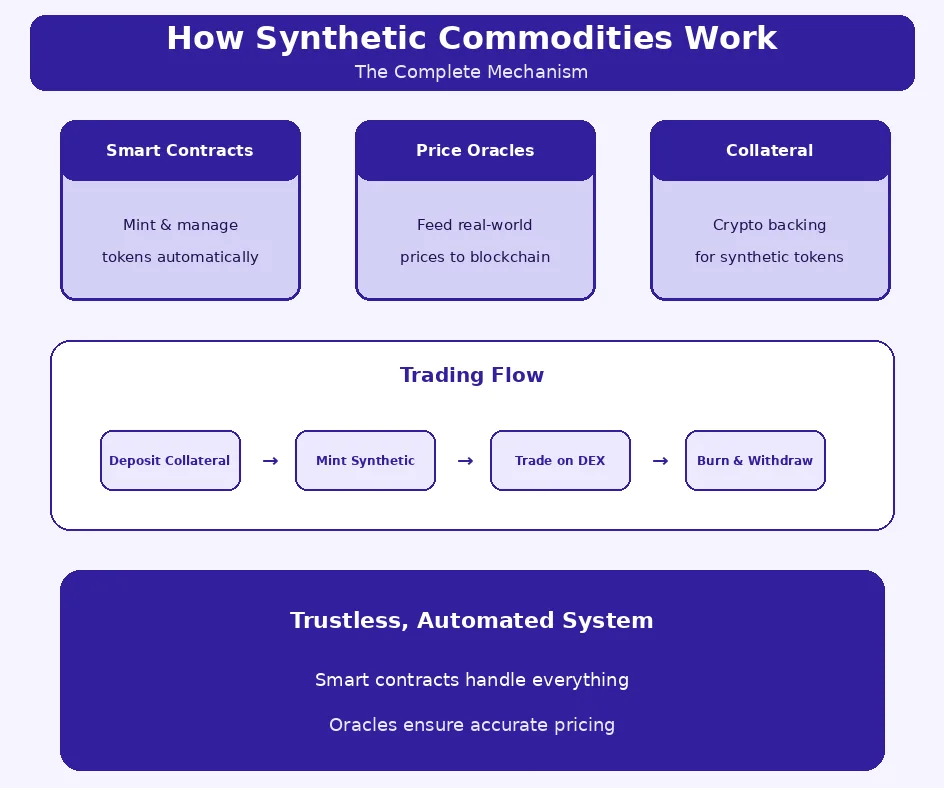
Synthetic commodities trading on decentralized exchanges involves sophisticated mechanisms combining smart contracts, price oracles, and collateral management. Understanding these components helps traders and builders appreciate both the opportunities and risks inherent in DeFi commodity trading platforms.
Smart Contract-Based Commodity Trading
Smart contract-based commodities enable trustless trading where code enforces rules without human intervention. These contracts manage minting, burning, collateral requirements, and liquidations automatically, ensuring consistent protocol operation regardless of market conditions or participant behavior.
Role of Smart Contracts in Synthetic Commodities
Smart contracts serve as the foundation for synthetic commodity systems, handling token minting when users deposit collateral, calculating collateralization ratios, triggering liquidations when positions become undercollateralized, and managing price feeds from oracles. This automation creates efficient, transparent systems that operate continuously without operational overhead. Building decentralized exchanges with synthetic capabilities requires robust smart contract architecture.
Automation and Trustless Execution on DEX
Automation and trustless execution distinguish DeFi commodity trading from traditional alternatives. Exploring trustless exchange mechanisms reveals how smart contracts eliminate counterparty risk by ensuring all participants follow identical rules enforced by immutable code rather than relying on institutional trust.
Oracle-Based Price Feeds for Commodities
Oracle-based price feeds form the critical link between off-chain commodity markets and on-chain synthetic representations. These systems must deliver accurate, timely, and manipulation-resistant price data to maintain synthetic asset integrity and proper protocol functioning.
Importance of Price Oracles in Synthetic Assets
Price oracles determine synthetic asset value, trigger liquidations, and enable fair trading. Without reliable oracles, synthetic commodities cannot maintain their peg to underlying assets. Decentralized oracle networks like Chainlink aggregate prices from multiple sources, using consensus mechanisms to resist manipulation and ensure data accuracy critical for protocol solvency.
Maintaining Accurate Commodity Prices On-Chain
Maintaining accurate commodity prices on-chain requires robust oracle infrastructure with multiple data sources, update frequency appropriate for market volatility, and economic incentives ensuring oracle operators provide truthful information. Time-weighted average prices and circuit breakers add additional protection against flash crashes or temporary price manipulation.
Collateralized Synthetic Assets Model
The collateralized synthetic assets model ensures synthetic commodities maintain backing sufficient to honor their value. This model borrows concepts from traditional finance while adapting them for decentralized, trustless operation.
Overcollateralized DeFi Assets Explained
Overcollateralization requires users to deposit more collateral value than the synthetic assets they mint. Typical ratios range from 150-400%, providing buffer against price volatility. If collateral value drops below minimum thresholds, liquidation mechanisms sell collateral to maintain system solvency, protecting other users while penalizing undercollateralized positions.
Risk Management in Synthetic Commodity Trading
Risk management in synthetic commodities trading involves maintaining healthy collateralization ratios, monitoring market conditions, and understanding liquidation mechanics. Traders should factor in oracle delays, gas costs during volatile periods, and protocol-specific parameters when sizing positions and managing exposure.
Synthetic vs Physical Commodities Comparison
| Factor | Synthetic Commodities | Physical Commodities |
|---|---|---|
| Ownership | Token-based price exposure | Direct physical ownership |
| Storage | No storage required | Storage and insurance needed |
| Trading Hours | 24/7/365 | Market hours only |
| Minimum Investment | Fractional amounts | Often high minimums |
| Settlement | Instant on-chain | T+2 or longer |
Types of Synthetic Commodities Available on DEX Platforms
DEX platforms offer various synthetic commodity types covering precious metals, energy resources, and agricultural products. Each category presents unique characteristics, use cases, and considerations for traders seeking commodity exposure through decentralized markets.
Synthetic Gold and Silver Tokens
Synthetic gold and silver tokens represent the most popular category of synthetic commodities, leveraging precious metals’ traditional role as stores of value and inflation hedges. These tokens enable cryptocurrency users to diversify into historically stable assets while maintaining blockchain-native benefits.
Tokenized Precious Metals on Blockchain
Tokenized commodities on blockchain for precious metals track gold and silver spot prices through oracle feeds. Unlike physically-backed gold tokens requiring actual bullion reserves, synthetic versions use cryptocurrency collateral to mint tokens that track prices without physical backing. This approach enables greater capital efficiency while sacrificing the security of physical asset backing.
Use Cases of Synthetic Gold in DeFi
Synthetic gold use cases in DeFi include portfolio hedging against cryptocurrency volatility, collateral for other DeFi protocols, yield generation through liquidity provision, and speculative trading. The composability of DeFi enables synthetic gold to serve as building blocks for more complex financial instruments, expanding utility beyond simple price exposure.
Synthetic Energy and Agricultural Commodities
Synthetic energy and agricultural commodities extend DeFi’s reach into markets with significant real-world economic importance. These assets enable exposure to oil, natural gas, wheat, and other essential commodities that drive global economic activity.
Oil and Gas Synthetic Assets
Oil and gas synthetic assets track benchmark prices like WTI crude or Brent crude, enabling exposure to energy markets without futures contracts or physical delivery concerns. These assets serve hedging purposes for businesses with energy costs while offering traders speculative opportunities based on geopolitical events and supply-demand dynamics.
Agricultural Commodity-Backed Synthetic Tokens
Agricultural commodity-backed synthetic tokens cover crops like wheat, corn, soybeans, and coffee. These markets traditionally require specialized knowledge and infrastructure access, but synthetic versions democratize participation. Food producers and consumers can hedge price risks while traders gain exposure to agricultural market dynamics through blockchain-native instruments.
Benefits of Trading Synthetic Commodities on DEX
Trading synthetic commodities on decentralized exchanges offers compelling advantages over traditional commodity market participation. These benefits drive adoption among both retail users and sophisticated traders seeking efficient market access.
Decentralized Commodity Markets
Decentralized commodity markets operate without central authorities controlling access or settlement. This structure enables global participation regardless of geographic location, banking access, or regulatory jurisdiction, representing a fundamental shift in how commodity exposure can be obtained.
Permissionless Access to Global Commodity Trading
Permissionless access to global commodity trading means anyone with an internet connection and cryptocurrency can participate in markets previously restricted to institutional investors or those with specialized brokerage accounts. This democratization expands market participation while potentially improving price discovery through broader participation.
Transparency and Security in On-Chain Trading
On-chain commodity trading provides complete transparency through publicly auditable transactions, collateral positions, and protocol operations. Users maintain self-custody throughout, eliminating counterparty risk from centralized intermediaries. Understanding protocol fee structures helps traders understand the economics of decentralized trading.
Liquidity Pools for Synthetic Commodities
Liquidity pools enable continuous trading of synthetic commodities through automated market maker mechanisms. These pools aggregate liquidity from multiple providers, enabling trades at any time while generating returns for liquidity providers.
Role of Liquidity Providers in DeFi Commodity Trading
Liquidity providers deposit synthetic commodities and paired assets into pools, earning trading fees in exchange for enabling continuous market access. This mechanism replaces traditional market makers with decentralized, permissionless alternatives where anyone can contribute liquidity and earn proportional returns.
Reducing Slippage in Synthetic Assets Trading
Reducing slippage in synthetic commodities trading requires deep liquidity pools and appropriate trade sizing. Larger pools with more liquidity enable larger trades with minimal price impact. Traders should consider pool depth, trade size relative to liquidity, and potentially split large orders across multiple transactions or pools.
Synthetic Commodity Trading Lifecycle
| Step | Phase | Actions | Outcome |
|---|---|---|---|
| 1 | Collateral Deposit | Deposit crypto as collateral | Collateral locked in protocol |
| 2 | Minting | Mint synthetic commodity tokens | Receive synthetic tokens |
| 3 | Trading/Holding | Trade on DEX or hold position | Price exposure to commodity |
| 4 | Monitoring | Monitor collateral ratio | Maintain healthy position |
| 5 | Burning | Return synthetic tokens | Unlock collateral |
| 6 | Withdrawal | Withdraw collateral | Position closed |
Synthetic Commodities vs Traditional Commodities Trading
Comparing synthetic commodities trading with traditional alternatives reveals distinct advantages and trade-offs that traders should understand when choosing their market access approach.
Cost, Speed, and Accessibility Comparison
Cost, speed, and accessibility comparisons generally favor synthetic commodities for smaller traders seeking flexible, global market access without complex account requirements or significant minimum investments.
Elimination of Intermediaries
Synthetic commodities trading eliminates traditional intermediaries including brokers, clearinghouses, and custodians. Smart contracts handle functions these entities traditionally performed, reducing costs while maintaining (or improving) operational integrity through automated, transparent processes.
Faster Settlement Through Blockchain Technology
Blockchain technology enables instant settlement compared to traditional T+2 or longer settlement cycles. Traders receive tokens immediately upon trade execution, can use proceeds instantly for other transactions, and face no counterparty settlement risk during waiting periods.
Regulatory and Operational Differences
Regulatory and operational differences between synthetic and traditional commodity markets present both opportunities and challenges that market participants must navigate carefully.
Compliance Challenges in DeFi Commodities
Compliance challenges in DeFi commodities include regulatory uncertainty around synthetic assets, potential securities law implications, and tax reporting complexity. The evolving regulatory landscape requires participants to stay informed about developments in their jurisdictions while protocols work toward compliant frameworks.
Centralized vs Decentralized Commodity Exchanges
Centralized commodity exchanges offer regulatory clarity, institutional infrastructure, and familiar interfaces but require account approval, maintain custody of assets, and operate limited hours. Decentralized alternatives provide continuous access and self-custody but carry smart contract risks and regulatory uncertainty that traders must accept.
Risks and Challenges of Synthetic Commodity Trading on DEX
Synthetic commodity trading presents risks distinct from traditional commodity markets that participants must understand and manage appropriately. These risks require careful consideration when sizing positions and selecting protocols.
Smart Contract Risks in Synthetic Assets
Smart contract risks in synthetic assets include potential bugs, vulnerabilities, and exploits that could result in loss of funds. Unlike traditional financial systems with insurance and recourse mechanisms, smart contract failures may result in permanent, unrecoverable losses.
Vulnerabilities and Security Considerations
Vulnerabilities in synthetic asset protocols can arise from coding errors, logic flaws, or economic attack vectors that exploit protocol mechanics. Security considerations include contract upgradeability risks, admin key management, and dependencies on external protocols that may themselves contain vulnerabilities.
Importance of Smart Contract Audits
Smart contract audits provide third-party verification of code security, though audits cannot guarantee safety. Reputable protocols undergo multiple audits from different firms, maintain bug bounty programs, and practice responsible disclosure. Users should verify audit status before committing significant capital to any synthetic asset protocol.
Price Volatility and Oracle Manipulation
Price volatility and oracle manipulation represent significant risks in synthetic commodity systems where oracle accuracy directly affects position values and liquidation triggers.
Managing Price Risks in DeFi Synthetic Assets
Managing price risks in DeFi synthetic assets requires maintaining conservative collateralization ratios, setting position size limits, and understanding protocol-specific liquidation mechanics. Traders should monitor positions during volatile periods and maintain sufficient margin to avoid forced liquidations that often occur at unfavorable prices.
Oracle Failure Scenarios
Oracle failure scenarios include delayed price updates, incorrect data delivery, or manipulation attacks exploiting oracle weaknesses. Well-designed protocols implement safeguards including price deviation limits, multi-oracle consensus, and circuit breakers, but residual risk remains that users must accept when participating in synthetic markets.
Critical Warning: Synthetic commodity trading involves significant risks including smart contract vulnerabilities, oracle failures, and potential total loss of deposited collateral. These instruments are experimental and should only be used with capital users can afford to lose entirely. Past performance of synthetic assets does not guarantee future results.
Use Cases of Synthetic Commodities in Decentralized Finance
Synthetic commodities serve multiple purposes within DeFi ecosystems, extending beyond simple speculative trading to provide genuine utility for portfolio management and yield generation strategies.
Hedging and Portfolio Diversification
Hedging and portfolio diversification represent primary use cases for synthetic commodities, enabling cryptocurrency holders to reduce correlation risk and protect against crypto-specific downturns.
Using Synthetic Commodities as Hedge Instruments
Synthetic commodities as hedge instruments enable crypto-native users to gain exposure to traditionally uncorrelated assets without exiting the blockchain ecosystem. Gold synthetic tokens, for example, may appreciate during crypto market stress, providing portfolio protection while maintaining DeFi composability. Examining synthetic futures market dynamics provides additional hedging strategy insights.
Diversifying Crypto Portfolios with Commodity Exposure
Diversifying crypto portfolios with commodity exposure through synthetics adds asset classes with different risk-return profiles and market drivers. A portfolio combining cryptocurrency with synthetic gold, silver, and energy commodities may exhibit lower volatility while maintaining growth potential, though synthetic-specific risks must be considered in allocation decisions.
Yield Generation Through DeFi Protocols
Yield generation through DeFi protocols extends synthetic commodity utility beyond simple price exposure, enabling holders to earn returns while maintaining commodity positions.
Staking and Yield Farming with Synthetic Assets
Staking and yield farming with synthetic assets involves providing liquidity to trading pools, lending synthetic tokens, or participating in protocol incentive programs. These strategies generate additional returns but carry impermanent loss risk and smart contract exposure that must be factored into yield calculations.
Passive Income Opportunities in DeFi
Passive income opportunities in DeFi with synthetic commodities include liquidity provision earning trading fees, lending synthetic tokens for interest, and participating in protocol governance with staking rewards. These strategies convert commodity exposure into yield-generating positions while maintaining underlying price exposure.
How to Create Synthetic Commodities on Blockchain
Creating synthetic commodities on blockchain requires sophisticated technical implementation combining token mechanics, oracle integration, and robust risk management systems.
Synthetic Commodity Token Development Process
The synthetic commodity token process involves designing token mechanics, implementing collateral management, integrating price oracles, and deploying smart contracts that manage the entire lifecycle of synthetic asset creation and redemption.
Designing Tokenomics for Synthetic Assets
Designing tokenomics for synthetic assets requires balancing capital efficiency with system stability. Collateralization ratios must provide sufficient buffer against volatility while remaining attractive for users. Fee structures should cover protocol costs and incentivize healthy behavior without creating excessive friction for traders.
Collateral and Oracle Integration
Collateral and oracle integration forms the technical foundation of synthetic commodity systems. Smart contracts must correctly handle collateral deposits, calculate ratios using oracle prices, trigger liquidations appropriately, and manage the complexities of multi-collateral systems while maintaining gas efficiency.
Choosing the Right Decentralized Exchange Infrastructure
Choosing the right decentralized exchange infrastructure affects synthetic commodity platform performance, security, and user experience significantly.
DEX Architecture for Synthetic Assets
DEX architecture for synthetic assets must support the unique requirements of synthetic trading including efficient collateral management, oracle price integration, and liquidation handling. AMM pools work well for liquid synthetic pairs while hybrid models may better serve complex synthetic instruments requiring order book functionality.
Scalability and Security Considerations
Scalability and security considerations for synthetic commodity platforms include blockchain selection affecting transaction costs and throughput, smart contract optimization for gas efficiency, and security architecture protecting against both technical exploits and economic attacks that could drain protocol funds.
Synthetic Commodity Protocol Selection Criteria
When evaluating synthetic commodity platforms, consider:
- Audit Status: Multiple audits from reputable firms
- Oracle Quality: Decentralized, manipulation-resistant price feeds
- Collateral Ratios: Appropriate buffer for asset volatility
- Liquidity Depth: Sufficient trading liquidity for position sizes
- Track Record: Protocol history and team reputation
- Governance: Transparent decision-making processes
Role of a DeFi Exchange Creation Company
Building synthetic commodity platforms requires specialized expertise spanning smart contract engineering, oracle integration, tokenomics design, and security best practices. Professional assistance ensures robust implementations that protect user funds while delivering intended functionality.
Synthetic Asset Creation Services
Synthetic asset creation services encompass the full spectrum of technical work required to launch commodity-tracking tokens on blockchain, from initial design through deployment and ongoing maintenance.
Custom DEX Creation for Commodities
Custom DEX creation for commodities involves designing and implementing trading infrastructure specifically optimized for synthetic asset characteristics. This includes liquidity pool mechanics, oracle integration, collateral management interfaces, and user experiences tailored for commodity traders.
End-to-End Blockchain Services
End-to-end blockchain services cover the complete journey from concept through deployment and maintenance. This comprehensive approach ensures all components work together seamlessly while maintaining security standards essential for financial applications handling user assets.
How Nadcab Labs Supports Synthetic Commodity Platforms
Nadcab Labs provides comprehensive support for synthetic commodity platform creation, combining deep technical expertise with practical understanding of DeFi market requirements.
Smart Contract Engineering and Auditing
Smart contract engineering and auditing services ensure synthetic commodity protocols operate securely and efficiently. This includes initial contract creation, optimization for gas efficiency, security review, and coordination with third-party auditors to validate code integrity before deployment.
Ongoing Support and DeFi Integration
Ongoing support and DeFi integration services ensure synthetic commodity platforms remain current with evolving ecosystem standards, security practices, and integration opportunities. This includes monitoring, maintenance, and enhancement services that sustain platform competitiveness over time.
Synthetic Commodity Types Comparison
| Commodity Type | Examples | Primary Use Case |
|---|---|---|
| Precious Metals | sGOLD, sSILVER | Store of value, inflation hedge |
| Energy | sOIL, sNATGAS | Energy cost hedging |
| Agricultural | sWHEAT, sCORN | Food price exposure |
| Industrial Metals | sCOPPER, sALUM | Industrial cycle exposure |
Future of Synthetic Commodities in Decentralized Exchanges
The future of synthetic commodities involves continued innovation in protocol design, expanded asset coverage, and increasing integration with traditional financial infrastructure. These developments will shape how commodity markets evolve in the blockchain era.
Growth of Blockchain-Based Commodities
Growth of blockchain-based commodities will accelerate as protocols mature, regulatory clarity emerges, and institutional players enter the space. This growth will bring deeper liquidity, more sophisticated instruments, and closer integration with traditional commodity markets.
Institutional Adoption of Synthetic Assets
Institutional adoption of synthetic assets requires infrastructure meeting professional standards including custody solutions, compliance tools, and risk management frameworks. As these capabilities develop, institutional capital will flow into synthetic commodity markets, dramatically increasing liquidity and market efficiency.
Cross-Chain Synthetic Commodity Trading
Cross-chain synthetic commodity trading will enable synthetic assets to move between blockchain networks, accessing liquidity and features across multiple ecosystems. This interoperability will reduce fragmentation and enable more efficient price discovery across the entire DeFi landscape.
Innovations in DeFi Synthetic Markets
Innovations in DeFi synthetic markets will continue expanding capabilities, improving capital efficiency, and enabling new use cases that blur boundaries between traditional and decentralized finance.
Advanced Risk Models and Automation
Advanced risk models and automation will improve synthetic commodity protocol safety and efficiency. Machine learning for risk assessment, automated position management, and dynamic collateralization will enable more sophisticated products while reducing operational risks.
Expanding Use Cases of Synthetic Commodities
Expanding use cases of synthetic commodities will include structured products, exotic derivatives, and novel financial instruments impossible in traditional markets. The composability of DeFi enables synthetic commodities to serve as building blocks for increasingly complex financial innovations.
Build a Secure DEX for Synthetic Commodity Trading
Build a secure, scalable DEX for synthetic commodities with expert smart contract and DeFi solutions.
Launch Your Exchange Now
Final Thoughts
Synthetic commodities represent a transformative innovation in how global commodity markets can be accessed and traded. By combining blockchain technology with sophisticated financial engineering, DeFi protocols enable permissionless, 24/7 access to gold, silver, oil, agricultural products, and other commodities that were previously accessible only through traditional financial infrastructure.
The benefits of synthetic commodities including fractional ownership, instant settlement, and global accessibility must be weighed against risks including smart contract vulnerabilities, oracle dependencies, and regulatory uncertainty. Informed participants who understand these trade-offs can use synthetic commodities for portfolio diversification, hedging, and yield generation while managing exposure appropriately.
As the DeFi ecosystem matures, synthetic commodity markets will likely grow in sophistication, liquidity, and institutional adoption. This evolution will strengthen the bridge between traditional and decentralized finance, ultimately creating more efficient, accessible, and transparent commodity markets for participants worldwide.