Ai Overview
Parent block architecture forms the foundational structure that enables blockchain networks to maintain immutable, chronologically ordered records of transactions. Every block in a blockchain, except the genesis block, contains a cryptographic reference to its immediate predecessor, creating an unbreakable chain of linked data structures.
Key Takeaways
- Parent block architecture creates cryptographic chains where each block references its predecessor’s hash, ensuring complete data immutability across networks.
- Block hash referencing enables tamper-evident ledgers where modifying any parent block invalidates all subsequent child blocks in the chain.
- Merkle trees within parent blocks provide efficient transaction verification without downloading entire blockchain history for light client operations.
- Consensus mechanisms validate parent block references before accepting new blocks, preventing malicious actors from creating alternate chain histories.
- Fork attacks are mitigated through parent block verification rules that require significant computational resources to override established chain history.
- Sharded blockchain networks extend parent block concepts with cross-shard references enabling horizontal scalability without sacrificing security guarantees.
- Orphan and stale block handling mechanisms ensure network consistency when multiple miners discover blocks referencing the same parent simultaneously.
- Gas efficiency improves through parent block data compression techniques that reduce redundant information storage across consecutive blocks.
- Cross-chain communication protocols leverage parent block proofs to verify transaction finality across different blockchain networks securely.
- Future Web3 scalability solutions evolve parent block architecture with DAG structures and parallel processing capabilities for enterprise adoption.
Understanding Parent Block Architecture in Blockchain Systems
Parent block architecture forms the foundational structure that enables blockchain networks to maintain immutable, chronologically ordered records of transactions. Every block in a blockchain, except the genesis block, contains a cryptographic reference to its immediate predecessor, creating an unbreakable chain of linked data structures. This parent-child relationship is essential for Decentralized Exchange platforms and other blockchain applications that require absolute data integrity and trustless verification mechanisms.
Our agency has spent over eight years implementing blockchain solutions for clients across the USA, UK, UAE, and Canada, providing deep insights into how parent block architecture impacts system security and performance. The elegance of this design lies in its simplicity: by including a hash of the previous block’s header, each new block creates a dependency that makes historical tampering computationally infeasible. Any modification to a parent block would change its hash, breaking the link with all subsequent blocks.
Understanding parent block architecture is crucial for architects designing scalable blockchain systems, security engineers auditing chain integrity, and business leaders evaluating blockchain solutions for enterprise applications. This comprehensive guide explores the technical foundations, security implications, and future evolution of parent block design patterns.
Block Hash Referencing and Its Role in Secure Block Linking
Block hash referencing serves as the cryptographic backbone of parent block architecture, creating tamper-evident chains that resist modification attempts. The hash function, typically SHA-256 or Keccak-256, produces a fixed-length output that uniquely identifies each block’s contents. Even a single bit change in the parent block produces an entirely different hash, immediately detectable by all network participants.
| Hash Component | Size | Security Function |
|---|---|---|
| Parent Hash | 32 bytes | Links current block to predecessor |
| State Root | 32 bytes | Commits to global state after execution |
| Transactions Root | 32 bytes | Merkle root of all block transactions |
| Receipts Root | 32 bytes | Commits to transaction execution results |
| Block Hash | 32 bytes | Unique identifier for entire block |
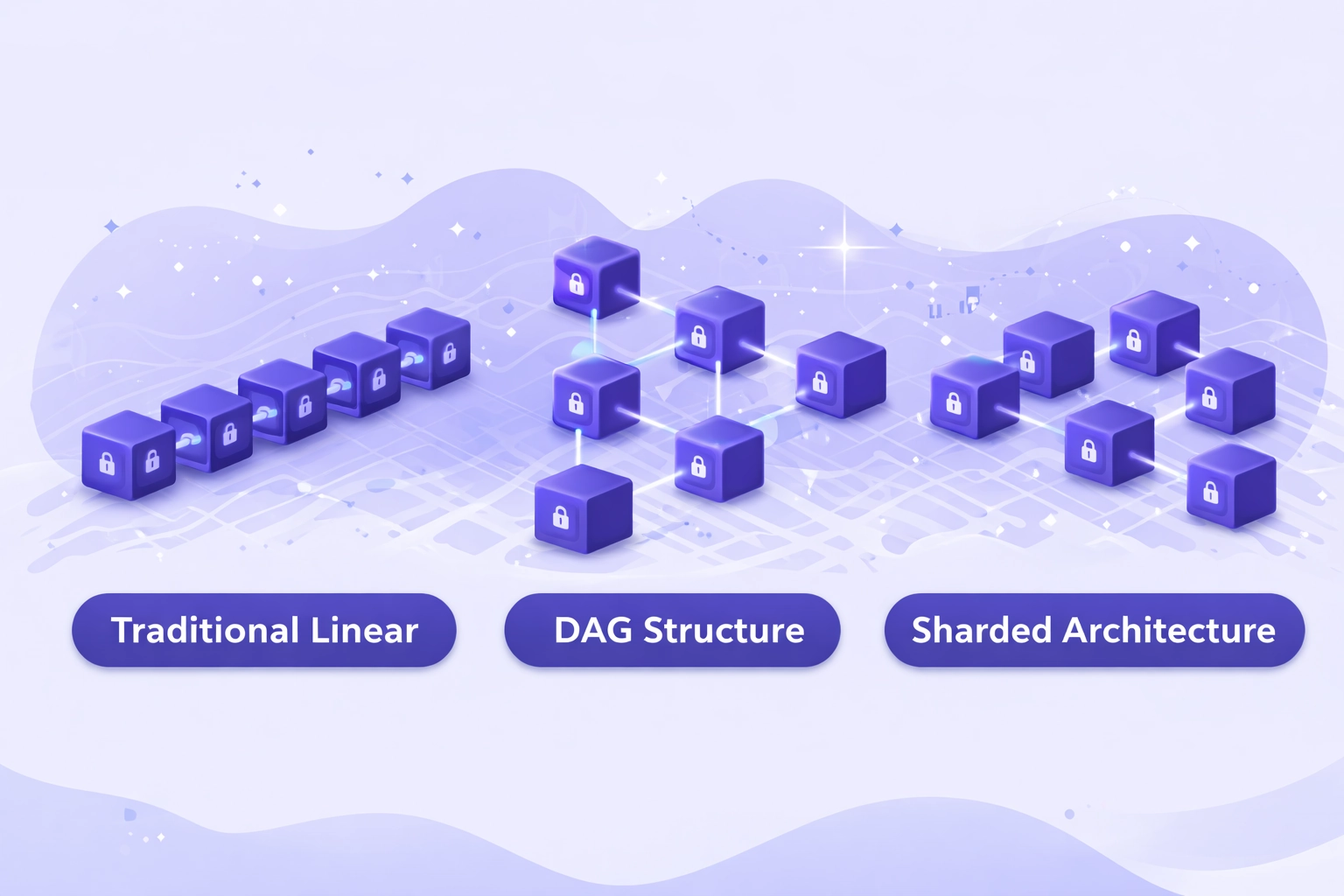 Parent Block Architecture vs Linear Blockchain Structures
Understanding the architectural differences helps engineers select appropriate designs for specific use cases.
Traditional Linear
- Single chain with sequential blocks
- One parent per block maximum
- Simple validation logic
- Limited throughput capacity
DAG Structure
- Multiple parent references allowed
- Parallel block creation enabled
- Higher transaction throughput
- Complex consensus requirements
Sharded Architecture
- Multiple parallel parent chains
- Cross-shard block references
- Horizontal scalability achieved
- Beacon chain coordination needed
Merkle Trees and Parent Block Dependency Models
Merkle trees provide efficient data structures within parent blocks that enable lightweight verification of transaction inclusion without downloading entire block contents. Named after Ralph Merkle, these binary hash trees recursively combine transaction hashes until reaching a single root hash stored in the block header. This design allows light clients to verify specific transactions using logarithmically sized proofs rather than full block data.
The dependency model created by Merkle roots extends parent block relationships to individual transaction level. A transaction’s inclusion proof depends on its position within the parent block’s Merkle tree, creating verifiable paths from any transaction to the block header. This architecture enables efficient SPV (Simplified Payment Verification) clients that trust block headers while independently verifying transaction inclusion.
Modern blockchain implementations across USA, UK, UAE, and Canada markets utilize extended Merkle structures including Patricia tries for state storage and binary Merkle trees for transaction ordering. These optimizations maintain the security guarantees of parent block linking while improving query performance for specific data retrieval operations.
Consensus Mechanisms Built Around Parent Block Validation
Consensus mechanisms fundamentally rely on parent block validation to determine canonical chain selection and fork resolution. In Proof of Work systems, nodes select the chain with the greatest cumulative difficulty, where each block’s difficulty contributes to its parent chain’s total work. This mechanism ensures that attacking the network requires not just producing valid blocks but outpacing the entire network’s historical computational effort.
Proof of Stake consensus adds stake-weighted parent block validation where validators attest to block validity based on their committed capital. The finality gadget in systems like Ethereum’s Casper FFG uses parent block references to establish checkpoints that become irreversible after sufficient validator attestations. This hybrid approach combines the security of PoW’s parent chain selection with PoS’s energy efficiency.
Byzantine Fault Tolerant consensus protocols validate parent blocks through multi-round voting among known validator sets. These mechanisms provide deterministic finality within fixed block counts, enabling enterprise applications that require guaranteed transaction settlement without probabilistic confirmation delays.
Preventing Fork Attacks Through Parent Block Verification
1. Block Reception
Node receives new block from network peers and initiates validation sequence for parent block verification.
2. Parent Hash Check
Verify that parent hash in block header matches a known valid block in local database.
3. Chain Height Validation
Confirm block number equals parent block number plus one, preventing height manipulation attacks.
4. Timestamp Verification
Ensure block timestamp is greater than parent timestamp and within acceptable future bound.
5. Difficulty Calculation
Verify block difficulty matches expected value derived from parent block parameters and adjustment algorithm.
6. State Transition
Execute all transactions starting from parent state root and verify resulting state matches block header.
7. Chain Selection
Compare cumulative difficulty against current canonical chain and reorganize if new chain has more work.
8. Block Acceptance
Store validated block in database and broadcast to connected peers for network propagation.
Transaction Finality Enabled by Parent Block Relationships
Transaction finality in blockchain systems depends directly on the strength of parent block relationships. Each subsequent block added to the chain reinforces the finality of transactions in earlier blocks by increasing the computational or economic cost required to reorganize the chain. Bitcoin’s six-confirmation convention reflects the exponentially decreasing probability that a transaction could be reversed as more child blocks accumulate.
Modern consensus protocols provide different finality models based on parent block architecture. Probabilistic finality in PoW systems offers increasing confidence with each confirmation, while deterministic finality in BFT systems provides absolute guarantees after a fixed number of validator signatures. The choice between these models impacts application design, particularly for financial services operating in the USA, UK, UAE, and Canada where regulatory requirements often mandate specific settlement timelines.
Economic finality mechanisms leverage parent block references to enable faster practical finality without waiting for deep confirmation counts. Protocols like Ethereum’s Casper FFG checkpoint system allows validators to attest that specific blocks will never be reverted, creating strong finality guarantees within two epochs.
Scalability Advantages of Hierarchical Block Structures
Hierarchical block structures extend traditional parent block architecture to enable significant scalability improvements. By organizing blocks into multiple levels with different roles and validation requirements, these systems can process more transactions while maintaining security guarantees. Layer 2 solutions exemplify this approach by anchoring periodic state commitments to parent chain blocks.
| Architecture Type | Throughput | Finality Time | Security Model |
|---|---|---|---|
| Single Chain | 15-30 TPS | 10-60 minutes | Full node validation |
| Layer 2 Rollups | 2,000-4,000 TPS | Minutes to hours | Parent chain anchoring |
| Sharded Chains | 10,000+ TPS | 12-32 seconds | Cross-shard validation |
| DAG Networks | 1,000-10,000 TPS | Seconds | Multi-parent consensus |
| Hybrid Systems | Variable | Configurable | Multi-layer security |
Parent Blocks in Sharded and Layered Blockchain Networks
Sharded blockchain networks extend parent block concepts across multiple parallel chains that periodically synchronize through a coordination layer. Each shard maintains its own parent-child block relationships while referencing a shared beacon chain that provides cross-shard finality. This architecture enables horizontal scaling where adding more shards increases total network capacity without degrading individual shard performance.
The beacon chain serves as the ultimate parent for all shard blocks, creating a hierarchical structure where shard block validity depends on beacon chain inclusion. Cross-shard transactions require careful coordination to ensure atomic execution across multiple parent chains, typically implemented through commit-reveal schemes or optimistic execution with fraud proofs.
Layer 2 solutions create similar hierarchical parent relationships where rollup blocks reference parent chain anchor points for security. This design allows high-frequency transaction processing on child chains while inheriting the security guarantees of established parent chain consensus, making it attractive for enterprise deployments across global markets.
Security Trade-Offs in Multi-Level Block Linking
Selecting appropriate parent block architecture requires balancing security guarantees against performance requirements.
Depth vs Speed
Deeper parent chain requirements increase security but slow finality time for transactions.
Centralization Risk
Fewer parent validators improve performance but concentrate trust in smaller groups.
Complexity Cost
Multi-level architectures add implementation complexity and potential attack surface.
Data Availability
Child chains depending on parent data must handle parent unavailability scenarios.
Cross-Chain Attacks
Interconnected parent chains create new attack vectors through bridge exploits.
Upgrade Coordination
Parent chain upgrades require careful child chain coordination to prevent breaks.
Handling Orphan and Stale Blocks in Parent-Based Systems
Orphan blocks occur when a node receives a block whose parent hash does not match any block in its local database. This situation arises from network propagation delays where child blocks arrive before their parents. Proper handling requires buffering orphan blocks temporarily and attempting to connect them once their parent appears, with timeout mechanisms to prevent memory exhaustion from malicious orphan flooding.
Stale blocks represent valid blocks that lose the chain selection competition to competing blocks built on the same parent. When two miners discover blocks simultaneously, the network temporarily splits until one chain accumulates more work. The losing chain’s blocks become stale, and transactions they contain must be re-included in the winning chain to achieve confirmation.
Uncle block mechanisms in Ethereum reward stale block producers, reducing the economic penalty for losing chain races and improving network security by incentivizing honest mining even during high-competition periods. This approach strengthens parent chain security while maintaining fair compensation for valid computational work.
Gas Efficiency and Data Compression via Parent Blocks
Parent block references enable significant gas efficiency improvements through data deduplication and incremental state encoding. Instead of storing complete state in every block, child blocks can reference parent state and encode only the differences, dramatically reducing storage requirements. This delta encoding approach is fundamental to state-efficient blockchain designs serving high-volume applications.
| Optimization Technique | Gas Savings | Implementation Complexity |
|---|---|---|
| State Delta Encoding | 40-60% | Medium |
| Transaction Batching | 20-35% | Low |
| Calldata Compression | 50-80% | High |
| Proof Aggregation | 70-90% | Very High |
| Blob Transactions (EIP-4844) | 90-95% | Protocol Level |
Cross-Chain Communication Leveraging Parent Block Models
Parent block proofs enable secure verification of transactions across different blockchain networks.
Standard 1: Light client proofs verify transaction inclusion using parent block header chain without full node requirements.
Standard 2: Relay networks transmit parent block headers between chains enabling trustless cross-chain state verification.
Standard 3: SPV proofs combine Merkle paths with parent chain references for compact transaction verification.
Standard 4: Optimistic bridges assume parent chain validity with fraud proof mechanisms for dispute resolution.
Standard 5: ZK bridges generate validity proofs for parent chain state transitions enabling instant finality.
Standard 6: Multi-chain indexers track parent block relationships across ecosystems for unified state queries.
Standard 7: Atomic swaps leverage parent block finality proofs to ensure trustless cross-chain asset exchanges.
Standard 8: Interoperability protocols standardize parent block proof formats for seamless multi-chain integration.
 Real-World Blockchain Implementations Using Parent Blocks
Major blockchain platforms demonstrate various approaches to parent block architecture in production environments.
Bitcoin
- Simple linear parent chain
- SHA-256 double hashing
- Longest chain rule selection
- 10 minute block intervals
Ethereum
- Parent plus uncle references
- Keccak-256 hashing
- Casper FFG finality
- 12 second slot times
Polkadot
- Relay chain parent model
- Parachain block references
- GRANDPA finality gadget
- Cross-shard messaging
Future Evolution of Parent Block Architecture for Web3 Scalability
The future of parent block architecture points toward increasingly sophisticated structures that maintain security while achieving unprecedented scalability. Research into DAG-based consensus, recursive validity proofs, and modular blockchain designs is reshaping how parent-child relationships are implemented. These innovations aim to support the transaction volumes required for global Web3 adoption across markets in the USA, UK, UAE, and Canada.
Zero-knowledge proof technology enables parent chain verification without exposing underlying transaction data, opening possibilities for privacy-preserving scalability solutions. ZK-rollups already demonstrate how child chain transactions can be efficiently anchored to parent chains through validity proofs, and ongoing research promises further efficiency improvements through recursive proof composition.
Data availability sampling represents another frontier where parent blocks evolve to support erasure-coded data with probabilistic availability guarantees. Combined with danksharding proposals, these advances promise to scale blockchain capacity to millions of transactions per second while maintaining the trustless verification that parent block architecture enables.
Parent Block Implementation Governance Checklist
Validation Rules
- Parent hash verification enforced
- Timestamp bounds validated
- Difficulty adjustment checked
Fork Handling
- Chain selection algorithm defined
- Reorganization depth limits set
- Stale block handling documented
Security Monitoring
- Orphan block alerts configured
- Fork detection active
- Finality monitoring enabled
Build Scalable Blockchain Architecture with Our Expert Team!
Partner with our blockchain engineers who have 8+ years designing parent block systems for enterprise clients across USA, UK, UAE, and Canada.
Frequently Asked Questions
Q1.1. What is a parent block in blockchain architecture?
A parent block is the immediately preceding block in a blockchain that a new block references through its hash. Every block except the genesis block contains a reference to its parent block’s hash, creating an unbreakable chain of linked data. This parent-child relationship ensures data integrity because any modification to a parent block would invalidate all subsequent child blocks, making tampering computationally impossible across networks.
Q2.2. How does parent block referencing enhance blockchain security?
Parent block referencing creates cryptographic dependency between consecutive blocks, making historical data immutable. When a new block includes its parent’s hash, any alteration to the parent changes its hash, breaking the link. This cascading effect means attackers would need to recalculate every subsequent block’s hash, requiring enormous computational power. Networks in USA, UK, UAE, and Canada rely on this mechanism for transaction security and trust.
Q3.3. What happens when a parent block is not found in blockchain systems?
When a blockchain node receives a block whose parent hash does not match any known block, the new block becomes an orphan. Orphan blocks are temporarily stored until their parent arrives or permanently discarded if the parent never appears. This situation commonly occurs during network delays or chain reorganizations. Proper handling of missing parent blocks prevents chain corruption and maintains network synchronization.
Q4.4. How do parent blocks affect blockchain scalability?
Parent block architecture impacts scalability through block propagation times and validation requirements. Each block must reference its parent, creating sequential dependencies that limit parallel processing. However, advanced architectures like DAGs and sharded networks modify traditional parent-child relationships to enable parallel block creation. These innovations help blockchain systems achieve higher throughput while maintaining the security benefits of parent block verification.
Q5.5. What is the difference between parent blocks and uncle blocks?
Parent blocks are direct ancestors in the main blockchain chain, while uncle blocks (or ommer blocks) are valid blocks that were mined but not included in the main chain. Uncle blocks share the same parent as another block that became part of the canonical chain. Some blockchains like Ethereum reward uncle block miners to improve security and reduce wasted computational effort from competing miners.
Reviewed by

Aman Vaths
Founder of Nadcab Labs
Aman Vaths is the Founder & CTO of Nadcab Labs, a global digital engineering company delivering enterprise-grade solutions across AI, Web3, Blockchain, Big Data, Cloud, Cybersecurity, and Modern Application Development. With deep technical leadership and product innovation experience, Aman has positioned Nadcab Labs as one of the most advanced engineering companies driving the next era of intelligent, secure, and scalable software systems. Under his leadership, Nadcab Labs has built 2,000+ global projects across sectors including fintech, banking, healthcare, real estate, logistics, gaming, manufacturing, and next-generation DePIN networks. Aman’s strength lies in architecting high-performance systems, end-to-end platform engineering, and designing enterprise solutions that operate at global scale.