Ai Overview
The exponential growth of decentralized applications has fundamentally transformed how we approach blockchain interaction, creating unprecedented demand for reliable and scalable node infrastructure. This tiered approach enables experimentation and prototyping at minimal cost while providing enterprise-grade capabilities for applications serving substantial user bases. Each provider brings distinct strengths, pricing philosophies, and feature sets that appeal to different project requirements and team preferences.
Key Takeaways
- Node infrastructure for dApps provides the essential connectivity layer between applications and blockchain networks, enabling seamless data retrieval and transaction broadcasting capabilities.
- RPC providers eliminate infrastructure complexity by offering managed node services, reducing operational overhead while ensuring high availability and scalability for blockchain applications.
- Infura, Alchemy, and QuickNode each offer distinct advantages: Infura for proven reliability, Alchemy for enhanced developer tools, and QuickNode for multi-chain performance optimization.
- Selecting the best RPC provider for dApp projects requires evaluating performance metrics, pricing structures, blockchain support, developer tooling, and geographic node distribution factors.
- Implementing multi-provider fallback strategies enhances dApp reliability, ensuring continuous operation even during individual provider outages or rate limiting scenarios across different markets.
- Understanding how RPC works in blockchain architectures enables developers to optimize request patterns, implement efficient caching strategies, and reduce unnecessary network calls significantly.
- Scalable blockchain infrastructure requires proper request batching, websocket connections for real-time updates, and comprehensive monitoring to maintain optimal application performance at scale.
- The future of node infrastructure in Web3 focuses on enhanced cross-chain interoperability, improved data availability solutions, and decentralized RPC networks for censorship resistance.
- Enterprise dApp initiatives in USA, UK, UAE, and Canada increasingly rely on professional RPC providers to meet stringent uptime, compliance, and performance requirements.
- Cost optimization strategies including request caching, efficient query design, and hybrid self-hosted node setups help manage expenses while maintaining application quality and responsiveness.
Introduction to Node Infrastructure for dApps
The exponential growth of decentralized applications has fundamentally transformed how we approach blockchain interaction, creating unprecedented demand for reliable and scalable node infrastructure. As a specialized dApp development company with over 8 years of experience delivering enterprise-grade solutions across USA, UK, UAE, and Canada, we understand that robust node infrastructure for dApps represents the critical foundation upon which successful blockchain applications are built. This infrastructure serves as the vital communication bridge between user-facing applications and distributed ledger networks, enabling seamless data queries, transaction broadcasting, and smart contract interactions that power modern Web3 experiences.
The complexity of maintaining blockchain nodes has historically presented significant barriers to entry for teams seeking to launch dApp solutions. Self-hosted nodes require substantial technical expertise, continuous monitoring, regular software updates, and considerable computational resources that divert focus from core product innovation. Modern RPC providers for dApps have emerged as the solution to these challenges, offering managed infrastructure services that abstract away operational complexities while delivering enterprise-grade reliability, performance, and scalability. These providers enable dApp development services to accelerate time-to-market, reduce infrastructure costs, and focus resources on building exceptional user experiences rather than managing backend blockchain connectivity.
Throughout this comprehensive guide, we will explore the architectural foundations of node infrastructure in Web3 explained through practical examples, examine leading platforms including the detailed Infura vs Alchemy vs QuickNode comparison, and provide actionable insights on how to choose RPC provider for dApp initiatives based on specific project requirements. Our analysis draws from extensive hands-on experience deploying production applications across multiple blockchain networks, serving millions of users globally, and navigating the evolving landscape of decentralized infrastructure services that continue to reshape the blockchain ecosystem.[1]
Why Node Infrastructure is Critical in dApp Development Services?
Node infrastructure constitutes the fundamental backbone of every functional decentralized application, serving as the essential intermediary that enables applications to communicate with blockchain networks. Without reliable node access, dApps cannot read blockchain state, retrieve account balances, query smart contract data, or broadcast signed transactions to the network. This dependency makes node infrastructure quality directly proportional to application performance, user experience, and overall reliability. For dApp development services targeting enterprise clients in competitive markets like USA and UK, infrastructure uptime and response times often determine the difference between successful user adoption and application abandonment.
The technical requirements for maintaining production-grade blockchain nodes extend far beyond simple server provisioning. Full nodes must synchronize complete blockchain history, validate all transactions, participate in network consensus mechanisms, and maintain real-time data accuracy across constantly evolving distributed ledgers. This synchronization process for major networks like Ethereum requires terabytes of storage, substantial bandwidth allocation, and powerful processing capabilities that scale proportionally with network activity. Additionally, nodes require continuous monitoring for performance degradation, security vulnerabilities, and software updates that must be applied without service interruption, creating operational overhead that quickly exceeds the capacity of small technical teams.
Professional RPC providers address these complexities by operating globally distributed node networks with redundant infrastructure, automated failover mechanisms, and dedicated engineering teams managing updates and optimizations. This managed approach enables dApp development teams to leverage enterprise-grade infrastructure through simple API endpoints, transforming months of infrastructure planning into hours of integration work. For projects serving international audiences across UAE and Canada, geographically distributed nodes provided by professional RPC services ensure low-latency access regardless of user location, delivering consistent performance that self-hosted infrastructure rarely achieves without significant investment.
What Are RPC Providers in Blockchain?
RPC providers in blockchain represent specialized infrastructure companies that operate and maintain networks of blockchain nodes, exposing their functionality through standardized API endpoints that applications can access remotely. Rather than requiring each dApp development company to operate its own blockchain infrastructure, RPC providers aggregate node access into scalable services that handle millions of requests daily. These providers implement sophisticated load balancing, caching strategies, and redundancy mechanisms that ensure high availability even during network congestion or unexpected traffic spikes. The RPC model fundamentally democratizes blockchain access by transforming complex infrastructure management into simple API integrations accessible to teams regardless of infrastructure expertise.
The business model underlying RPC providers typically combines freemium tiers for smaller projects with premium subscription plans offering enhanced performance, higher rate limits, and advanced features for production applications. This tiered approach enables experimentation and prototyping at minimal cost while providing enterprise-grade capabilities for applications serving substantial user bases. Leading providers differentiate through network coverage, supporting multiple blockchain ecosystems beyond Ethereum including Polygon, Arbitrum, Optimism, BNB Chain, and emerging Layer 2 solutions. For teams building multi-chain applications targeting diverse markets across USA, UK, UAE, and Canada, this comprehensive network support eliminates the need to establish separate infrastructure relationships for each blockchain, significantly simplifying operational complexity.
Beyond basic node access, modern RPC providers enhance their offerings with value-added services including enhanced APIs that simplify common operations, real-time webhooks for event monitoring, comprehensive analytics dashboards for usage tracking, and developer tools that accelerate debugging and optimization. These additional capabilities transform RPC providers from simple infrastructure vendors into strategic technology partners that contribute directly to application quality and team productivity. Understanding the benefits of using RPC providers in dApps extends beyond cost considerations to encompass faster iteration cycles, reduced time-to-market, and the ability to focus engineering resources on differentiating features rather than infrastructure maintenance.
How RPC Works in dApp Development
Understanding how RPC works in blockchain requires examining the fundamental client-server communication pattern that enables decentralized applications to interact with distributed networks. When a user performs an action in a dApp such as checking their token balance, the application constructs a JSON-RPC request containing the specific method to invoke and any required parameters. This request is transmitted via HTTPS to the RPC provider’s endpoint, where load balancers distribute incoming requests across a pool of healthy nodes. The selected node processes the request by querying its local blockchain state, executing the requested method, and formatting the response according to JSON-RPC specifications before returning it to the application.
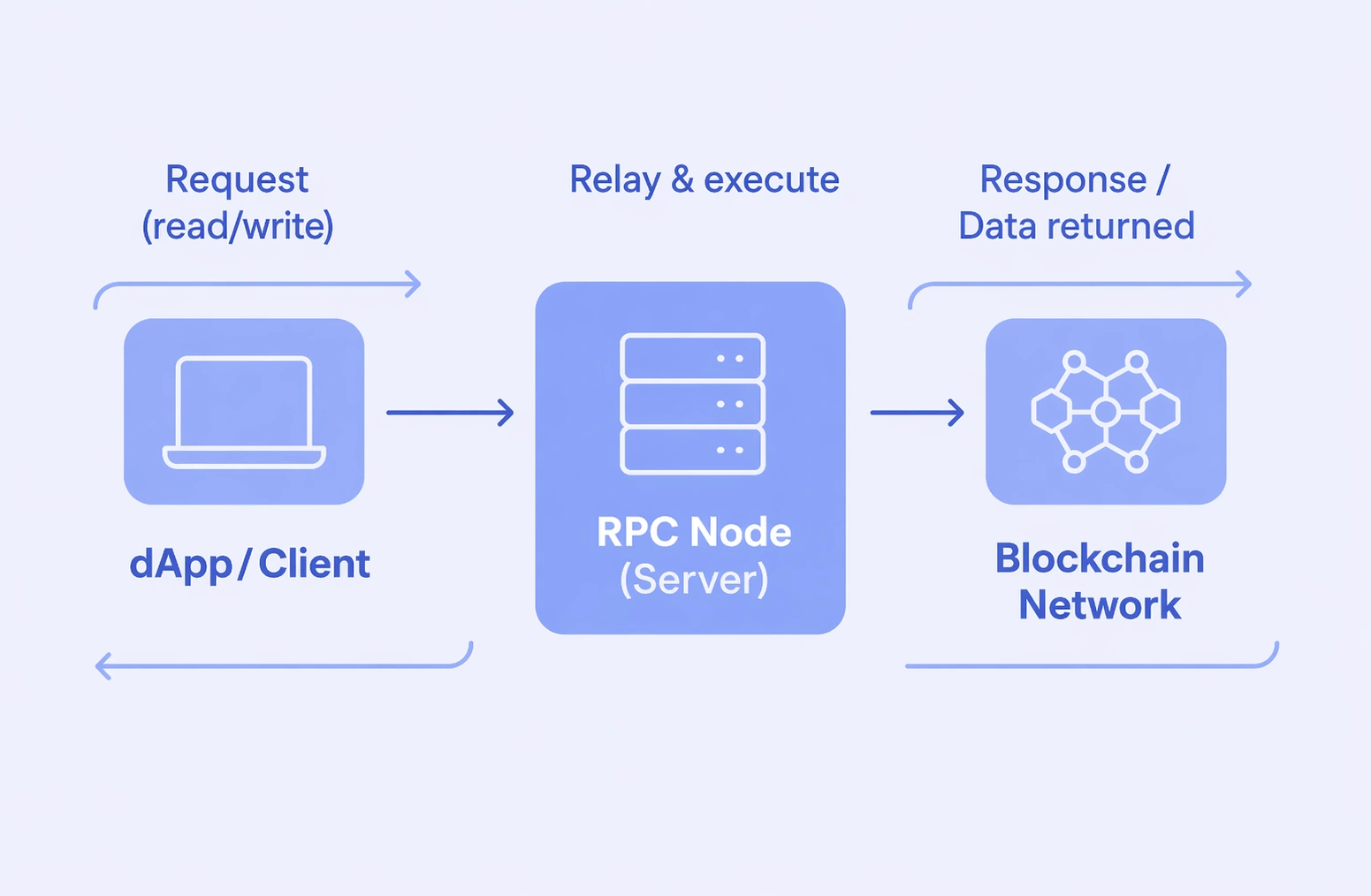
The RPC protocol supports two primary operation categories: read operations that query blockchain state without modifying it, and write operations that broadcast signed transactions to the network. Read operations like eth_getBalance, eth_call, and eth_getBlockByNumber retrieve data instantly from the node’s synchronized blockchain database, typically completing in milliseconds. Write operations follow a more complex flow where the application signs a transaction locally using the user’s private key, then submits the signed transaction via methods like eth_sendRawTransaction. The RPC node validates the transaction format, broadcasts it to the peer-to-peer network, and returns a transaction hash that the application can use to monitor confirmation status through subsequent polling or websocket subscriptions.
Advanced RPC implementations extend beyond basic JSON-RPC functionality by offering batch request capabilities that reduce network round trips, websocket connections for real-time event streaming, and enhanced methods that aggregate multiple operations into single calls. For instance, instead of making separate requests for block data, transaction receipts, and log entries, developers can utilize batch requests to retrieve all information simultaneously, dramatically reducing latency and improving application responsiveness. This optimization becomes particularly critical for complex dApp interfaces displaying real-time data across multiple smart contracts, where efficient RPC usage directly impacts user experience quality and overall application performance.
Real-World Example: RPC Request Flow
When a DeFi application displays a user’s staked token balance, it sends an eth_call request to the RPC provider specifying the staking contract address and the balanceOf function. The RPC node executes this view function against its local blockchain state, retrieves the balance value, and returns it to the application within 50-200 milliseconds, enabling instant UI updates without blockchain gas costs.
Understanding Blockchain Nodes and Their Role
Blockchain nodes represent individual computers running blockchain client software that collectively maintain the distributed ledger through consensus mechanisms and peer-to-peer communication. Each node stores a copy of the blockchain, validates new transactions against protocol rules, participates in block propagation, and serves data requests from connected applications. Full nodes maintain complete blockchain history from genesis to current state, enabling them to independently verify all transactions and blocks without trusting external parties. This complete verification capability makes full nodes the gold standard for security-critical applications, though their resource requirements and synchronization complexity create practical barriers for most teams.[2]
Beyond full nodes, the blockchain ecosystem includes several specialized node types optimized for different use cases. Archive nodes extend full node functionality by preserving historical state at every block height, enabling queries about account balances or contract state at arbitrary points in blockchain history. Light nodes synchronize only block headers rather than complete blocks, dramatically reducing storage requirements while sacrificing some verification capabilities. Validator nodes in proof-of-stake networks participate in consensus by proposing and attesting to new blocks, earning rewards for honest participation. Understanding these distinctions helps teams align node infrastructure choices with specific application requirements, balancing security guarantees against resource constraints and performance needs.
The operational reality of running production blockchain nodes encompasses continuous monitoring, security hardening, performance optimization, and regular software updates that require specialized expertise. Nodes must maintain stable peer connections, manage disk space as blockchain size grows, handle request load fluctuations, and implement security measures against DDoS attacks and unauthorized access. For major networks, synchronizing a new full node from genesis can require several days of continuous operation, while maintaining synchronization demands ongoing bandwidth consumption and computational resources. These operational demands explain why scalable blockchain infrastructure for dApps increasingly relies on professional node operators who can amortize these costs across thousands of customers while delivering reliability that individual teams struggle to achieve independently.
Overview of Popular RPC Providers for dApps
The RPC provider landscape features several established platforms that dominate the market through proven reliability, comprehensive network support, and continuous innovation. Infura, Alchemy, and QuickNode represent the three most prominent providers, collectively serving the majority of production dApps across DeFi, NFT, gaming, and enterprise blockchain sectors. Each provider brings distinct strengths, pricing philosophies, and feature sets that appeal to different project requirements and team preferences. Beyond these leaders, emerging providers like Ankr, Blast, and GetBlock offer alternative options with competitive pricing or specialized capabilities, creating a diverse ecosystem that benefits developers through choice and competitive pressure driving continuous improvement.
When evaluating the best RPC provider for dApp initiatives, teams must consider multiple dimensions beyond simple cost comparisons. Network coverage determines which blockchains the application can support, critical for projects targeting multi-chain strategies or emerging ecosystems. Performance characteristics including request latency, throughput capacity, and data freshness directly impact user experience quality. Developer experience factors such as documentation quality, SDK availability, debugging tools, and customer support responsiveness affect productivity and time-to-resolution for technical issues. Enterprise considerations like SLA guarantees, compliance certifications, and dedicated support channels become essential for applications serving regulated industries or large user bases in markets like USA, UK, UAE, and Canada where reliability expectations are exceptionally high.
The competitive dynamics within the RPC provider market continue driving innovation across pricing models, feature sets, and supported networks. Providers regularly announce support for emerging Layer 2 solutions, implement enhanced caching mechanisms, and introduce developer tools that simplify complex blockchain operations. This rapid evolution means that provider evaluations should be revisited periodically as capabilities, pricing, and relative competitive positions shift. Teams building long-term applications benefit from maintaining relationships with multiple providers, enabling flexibility to migrate or implement failover strategies as business requirements evolve and provider landscapes continue maturing across the expanding Web3 ecosystem.
What is Infura and How Does It Work?
Infura pioneered the managed blockchain infrastructure model when ConsenSys launched the service in 2016, establishing itself as the foundational RPC provider that enabled the first wave of Ethereum applications to scale beyond hobbyist experiments into production services. The platform operates a globally distributed network of Ethereum nodes alongside support for IPFS, Polygon, Optimism, Arbitrum, and other major networks. Infura’s architecture implements sophisticated load balancing that automatically routes requests to healthy nodes, maintains hot standby capacity to handle traffic spikes, and employs aggressive caching strategies that reduce blockchain query latency while minimizing load on underlying node infrastructure. This robust foundation has earned Infura trust from major projects including MetaMask, OpenSea, and thousands of other applications collectively serving hundreds of millions of users worldwide.
The Infura service model emphasizes simplicity and reliability, providing straightforward API endpoints that developers can integrate through basic HTTP requests without requiring specialized SDKs or complex configuration. Creating an Infura account grants instant access to project-specific API keys that authenticate requests while enabling usage tracking and rate limiting. The free tier offers generous allocations suitable for prototyping and small production applications, while paid plans scale capacity for applications experiencing substantial traffic growth. Infura’s dashboard provides clear visibility into request volumes, error rates, and usage patterns, enabling teams to monitor infrastructure health and optimize request patterns for improved efficiency and cost management.[3]
Beyond basic RPC functionality, Infura has expanded its offerings to include additional services like the NFT API that simplifies retrieving token metadata and ownership information, transaction simulation capabilities, and enhanced archive node access for historical blockchain queries. The platform’s strong integration with ConsenSys ecosystem tools including MetaMask, Truffle, and Diligence creates seamless workflows for teams already leveraging these development resources. For enterprises operating in regulated markets across USA, UK, and UAE, Infura’s SOC 2 certification and enterprise SLAs provide compliance assurances and reliability guarantees that justify premium tier investments for mission-critical applications requiring maximum uptime and dedicated support resources.
Industry Standard: Infura’s Market Position
Infura processes over 600 billion blockchain requests annually, serving as the default infrastructure provider for MetaMask wallet connections. This dominant market position reflects the platform’s exceptional reliability track record and the network effects created by being the first major RPC provider to achieve widespread adoption across the Ethereum ecosystem and beyond.
Exploring Alchemy for dApp Development
Alchemy entered the RPC provider market with a differentiated value proposition centered on superior developer experience, offering enhanced APIs and debugging tools that streamline common blockchain operations and accelerate troubleshooting workflows. The platform’s core infrastructure provides reliable node access comparable to Infura while layering additional capabilities including Notify for real-time webhooks, Composer for no-code transaction workflows, and comprehensive analytics dashboards that provide unprecedented visibility into application blockchain interactions. This developer-first approach resonates particularly well with teams building complex applications that benefit from enhanced tooling, making Alchemy the preferred choice for many DeFi protocols, NFT platforms, and blockchain gaming projects requiring sophisticated infrastructure capabilities.
The Alchemy Supernode architecture represents a reimagined approach to blockchain node infrastructure, implementing proprietary optimizations including dedicated data availability layers, intelligent request routing based on query type, and coordination systems that ensure data consistency across distributed node pools. These architectural innovations enable Alchemy to deliver superior performance characteristics including faster response times, higher data freshness guarantees, and better handling of archive queries compared to traditional node implementations. The platform supports Ethereum mainnet and major Layer 2 networks including Polygon, Arbitrum, and Optimism, with continued expansion into emerging ecosystems that align with evolving dApp development services requirements across multi-chain strategies.
Alchemy’s enhanced API suite extends beyond standard JSON-RPC methods to include powerful abstractions like getAssetTransfers that retrieves all token movements for an address in a single call, eliminating complex multi-step queries previously required for this common operation. The NFT API provides comprehensive methods for retrieving collection metadata, ownership information, and transfer history without requiring teams to index blockchain events directly. These developer productivity enhancements translate directly into faster iteration cycles and reduced engineering overhead, enabling teams to focus on application logic rather than blockchain data retrieval complexities. For dApp development company teams operating in competitive markets across USA and Canada, this productivity advantage can significantly accelerate time-to-market and enable smaller technical teams to punch above their weight class.
Why Developers Choose QuickNode?
QuickNode distinguishes itself through exceptional multi-chain support and performance-focused infrastructure that appeals to projects requiring dedicated node resources and global node distribution. Unlike shared node pools common in other providers, QuickNode’s dedicated node offerings guarantee exclusive compute resources, eliminating noisy neighbor problems where one application’s traffic surge impacts other users sharing infrastructure. This isolation ensures consistent performance characteristics critical for high-throughput applications including NFT minting platforms, DeFi arbitrage bots, and blockchain gaming backends that cannot tolerate variable latency. The platform’s global node distribution spans strategic locations worldwide, enabling teams to provision nodes close to their primary user bases whether serving audiences in UK, UAE, or across North America.
The breadth of QuickNode’s blockchain network support surpasses competitors, offering nodes for over 20 different chains including major networks like Ethereum, Bitcoin, Solana, BNB Chain, and Avalanche alongside emerging ecosystems like NEAR, Fantom, and Celo. This comprehensive coverage positions QuickNode as the ideal partner for multi-chain dApp strategies that require consistent infrastructure quality across diverse blockchain environments. The platform’s marketplace model enables third-party developers to contribute add-on services including enhanced analytics, data indexing solutions, and specialized APIs, creating an ecosystem of complementary tools that extend core infrastructure capabilities. This extensibility supports complex application architectures without requiring multiple vendor relationships or integration overhead.
QuickNode’s pricing model reflects its premium positioning, typically commanding higher costs than Infura or Alchemy for comparable request volumes while delivering superior performance guarantees and dedicated resources. The platform targets enterprise customers and high-performance applications willing to invest in infrastructure quality, offering custom enterprise plans with dedicated account management, architecture consulting, and contractual SLAs. For teams building mission-critical applications serving substantial user bases across USA and international markets, QuickNode’s performance consistency and multi-chain expertise justify premium pricing through reduced operational risk and enhanced application reliability that directly impacts user retention and satisfaction metrics.
RPC Provider Selection Criteria
CRITERION 01
Network Coverage
Ensure the provider supports all blockchain networks your application targets, including Layer 2 solutions and emerging ecosystems critical for your multi-chain strategy.
CRITERION 02
Performance Metrics
Evaluate request latency, throughput capacity, and uptime guarantees to ensure infrastructure quality meets your application’s user experience requirements and SLA commitments.
CRITERION 03
Cost Structure
Analyze pricing models including free tier limits, pay-as-you-go rates, and enterprise contracts to project long-term infrastructure costs as your user base scales.
Infura vs Alchemy vs QuickNode: Key Differences
The Infura vs Alchemy vs QuickNode comparison reveals distinct positioning strategies that appeal to different project requirements and team preferences. Infura emphasizes proven reliability and ecosystem integration, positioning itself as the stable, trusted choice for teams prioritizing operational stability over cutting-edge features. Alchemy targets developers seeking enhanced productivity through superior tooling, analytics, and APIs that accelerate application building and debugging workflows. QuickNode serves performance-focused applications requiring dedicated resources, multi-chain support, and global node distribution that justify premium pricing. Understanding these fundamental positioning differences helps teams align provider selection with project priorities, whether optimizing for cost, developer experience, performance, or reliability.
From an architectural perspective, these providers implement different approaches to scaling and optimization. Infura’s proven infrastructure leverages traditional load balancing and caching strategies refined over years of production operation. Alchemy’s Supernode represents a more opinionated architecture with custom data availability layers and intelligent routing that optimize for specific query patterns. QuickNode’s dedicated node model provides resource isolation that eliminates performance variability at the cost of higher infrastructure overhead. These architectural differences manifest in subtle performance characteristics that become significant at scale, making provider selection increasingly important as applications grow from thousands to millions of monthly active users across markets including USA, UK, UAE, and Canada.
Performance, Scalability, and Pricing Comparison
Performance benchmarks across RPC providers reveal nuanced differences that impact application responsiveness and user experience quality. Independent testing consistently shows median request latencies ranging from 50-200 milliseconds depending on provider, query type, user location, and current network load. Alchemy typically demonstrates slightly faster response times for common queries through aggressive caching and optimized data structures, while QuickNode’s dedicated nodes excel in scenarios requiring consistent performance under high load. Infura delivers reliable middle-ground performance with exceptional consistency, avoiding the performance spikes occasionally observed with other providers during network congestion events. These differences matter most for latency-sensitive applications including real-time trading interfaces, blockchain gaming, and NFT minting platforms where milliseconds directly impact user success rates.
Scalability characteristics extend beyond simple request throughput to encompass how providers handle traffic growth, spike mitigation, and rate limiting behavior. Infura implements gradual rate limiting that slows request processing before hard cutoffs, providing applications graceful degradation under load. Alchemy’s compute unit model offers predictable scaling where complex queries consume more units than simple requests, enabling fine-grained capacity planning. QuickNode’s dedicated nodes eliminate noisy neighbor concerns entirely, scaling vertically through node upgrades or horizontally through multi-node deployments. Understanding these scaling behaviors helps teams architect applications with appropriate retry logic, request queuing, and failover strategies that maintain service quality during traffic variations or provider issues.
Pricing structures vary significantly across providers, making direct cost comparisons complex and context-dependent. Infura’s request-based pricing offers transparency and predictability for applications with steady traffic patterns. Alchemy’s compute unit model charges based on computational complexity, potentially providing better value for applications making many simple queries while penalizing heavy archive queries. QuickNode’s premium pricing reflects dedicated resources and superior performance, justifying costs for applications where infrastructure quality directly impacts revenue or user retention. For most projects, total infrastructure costs remain modest until reaching millions of monthly requests, making provider selection more about features and reliability than pure cost optimization until substantial scale is achieved.
How to Choose the Right RPC Provider for Your dApp?
Selecting how to choose RPC provider for dApp initiatives requires systematic evaluation across technical, operational, and business dimensions. Begin by cataloging your application’s specific requirements including target blockchain networks, expected request volumes, performance expectations, budget constraints, and team expertise levels. Applications supporting only Ethereum mainnet have broader provider options than multi-chain projects requiring coverage across ten different networks. Similarly, real-time applications with sub-100ms latency requirements demand different infrastructure than batch processing systems where occasional delays prove acceptable. Documenting these requirements creates objective evaluation criteria that prevent selection based on superficial factors or incomplete provider comparisons.
Performance testing represents a critical evaluation step that reveals actual provider behavior under realistic conditions. Rather than relying solely on marketing claims, teams should implement proof-of-concept integrations with shortlisted providers, measuring request latencies, error rates, and data freshness from geographic locations matching their user base distribution. This empirical testing often reveals discrepancies between advertised performance and real-world behavior, particularly during network congestion or provider maintenance windows. For applications serving users across USA, UK, UAE, and Canada, testing from multiple geographic regions exposes latency variations that impact user experience quality and helps identify providers with superior global infrastructure distribution.
Beyond technical considerations, evaluate provider stability, reputation, and long-term viability. Established providers like Infura, Alchemy, and QuickNode offer proven track records and financial stability that reduce risk of service discontinuation or acquisition-driven disruption. Examine provider documentation quality, community activity, and customer support responsiveness through trial interactions that simulate actual troubleshooting scenarios. Review contract terms for lock-in provisions, price increase protections, and data portability guarantees that affect long-term flexibility. Consider implementing multi-provider architectures where mission-critical applications use primary and secondary providers, ensuring continuity even during individual provider outages while gaining negotiating leverage through demonstrated willingness to switch based on performance or pricing changes.
Common Challenges with RPC Providers and Solutions
Rate limiting represents the most frequently encountered challenge when working with RPC providers, particularly for applications experiencing rapid growth or traffic spikes. Providers implement rate limits to ensure fair resource allocation and prevent individual users from overwhelming shared infrastructure. When applications exceed limits, requests fail or slow dramatically, creating poor user experiences and potential revenue loss. Solutions include implementing intelligent request caching to reduce redundant queries, batching multiple operations into single requests where possible, upgrading to higher-tier service plans with expanded limits, and implementing queue systems with exponential backoff that gracefully handle temporary rate limit hits without cascading failures across application components.
Data consistency challenges arise from the distributed nature of blockchain networks and node synchronization delays. Different nodes may temporarily report conflicting state during block reorganizations or network partitions, creating race conditions where sequential queries return inconsistent results. Applications must implement confirmation waiting logic that accounts for blockchain finality characteristics, typically waiting for multiple block confirmations before treating transactions as permanent. Websocket connections enable real-time event monitoring that reduces polling overhead while improving data freshness. For critical operations, consider querying multiple providers simultaneously and reconciling responses to identify potential inconsistencies before presenting data to users or executing dependent logic.
Cost management becomes increasingly important as applications scale beyond free tiers into paid service levels. Unexpected traffic spikes or inefficient query patterns can generate surprisingly high bills that strain startup budgets or exceed enterprise allocations. Implement comprehensive request logging and analytics to understand usage patterns, identify optimization opportunities, and forecast future costs. Common optimizations include aggressive caching of immutable data, using websocket subscriptions instead of polling for real-time updates, consolidating multiple queries through batch requests or enhanced API methods, and implementing circuit breakers that prevent cost runaway during denial-of-service attacks or application bugs that generate excessive requests. Regular usage reviews and provider comparisons ensure you maintain optimal cost efficiency as pricing models and capabilities evolve.
Risk Warning: Provider Dependency
Excessive reliance on a single RPC provider creates significant operational risk. Provider outages, rate limit changes, pricing increases, or service discontinuations can severely disrupt application functionality. Implementing fallback providers and maintaining provider-agnostic application architecture protects against these risks while preserving negotiating flexibility for improved terms.
Best Practices for Scalable dApp Development
Building scalable blockchain infrastructure for dApps requires implementing architectural patterns that optimize RPC usage while maintaining application responsiveness and reliability. Request caching forms the foundation of efficient dApp architectures, storing frequently accessed immutable data like historical block information, transaction receipts, and smart contract bytecode in application-layer caches. Implement time-based cache invalidation for mutable data like account balances and contract state, balancing data freshness against request reduction. For globally distributed applications serving users across USA, UK, UAE, and Canada, consider deploying edge caching through CDN providers that reduce latency while decreasing load on backend RPC infrastructure.
Websocket connections provide superior efficiency for real-time data requirements compared to traditional polling approaches. Rather than repeatedly querying for new blocks or pending transactions, websocket subscriptions enable RPC providers to push updates as they occur, dramatically reducing request volume while improving data freshness. Implement robust reconnection logic that handles network interruptions gracefully, maintains subscription state across reconnections, and includes exponential backoff to prevent connection storms during provider issues. For complex applications monitoring multiple contracts or addresses, carefully manage subscription counts to avoid overwhelming connection limits while ensuring comprehensive event coverage across all monitored blockchain activity.
Request batching consolidates multiple RPC calls into single network round trips, reducing latency and improving throughput for applications making numerous related queries. JSON-RPC batch requests enable sending arrays of method calls that the provider processes together, returning results in corresponding order. This optimization proves particularly valuable for dashboard interfaces displaying data from multiple sources simultaneously. Implement retry logic with idempotency checks that safely handle transient failures without duplicating state-changing operations. Monitor error rates and latency distributions to identify degrading performance before user impact, enabling proactive intervention through traffic shifting, provider failover, or temporary capacity restrictions that maintain service quality during infrastructure stress.
The Future of Node Infrastructure in Web3
The evolution of node infrastructure in Web3 explained through emerging trends reveals several transformative directions that will reshape how dApp development services access blockchain networks. Decentralized RPC networks like Pocket Network and Ankr’s distributed infrastructure aim to eliminate centralization concerns inherent in traditional provider models by creating marketplace-based systems where independent node operators compete to serve requests. These decentralized approaches promise censorship resistance, geographic diversity, and reduced single-point-of-failure risks while introducing new challenges around quality control, response time consistency, and economic sustainability. As these networks mature, hybrid models combining centralized reliability with decentralized redundancy may emerge as optimal architectures.
Cross-chain interoperability infrastructure represents another critical evolution area as applications increasingly operate across multiple blockchain networks simultaneously. Future RPC providers will need to support unified interfaces that abstract chain-specific differences, implement intelligent routing that optimizes requests across heterogeneous networks, and provide cross-chain data correlation capabilities that simplify multi-chain application logic. Enhanced data availability solutions including Layer 2 rollup-specific indexing, historical state access optimizations, and real-time event streaming across chains will enable new application categories impossible with current infrastructure limitations. For dApp development company teams building next-generation applications across USA, UK, UAE, and Canada markets, these infrastructure improvements will unlock experiences currently constrained by technical limitations.
Privacy-preserving infrastructure innovations including zero-knowledge RPC endpoints, encrypted request routing, and decentralized query execution will address growing concerns about blockchain activity surveillance and data privacy. As regulatory frameworks evolve across different jurisdictions, compliant infrastructure solutions that maintain user privacy while enabling required transparency will become increasingly valuable. The integration of artificial intelligence for intelligent caching, predictive prefetching, and automated optimization will further enhance infrastructure efficiency. These technological advances combined with continued competition among providers ensure that node infrastructure quality, capabilities, and cost efficiency will continue improving, enabling ever more sophisticated decentralized applications that rival centralized alternatives in performance and reliability.
Role of RPC Providers in Multi-Chain dApp Development
Multi-chain dApp strategies have evolved from theoretical concepts into practical necessities as users distribute assets and activities across diverse blockchain ecosystems. RPC providers play a foundational role in enabling these multi-chain applications by offering unified infrastructure access across networks with different consensus mechanisms, data structures, and API specifications. Rather than integrating with separate infrastructure providers for each supported chain, development teams can consolidate relationships with comprehensive providers like QuickNode or Alchemy that support dozens of networks through consistent interfaces. This consolidation dramatically reduces operational complexity, simplifies monitoring and cost management, and accelerates integration of new chains as application strategies evolve.
The technical challenges of multi-chain applications extend beyond simple connectivity to encompass data correlation, state synchronization, and cross-chain transaction coordination. Advanced RPC providers offer enhanced capabilities including unified wallet connection abstractions, cross-chain balance aggregation, and transaction status tracking across heterogeneous networks. These abstractions enable application developers to focus on user experience and business logic rather than navigating the technical minutiae of each blockchain’s specific RPC methods and data formats. For applications serving international audiences across USA, UK, UAE, and Canada, provider-managed abstractions also handle region-specific optimizations including request routing to geographically proximate nodes and compliance-aware data handling that varies by jurisdiction.
Looking forward, multi-chain infrastructure will increasingly incorporate intelligent routing capabilities that automatically select optimal chains for specific operations based on cost, speed, and finality requirements. RPC providers will evolve into comprehensive infrastructure platforms offering not just node access but also indexing services, cross-chain messaging, and unified developer experiences that abstract network differences. This evolution transforms how to choose RPC provider for dApp decisions from simple connectivity questions into strategic partnerships that shape application architecture, user experience quality, and long-term technical flexibility as the Web3 ecosystem continues fragmenting across specialized networks optimized for specific use cases.
Final Thoughts
Node infrastructure for dApps represents far more than simple technical plumbing, instead forming the critical foundation upon which all blockchain application experiences are built. As we have explored throughout this comprehensive guide, the quality, reliability, and performance of RPC providers directly determine application success, influencing everything from user experience quality to operational costs and technical team productivity. The mature provider landscape featuring established players like Infura, Alchemy, and QuickNode alongside emerging alternatives creates unprecedented choice for dApp development services, enabling teams to optimize infrastructure selection based on specific project requirements rather than accepting one-size-fits-all solutions.
Understanding the benefits of using RPC providers in dApps extends beyond immediate technical considerations to encompass strategic advantages including accelerated time-to-market, reduced operational overhead, and the ability to focus engineering resources on differentiating features rather than infrastructure management. Our 8+ years of experience delivering enterprise-grade blockchain solutions across USA, UK, UAE, and Canada markets has reinforced that infrastructure decisions made during early project stages profoundly impact long-term success, scalability potential, and total cost of ownership. Teams that invest time in thorough provider evaluation, implement best practices around caching and optimization, and architect for multi-provider resilience position themselves for sustainable growth regardless of how blockchain ecosystems evolve.
As Web3 infrastructure continues maturing through decentralized alternatives, enhanced cross-chain capabilities, and AI-powered optimizations, the role of professional node operators will only grow in importance and sophistication. Whether you are launching a new dApp, optimizing an existing application, or planning multi-chain expansion, the insights shared throughout this guide provide the framework for making informed infrastructure decisions aligned with your technical requirements, business objectives, and user experience expectations. The future of decentralized applications depends fundamentally on the invisible infrastructure layer connecting users to blockchains, making strategic node infrastructure planning not merely a technical necessity but a competitive differentiator in the rapidly evolving Web3 landscape.
Ready to Build Scalable dApps with Professional Node Infrastructure?
Partner with our experienced team to architect and deploy blockchain applications leveraging optimal RPC provider selection, advanced caching strategies, and multi-chain infrastructure that scales with your vision.
Frequently Asked Questions
Q1.What is node infrastructure in blockchain and why is it important for dApps?
Node infrastructure refers to the network of servers that validate transactions, store blockchain data, and enable communication between decentralized applications and blockchain networks. For dApps, robust node infrastructure is essential because it provides the backbone for reading blockchain state, broadcasting transactions, and ensuring real-time data synchronization. Without reliable nodes, dApps cannot function properly as they would lack the ability to interact with smart contracts or retrieve on-chain information. Node infrastructure determines application performance, uptime, and user experience, making it a critical component for any successful dApp deployment across Web3 ecosystems.
Q2.How do RPC providers differ from running your own blockchain node?
RPC providers offer managed node infrastructure as a service, eliminating the need for teams to maintain their own blockchain nodes. Running your own node requires significant technical expertise, hardware resources, ongoing maintenance, and substantial operational costs. Self-hosted nodes demand continuous monitoring, software updates, and scaling adjustments as traffic grows. In contrast, RPC providers handle all infrastructure complexities, offering instant scalability, high availability, and multi-chain support through simple API endpoints. While self-hosted nodes provide maximum control and decentralization, RPC providers deliver faster time-to-market, reduced overhead, and professional-grade reliability, making them the preferred choice for most dApp projects seeking efficient blockchain connectivity without infrastructure burden.
Q3.What are the main differences between Infura, Alchemy, and QuickNode?
Infura, Alchemy, and QuickNode are leading RPC providers with distinct strengths. Infura, owned by ConsenSys, pioneered managed node services and offers extensive Ethereum support with reliable infrastructure trusted by major dApps. Alchemy provides enhanced developer tools including real-time webhooks, advanced analytics, and debugging features that streamline the building process. QuickNode focuses on multi-chain support and global node distribution, offering superior performance through dedicated nodes and extensive blockchain network coverage. Pricing models vary, with Infura offering generous free tiers, Alchemy emphasizing developer experience, and QuickNode providing performance-focused premium options. The choice depends on specific project requirements including supported chains, performance needs, budget constraints, and required developer tooling for optimal dApp functionality.
Q4.How does RPC work in blockchain applications?
RPC (Remote Procedure Call) in blockchain enables dApps to communicate with blockchain networks by sending standardized requests to nodes and receiving data responses. When a user interacts with a dApp, the application generates RPC calls to query blockchain state, retrieve account balances, fetch smart contract data, or broadcast signed transactions. The RPC provider’s node processes these requests, interacts with the blockchain network, and returns formatted responses to the application. This client-server model abstracts the complexity of direct blockchain interaction, allowing developers to use simple API calls rather than managing low-level network protocols. RPC endpoints support various methods for reading data, estimating gas fees, and submitting transactions, providing the essential communication layer between user interfaces and decentralized networks.
Q5.What factors should I consider when choosing an RPC provider for my dApp?
Selecting the right RPC provider requires evaluating multiple critical factors. Performance metrics including response times, uptime guarantees, and request throughput directly impact user experience. Blockchain network support ensures compatibility with your target chains, whether Ethereum, Polygon, Arbitrum, or emerging networks. Pricing structures vary significantly, with considerations for free tier limits, pay-as-you-go models, and enterprise contracts affecting long-term costs. Developer tools such as enhanced APIs, webhooks, analytics dashboards, and debugging capabilities accelerate building and troubleshooting. Geographic distribution of nodes affects latency for global users. Security features including DDoS protection, authentication mechanisms, and compliance certifications protect your application. Finally, evaluate provider reliability, community reputation, documentation quality, and customer support responsiveness to ensure sustainable long-term partnership.
Q6.Can I use multiple RPC providers for the same dApp?
Yes, implementing multiple RPC providers as a fallback strategy significantly enhances dApp reliability and resilience. This approach, called RPC provider failover or multi-provider architecture, ensures continuous operation even if one provider experiences downtime or rate limiting. Developers configure their applications to automatically switch between providers when primary endpoints fail or respond slowly. This redundancy strategy mitigates single points of failure, distributes request load, and optimizes costs by utilizing free tiers across multiple services. Implementation typically involves connection libraries that manage provider rotation, health checking, and automatic failover logic. While adding complexity to infrastructure management, multi-provider setups are considered best practice for production dApps requiring high availability, particularly for applications serving users across USA, UK, UAE, and Canada markets where reliability expectations are high.
Q7.What are the common challenges when using RPC providers and how can they be resolved?
Common RPC provider challenges include rate limiting, inconsistent data across nodes, request latency, and cost management at scale. Rate limits can disrupt application functionality during traffic spikes; solutions include implementing request caching, optimizing query efficiency, and upgrading to higher-tier plans. Data inconsistencies arise from blockchain finality delays; developers should implement confirmation waiting logic and use websocket subscriptions for real-time updates. High latency affects user experience; choosing geographically distributed providers and implementing connection pooling improves performance. Cost escalation occurs as applications scale; implementing efficient data fetching strategies, batching requests, and monitoring usage patterns helps control expenses. Additional challenges include provider outages (solved through multi-provider failover), API version changes (requiring regular updates), and debugging difficulties (addressed through comprehensive logging and provider-specific analytics tools).
Explore Services
Related Services
Reviewed by

Aman Vaths
Founder of Nadcab Labs
Aman Vaths is the Founder & CTO of Nadcab Labs, a global digital engineering company delivering enterprise-grade solutions across AI, Web3, Blockchain, Big Data, Cloud, Cybersecurity, and Modern Application Development. With deep technical leadership and product innovation experience, Aman has positioned Nadcab Labs as one of the most advanced engineering companies driving the next era of intelligent, secure, and scalable software systems. Under his leadership, Nadcab Labs has built 2,000+ global projects across sectors including fintech, banking, healthcare, real estate, logistics, gaming, manufacturing, and next-generation DePIN networks. Aman’s strength lies in architecting high-performance systems, end-to-end platform engineering, and designing enterprise solutions that operate at global scale.