Ai Overview
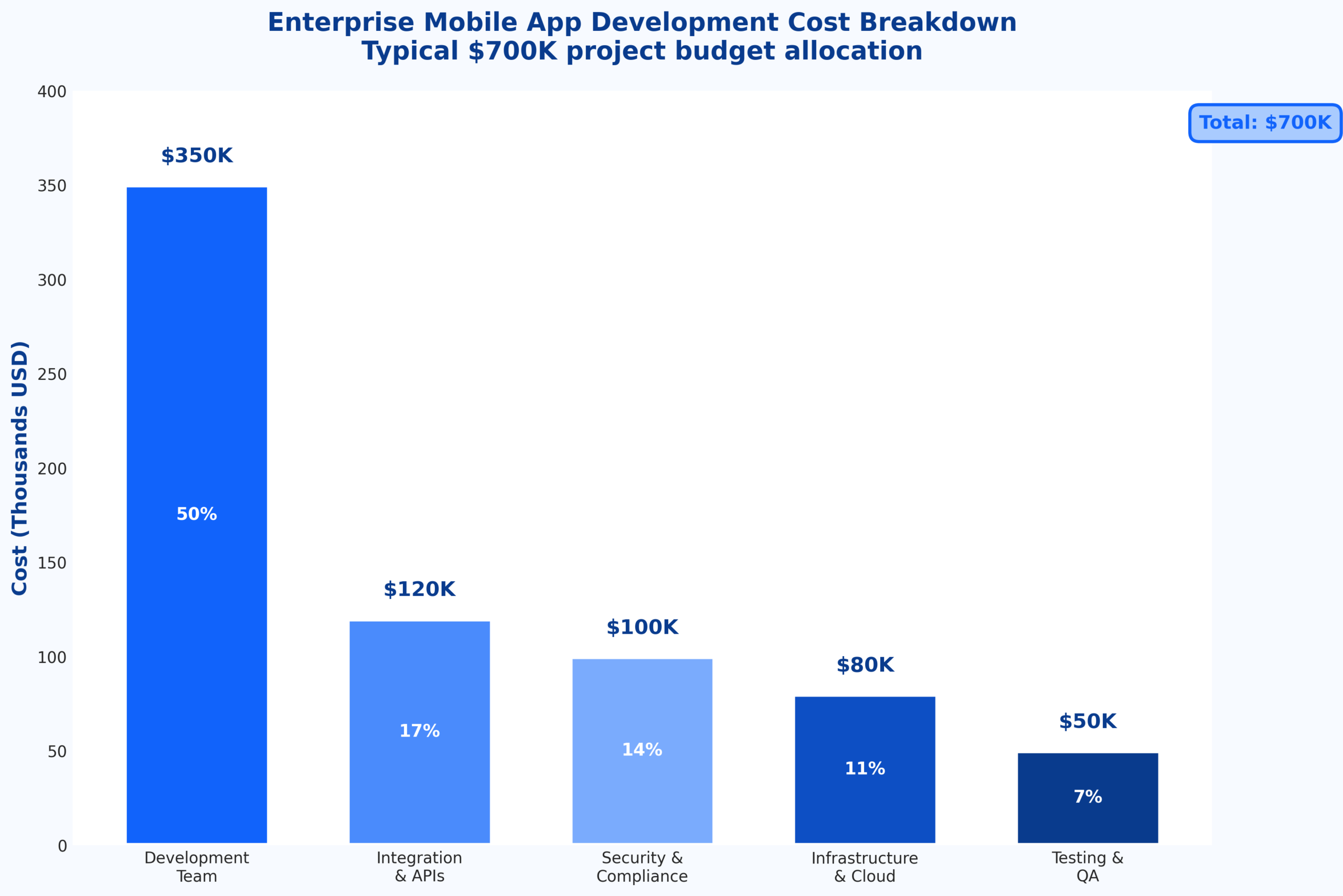
Enterprise Architecture Foundation: App architecture without standards increases cost and maintenance overhead—KISS, DRY, and SOLID principles accelerate delivery and enable predictable scaling. 75% (2022–2024); cross-platform reduces development cost by 30–40% while retaining ~95% native performance for business apps. Cost Reality for Enterprise Apps: Enterprise mobile apps range $500K–$1M; security and compliance add 20–30%, integrations cost $10K–$150K per system, maintenance runs 15–20% annually.
Key Takeaways: Enterprise Mobile App Development
- Enterprise Architecture Foundation:
App architecture without standards increases cost and maintenance overhead—KISS, DRY, and SOLID principles accelerate delivery and enable predictable scaling. - Cross-Platform Market Dominance:
Flutter adoption grew from 4.73% to 6.75% (2022–2024); cross-platform reduces development cost by 30–40% while retaining ~95% native performance for business apps. - Cost Reality for Enterprise Apps:
Enterprise mobile apps range $500K–$1M; security and compliance add 20–30%, integrations cost $10K–$150K per system, maintenance runs 15–20% annually. - Integration Complexity Driver:
Legacy systems (SOAP, mainframes) cost $30K–$150K per integration versus $10K–$20K for modern REST APIs; undocumented APIs add 2–4 months unplanned delays. - User Adoption Is the Real Risk:
60% of enterprise apps fail due to low adoption—not technology—requiring early user involvement, pilot champions, and weekly adoption tracking. - AI-First Architecture 2025:
AI now underpins mobile architectures—on-device ML enables real-time decisions (up to 95% accuracy), NLP powers voice workflows, edge AI cuts bandwidth 80–90%. - Risk Mitigation Framework Required:
Architecture reviews, security gates, integration checks, performance benchmarks, and compliance validation prevent 25–40% budget overruns. - ROI Measurement Drives Investment:
Proven cases show $650K investment delivering 83% faster processing, $2.4M annual savings, and 3.2-month payback through operational efficiency.
Understanding Enterprise Mobile App Development in 2025
What Distinguishes Enterprise Apps from Consumer Apps
Enterprise mobile apps and consumer apps operate under fundamentally different technical and business constraints. Custom enterprise app development prioritizes enterprise system integration, regulatory compliance, and operational continuity over viral growth metrics. Businesses looking to build scalable and high-performing applications often partner with a reliable mobile application agency to ensure quality and long-term success.
Enterprise mobile application platform requirements:
- → Deep integration with ERP systems (SAP, Oracle, Microsoft Dynamics)
- → Multi-layer security (SSO, MFA, RBAC, end-to-end encryption)
- → Regulatory compliance frameworks (GDPR, HIPAA, SOC 2, PCI-DSS)
- → Offline-first architecture with complex synchronization
- → Long-term support cycles (5-7 years versus 2-3 years consumer)
- → Enterprise deployment (MDM integration, private app stores)
Enterprise mobile apps development differs from consumer apps in user base (controlled employee/partner access), deployment (centralized IT management), data sensitivity (confidential business information), and mobile application price justification (ROI-driven versus user acquisition metrics). Mobile enterprise applications require enterprise mobile app development services addressing organizational complexity.
When Your Business Needs an Enterprise Mobile Solution
Organizations need enterprise mobile app development when operational inefficiencies exceed development investment. Field service teams spending 3+ hours daily on manual paperwork, sales inability to access systems offline, or manufacturing lacking real-time data signal mobile enterprise software necessity. Enterprise mobile application development services deliver measurable ROI when manual processes cost $500K+ annually, data errors exceed 5%, or regulatory compliance gaps create risk exposure.
Enterprise mobile app development platform triggers: Employee productivity loss exceeding 20 hours weekly, customer service SLA misses, audit findings requiring process digitization, competitive disadvantage from digital gaps. Nadcab Labs’ enterprise mobile apps development reduced healthcare patient intake time 60%, financial services loan processing 83%, and manufacturing quality defects 40%.
Mobile App Architecture: Choosing the Right Foundation
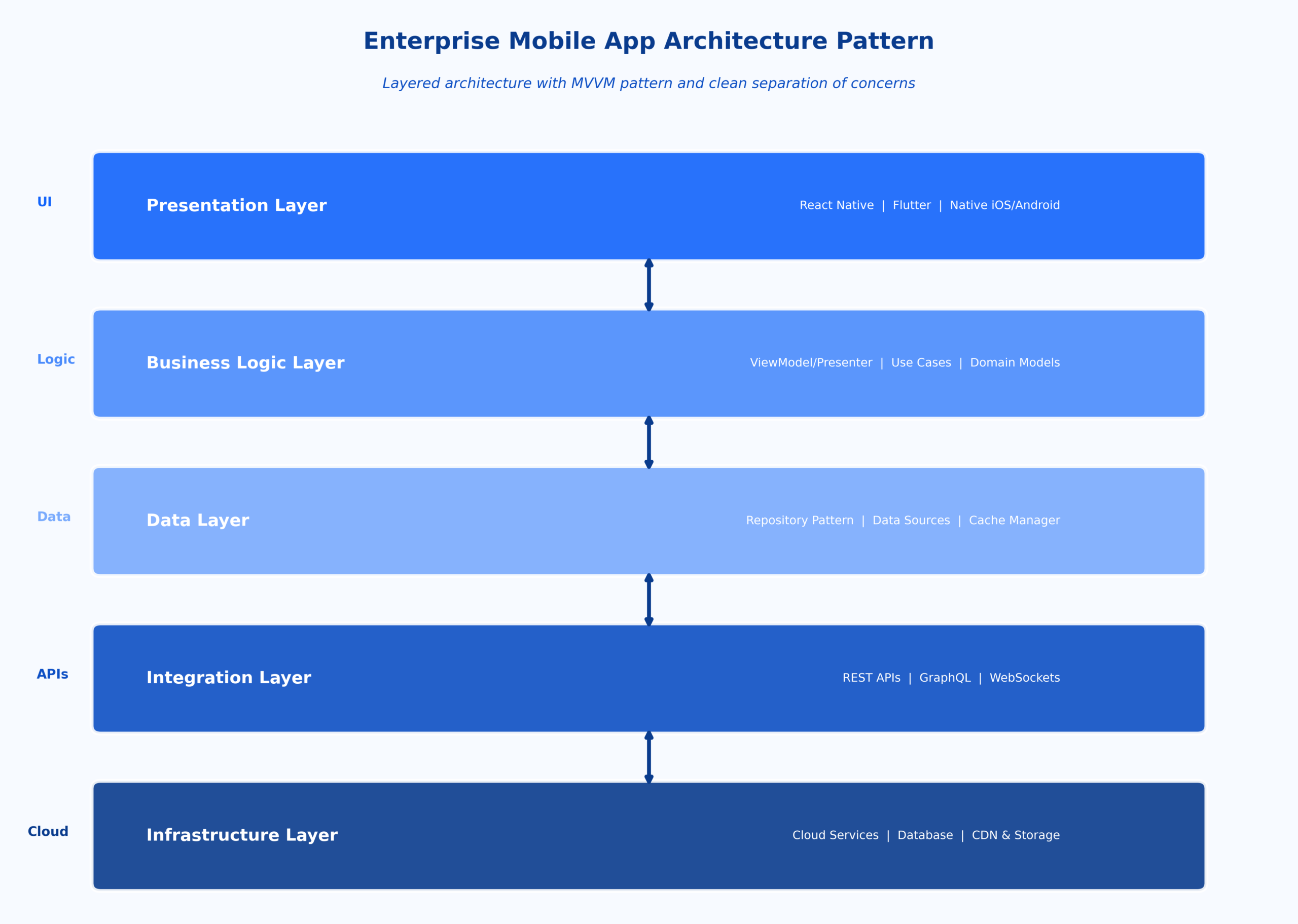
App architecture without standards leads to increased development costs, longer timelines, harder maintenance, scalability issues, testing difficulties, and more errors. Strong architecture enforces KISS, DRY, SOLID principles, accelerating development, enabling Agile methods, efficient testing, and easier scaling. 2025 cross-platform frameworks like Flutter and React Native dominate trends alongside modular designs, cloud-native solutions, microservices, and edge computing.
Native vs. Cross-Platform vs. Hybrid Architecture
Native Architecture (iOS and Android)
Native iOS apps rely on MVVM or VIPER featuring UIKit/SwiftUI, ViewModel/Presenter, Data Manager/Interactor, and Router for navigation. Android apps typically use MVVM or MVP patterns with components like Jetpack Compose, ViewModel, Repository, Room, LiveData, and Data Binding. Native development delivers maximum performance (60fps+), complete device API access, and optimal platform integration for compute-intensive enterprise mobile applications.
Native architecture benefits: Superior performance for AR/VR, real-time analytics, video processing; deepest hardware integration (biometrics, NFC, health sensors); platform-specific features immediately available; best user experience adhering to platform conventions. Mobile application development budget for native: $500K-$1M for dual-platform deployment.
Cross-Platform Architecture (React Native, Flutter)
Flutter holds the lead in cross-platform development with apps outnumbering React Native; its market share grew from 4.73% in 2022 to 6.75% in 2024. After Bubble’s native mobile app editor launch, over 68,000 cross-platform mobile apps were created in one month. Cross-platform frameworks reduce development cost 30-40% and accelerate time-to-market 50% while maintaining 95% native performance for business applications.
Cross-platform advantages for enterprise: Single codebase serving iOS and Android, faster feature parity across platforms, reduced maintenance overhead, easier talent acquisition (JavaScript/Dart versus Swift/Kotlin specialists). Cost of building a mobile app with cross-platform: $300K-$600K versus $500K-$1M native dual-platform.
Hybrid Architecture (Progressive Web Apps)
Progressive Web Apps (PWAs) deliver web applications through browsers with native-like capabilities—offline functionality, push notifications, home screen installation. PWAs suit content-heavy mobile enterprise apps with limited device API requirements, making them a cost-effective choice for news app development and information portals. Mobile application price for PWA: $150K-$300K. Limitations: restricted hardware access (60% versus 95-100% native), performance constraints for complex interactions, reduced offline capabilities compared to native local storage.
Enterprise Architecture Patterns and Design Principles
Microservices vs. Monolithic Architecture
Microservices architecture breaks apps into smaller reusable parts for easier maintenance. Each microservice handles specific business capability—authentication, payments, inventory, analytics—deployed independently with dedicated databases. Enterprise mobile application platform architectures serving 10,000+ concurrent users require microservices for fault isolation, independent scaling, and technology diversity.
Microservices advantages: Independent deployment cycles, technology stack flexibility per service, fault isolation preventing cascading failures, team autonomy for faster development. Monolithic architecture suits smaller enterprise mobile apps (under 1,000 users) where operational simplicity outweighs scalability requirements.
API-First and Backend-for-Frontend Patterns
API-first design separates mobile frontend from backend business logic, enabling multiple client types (iOS, Android, web dashboards) consuming identical enterprise mobile application development services. Backend-for-Frontend (BFF) pattern creates dedicated API layers per platform, optimizing data payloads for mobile constraints (bandwidth, battery life, screen real estate). Nadcab Labs implements BFF for clients requiring different data models for field workers (minimal bandwidth) versus office staff (comprehensive analytics).
Cloud-Native Architecture Considerations
In 2025, cloud-native solutions and microservices will continue to shape the way we develop scalable, resilient mobile apps—enabling easier deployment, maintenance, and integration. Mobile backends like Firebase, AWS Amplify, and Azure Mobile Apps handle authentication, storage, push notifications, and analytics as managed services, reducing custom backend development costs 40-60%.
Cloud-native enterprise benefits: Auto-scaling during peak loads, geographic distribution for global latency optimization, disaster recovery through multi-region deployment, pay-per-use cost models, managed security updates. AI has become the foundation of app architecture—apps in 2025 are being designed to run with AI at the core, leveraging cloud ML services for predictive analytics, natural language processing, and computer vision.
Platform Selection Framework for Enterprise Apps
| Criteria | Native | Cross-Platform | Hybrid |
|---|---|---|---|
| Development Cost | $500K-$1M | $300K-$600K | $150K-$300K |
| Time to Market | 6-9 months | 4-6 months | 3-4 months |
| Performance | Excellent (60fps+) | Very Good (55fps) | Good (30-45fps) |
| Device APIs | Complete (100%) | Extensive (95%) | Limited (60%) |
| Best Use Case | AR/VR, gaming, IoT | Business apps, SaaS | Content, portals |
The Enterprise Mobile App Development Process
Discovery and Strategic Planning Phase
Enterprise mobile application development services begin with comprehensive discovery workshops aligning stakeholders on measurable business outcomes. Nadcab Labs’ discovery includes: current-state process mapping, pain point quantification with cost impact analysis, user persona development across employee segments, competitive landscape assessment, regulatory requirement documentation, and technical constraints inventory.
Strategic planning deliverables: Business requirements document with prioritized user stories,
technical feasibility assessment, platform recommendation (native, cross-platform, hybrid), integration scope with existing enterprise systems, security and compliance framework, deployment model strategy (public app stores, private enterprise distribution, MDM), success metrics definition with baseline measurements.
Technical Architecture and Infrastructure Design
Architecture phase translates business requirements into technical blueprints for enterprise mobile apps development. 2025 trends include AI-first architecture, on-device ML, composable apps from super apps, Web3 identity and payments, edge computing, spatial computing, and AI-driven DevSecOps. Lack of architecture results in apps that are longer and more costly to develop, hard to maintain, and more prone to errors.
Infrastructure design components: Backend architecture (microservices topology, API gateway configuration, service mesh), database strategy (SQL for transactions, NoSQL for flexibility, graph for relationships), cloud provider selection aligned with enterprise IT standards, CDN and edge caching for global performance, observability stack (APM, distributed tracing, log aggregation), CI/CD pipeline design for automated testing and deployment.
UI/UX Design for Enterprise Users
Enterprise UX design prioritizes task efficiency over aesthetic experimentation. Field workers require large touch targets for gloved operation, warehouse staff need high-contrast displays for bright environments, executives demand data visualization clarity. Custom enterprise app development design process: contextual inquiry with actual users, workflow mapping identifying pain points, wireframe iterations with user feedback, high-fidelity prototypes, usability testing in operational environments, accessibility compliance (WCAG 2.1 AA minimum for government/healthcare).
Development and Integration Phase
Agile development proceeds in 2-week sprints with continuous integration and automated testing. Development team for enterprise mobile app development platforms: iOS/Android specialists (native) or React Native/Flutter developers (cross-platform), backend engineers (Node.js, Python, .NET Core), database administrators, DevOps engineers, security specialists, QA automation engineers. Integration complexity significantly impacts mobile application development budget—connecting to SAP ($50K-$80K), Oracle ($40K-$70K), Salesforce ($20K-$40K), or legacy mainframe systems ($80K-$150K) requires specialized middleware, data transformation, and extensive integration testing.
Quality Assurance and Security Testing
Enterprise QA encompasses: functional testing (feature validation against requirements), integration testing (API contracts, data flow), performance testing (load testing 3x expected users, stress testing failure points, endurance testing for memory leaks), security testing (OWASP Mobile Top 10 validation, penetration testing, vulnerability scanning), compliance testing (GDPR data handling, HIPAA encryption, SOC 2 controls), user acceptance testing with pilot groups.
Automated testing strategy: Unit tests (80%+ code coverage), integration tests (API contracts), UI automation (critical user flows), regression tests (preventing feature breaks). Security testing validates: secure data storage, network communication encryption, authentication/authorization controls, API security, code obfuscation, jailbreak/root detection.
Deployment and Launch Strategy
Enterprise deployment requires staged rollout minimizing organizational disruption. Deployment phases: pilot deployment (50-100 users, intensive monitoring), early adopter expansion (500-1000 users, feedback collection), departmental rollout (phased by business unit), organization-wide deployment (monitored gradual rollout). Deployment considerations: app store review timelines (Apple 2-4 weeks, Google 1-2 weeks), MDM integration for enterprise distribution, mobile enterprise application platform configuration, over-the-air update mechanisms, rollback procedures, change management communications, user training programs.
Post-Launch Maintenance and Evolution
Enterprise mobile application development services extend beyond launch. Ongoing maintenance includes: OS compatibility updates (iOS/Android annual releases), security patches (monthly), feature enhancements (quarterly releases), performance optimization (continuous), third-party SDK updates, bug fixes, user support. Annual maintenance costs: 15-20% of initial development investment. Five-year total cost of ownership: initial development + (annual maintenance × 5 years) + infrastructure costs + app store fees.
Cost Breakdown: Budgeting for Enterprise Mobile Apps
Understanding Cost Ranges by App Complexity
| Complexity | Features | Timeline | Cost |
|---|---|---|---|
| Basic | Auth, CRUD, reports, basic offline | 3-4 months | $150K-$300K |
| Intermediate | API integrations, workflows, analytics, notifications | 5-7 months | $300K-$600K |
| Advanced | AI/ML, blockchain, AR/VR, complex integrations | 8-12 months | $600K-$1M+ |
Primary Cost Drivers in Enterprise Development
Development Team Structure and Location
Geographic location dramatically impacts mobile application development budget. US-based teams: $150-$250/hour (total project: $600K-$1M). Eastern European teams: $80-$120/hour (total: $320K-$480K). Asian teams: $40-$80/hour (total: $160K-$320K). However, effective hourly rates include timezone coordination overhead, communication efficiency, quality consistency. Nadcab Labs’ hybrid model combines 100-1600+ experts across India development centers with UK project management, optimizing cost while maintaining enterprise-grade quality and stakeholder communication.
Feature Complexity and Custom Functionality
Custom features incrementally increase cost of building a mobile app. Baseline CRUD operations with standard UI: 100% baseline cost. Real-time collaboration (WebSockets, operational transformation): +30%. AI/ML integration (on-device models, cloud ML APIs): +40%. Blockchain integration (smart contracts, Web3 wallets): +50%. AR/VR features (3D rendering, spatial mapping): +60%. IoT device integration (BLE, sensor data processing): +35%.
Integration Requirements and Backend Infrastructure
Enterprise system integration drives mobile application price significantly. REST API integration (modern cloud services): $10K-$20K per system. SOAP/legacy integration (older enterprise systems): $30K-$50K per system. Custom protocol integration (proprietary systems): $50K-$80K per system. Mainframe connectivity (CICS, IMS): $80K-$150K per system. Each integration requires: API documentation analysis, middleware development, data transformation logic, error handling, integration testing, ongoing maintenance.
Security, Compliance, and Data Protection
Security and compliance add 20-30% to base development costs. HIPAA compliance (healthcare): +$80K-$120K (encrypted storage, audit logging, BAA agreements, breach notification). GDPR compliance (EU operations): +$50K-$80K (data residency, consent management, right-to-erasure, data portability). PCI-DSS (payment processing): +$60K-$90K (tokenization, secure transmission, cardholder data protection). SOC 2 Type II: +$60K-$100K annually (security controls, audit preparation, ongoing compliance).
Hidden Costs in Enterprise App Development
Often overlooked mobile application development budget items:
- → App store fees: Apple $99/year, Google $25 one-time, enterprise distribution $299/year
- → Third-party services: Analytics ($500-$2000/month), crash reporting ($200-$800/month), push notifications ($100-$500/month)
- → Cloud infrastructure: Compute ($1000-$5000/month), storage ($200-$1000/month), bandwidth ($500-$3000/month scaling with users)
- → SSL certificates: $50-$300/year depending on validation level
- → Legal review: Terms of service, privacy policy, compliance documentation ($5K-$15K)
- → Change management: Training development ($10K-$30K), documentation ($5K-$15K), user support setup ($15K-$40K)
- → App localization: Translation, cultural adaptation ($5K-$15K per language) — costs vary based on tooling; platforms with built-in dev tools reduce manual handoff overhead
Cost Optimization Strategies Without Compromising Quality
MVP approach for enterprise mobile apps reduces initial investment 40-50% by focusing on core workflows, proving business value. Phased feature delivery spreads costs across fiscal periods while generating early ROI, demonstrating project value. Cross-platform development (React Native, Flutter) eliminates duplicate iOS/Android codebases, reducing costs 30-40%. Leveraging managed backend services (Firebase, AWS Amplify, Azure Mobile Apps) reduces custom backend development 40-60%. Open-source components for commodity features (authentication, analytics, charting) versus custom development for competitive differentiation. Hybrid team models combining strategic in-house oversight with cost-effective outsourced execution optimize mobile application development budget allocation.
Risk Management in Enterprise Mobile Development
Technical and Architecture Risks
Scalability and Performance Risks
Architecture decisions during prototyping determine maximum user capacity. Monolithic architecture hitting performance walls at 5,000 concurrent users requires expensive re-architecture ($150K-$300K rework). Database query optimization failures cause exponential slowdown as data grows. Synchronous processing creating bottlenecks under load. Mitigation strategies: load testing at 3x expected peak usage, horizontal scaling architecture from inception, database indexing and query optimization, asynchronous processing for non-critical operations, caching strategies (Redis, CDN), connection pooling and resource management.
Integration and Legacy System Risks
Undocumented APIs, unstable legacy systems, data quality issues surface during integration. Real example: healthcare client’s 30-year-old patient system lacked API documentation—integration took 4 months versus planned 6 weeks, adding $120K unplanned costs. Mitigation: integration proof-of-concept before full development, dedicated integration testing environment, comprehensive error handling and retry logic, fallback strategies for legacy system unavailability, data validation and sanitization, API versioning and deprecation planning.
Technology Stack Obsolescence
Framework abandonment creates long-term maintenance nightmares. Meteor.js and Ionic lost market share to React Native and Flutter—apps built on declining platforms face talent shortage and security vulnerabilities. Mitigation: select technologies with strong community momentum (Flutter market share 4.73% to 6.75% growth), avoid pre-1.0 frameworks for enterprise production, maintain technology upgrade roadmap, monitor platform evolution and deprecation announcements, allocate 10-15% annual budget for technology updates.
Security and Compliance Risks
Data Breach and Privacy Vulnerabilities
Mobile enterprise software handles sensitive data outside corporate firewalls. Common vulnerabilities: insecure local storage (unencrypted SQLite databases), weak encryption (deprecated algorithms), inadequate authentication (weak password policies), API security gaps (missing rate limiting, injection vulnerabilities). Mitigation: security architecture review by certified professionals, regular penetration testing (quarterly minimum), data encryption at rest (AES-256) and in transit (TLS 1.3), certificate pinning for API communication, biometric authentication where supported, secure key storage (iOS Keychain, Android Keystore).
Regulatory Compliance Failures
Compliance requirements evolve continuously—GDPR updates, CCPA expansion, HIPAA clarifications, industry-specific regulations. Non-compliance consequences: GDPR fines up to €20M or 4% annual revenue, HIPAA penalties $100-$50,000 per violation, operational shutdown orders. Mitigation: compliance-by-design from architecture phase, regular compliance audits (annual minimum), legal review of data handling practices, geographic data residency controls, user consent management, data retention and deletion policies, audit trail logging, incident response procedures.
Business and Operational Risks
User Adoption and Change Management
60% of enterprise mobile apps fail from poor user adoption rather than technical issues. Field workers resist apps slower than existing paper processes. Sales teams abandon apps with complex navigation. Executives ignore dashboards lacking actionable insights. Mitigation: involve end users in design workshops, pilot programs with change champions, comprehensive training programs (not just documentation), adoption metrics monitoring (daily active users, feature usage), rapid iteration based on user feedback, executive sponsorship communicating organizational commitment, incentive alignment rewarding adoption.
Vendor Lock-In and Dependency Risks
Proprietary enterprise mobile app development platforms create vendor dependency. Low-code platforms, enterprise mobile app builder tools, mobile enterprise application platform MEAP solutions often use proprietary data models and deployment infrastructure. Exit costs: re-implementation ($200K-$500K), data migration, user retraining. Mitigation: evaluate vendor financial stability and market position, negotiate source code escrow agreements, design abstraction layers isolating vendor-specific code, maintain data export and portability capabilities, multi-vendor strategies for critical dependencies.
Budget Overruns and Timeline Delays
Enterprise projects exceed budget 25-40% on average. Scope creep from stakeholder requests, integration complexity underestimation, performance optimization requiring re-architecture drive overruns. Mitigation: fixed-price contracts for clearly defined scope, formal change request process with cost/timeline impact assessment, monthly budget variance reviews, 20% contingency budget for unknowns, phased delivery with go/no-go decision points, risk register tracking and mitigation, experienced project management with enterprise mobile app development expertise.
Risk Mitigation Strategies and Best Practices
Comprehensive risk framework for enterprise mobile apps development: technical architecture review board (monthly during development), security design review checkpoints (architecture, before deployment), integration readiness assessments (before each integration), performance benchmarking gates (before UAT), compliance validation checkpoints (architecture, pre-launch), user acceptance criteria signoff (pilot completion). Nadcab Labs implements risk registers updated weekly, categorizing by probability and impact, with assigned risk owners and documented mitigation plans achieving 95% on-time, on-budget delivery across 500+ projects.
Essential Features and Capabilities for Enterprise Apps
Security and Access Control
Enterprise-grade security foundations: Single Sign-On integration (Azure AD, Okta, ADFS, Ping Identity), multi-factor authentication (biometric, bulk SMS, authenticator apps, hardware tokens), role-based access control with granular permissions (read, write, delete, approve by module and data type), session management (configurable timeouts, concurrent session controls), device security (jailbreak/root detection, remote wipe, device encryption enforcement), certificate-based API authentication, secure credential storage (platform keychains), OAuth 2.0/OpenID Connect standards compliance.
Enterprise System Integration
Modern integration patterns for mobile enterprise applications: RESTful APIs (JSON over HTTPS, standard HTTP methods), GraphQL (efficient data fetching, reduced over-fetching), message queues (asynchronous processing, RabbitMQ, Apache Kafka), webhooks (event-driven real-time updates), iPaaS integration platforms (MuleSoft, Dell Boomi, Informatica). Common integrations: CRM (Salesforce, Microsoft Dynamics, HubSpot), ERP (SAP S/4HANA, Oracle ERP Cloud, Microsoft Dynamics 365), HRIS (Workday, SuccessFactors, ADP), document management (SharePoint, Box, Dropbox Business), communication (Microsoft Teams, Slack, Zoom).
Scalability and Performance Requirements
Enterprise performance benchmarks: app launch under 2 seconds (cold start), screen transitions under 300ms, API response times under 500ms (p95), support for 10,000+ concurrent users (peak load), database queries under 100ms (p95), 99.9% uptime SLA (43 minutes monthly downtime maximum). Scalability implementation: horizontal scaling (stateless application servers), database read replicas (reporting queries), caching layers (Redis for session/reference data), CDN for static assets (images, videos, documents), auto-scaling policies (CPU/memory thresholds), connection pooling (database efficiency), load balancing (distribute traffic), asynchronous processing (background jobs).
Offline Functionality and Data Synchronization
Offline-first architecture critical for field service, retail, logistics mobile enterprise apps. Implementation components: local database (SQLite for relational, Realm for object), conflict resolution strategies (last-write-wins with timestamps, operational transformation for collaborative editing, manual conflict resolution UI for critical data), differential synchronization (transmit only changes, not full datasets), background sync (when connectivity restored, retry with exponential backoff), offline action queue (store user actions, replay when online), sync status indicators (pending, syncing, conflicts), data freshness policies (automatic refresh intervals).
Analytics, Reporting, and Business Intelligence
Enterprise analytics requirements: user behavior tracking (screens viewed, actions taken, session duration), feature usage metrics (adoption rates, abandonment points), performance monitoring (load times, crash rates, API latency), custom business metrics (transactions completed, approval workflows, inventory movements), executive dashboards (KPI visualization, trend analysis), scheduled reports (automated delivery, configurable frequency), data export capabilities (CSV, Excel, PDF formats), integration with BI tools (Tableau, Power BI, Looker). Privacy-compliant analytics avoiding PII collection, respecting user consent preferences.
Enterprise Mobile App Development Platforms and Technologies
Low-Code/No-Code Platforms for Enterprise
Enterprise mobile app builder platforms accelerate development for standard business applications. Microsoft Power Apps (Microsoft 365 integration, Azure backend), Mendix (sophisticated workflows, multi-experience), OutSystems (enterprise-scale governance, full-stack development), Appian (process automation focus), Salesforce Lightning (CRM-native apps). Advantages: 3-5x faster development versus custom coding, citizen developer empowerment (business analysts building apps), built-in compliance controls, rapid prototyping and iteration. Limitations: customization constraints for complex logic, vendor lock-in risks, performance limitations beyond 10,000 users, higher per-user licensing costs long-term. Best for: internal productivity tools, departmental applications, rapid prototypes validating concepts before custom development investment.
Mobile Enterprise Application Platforms (MEAP)
MEAPs provide end-to-end enterprise mobile application platform capabilities. Leading solutions: VMware Workspace ONE (unified endpoint management, app development), IBM MaaS360 (security-first approach, Watson AI), SAP Mobile Platform (SAP ecosystem integration), Oracle Mobile Cloud (Oracle database/middleware integration). MEAP features: cross-platform development tools, managed backend services (data, authentication, push), API lifecycle management, security policy enforcement, MDM integration, analytics and monitoring, application catalog management. Use cases: large enterprises developing multiple apps, organizations requiring centralized IT governance, regulated industries needing comprehensive audit trails, companies with existing vendor relationships.
Custom Development Technology Stacks
Modern enterprise mobile application development services technology stack:
- → Mobile Frontend: React Native (JavaScript, large community), Flutter (Dart, superior performance), Swift/SwiftUI (iOS native), Kotlin/Jetpack Compose (Android native)
- → Backend Services: Node.js/Express (JavaScript full-stack), Python/Django (rapid development), Java/Spring Boot (enterprise-proven), .NET Core (Microsoft ecosystem)
- → Databases: PostgreSQL (relational ACID), MongoDB (document flexibility), Redis (caching/sessions), Elasticsearch (full-text search), Cassandra (wide-column scale)
- → Cloud Platforms: AWS (EC2, Lambda, RDS, S3, API Gateway), Azure (App Service, Functions, Cosmos DB), Google Cloud (Cloud Run, Firestore)
- → DevOps: Docker (containerization), Kubernetes (orchestration), Jenkins/GitLab CI (automation), Terraform (infrastructure-as-code)
- → Monitoring: Datadog (infrastructure/APM), New Relic (performance), Sentry (error tracking), Firebase Crashlytics (mobile-specific)
Building Your Enterprise Development Strategy
MVP Approach for Enterprise Applications
Enterprise MVP focuses on single critical workflow demonstrating measurable value. Manufacturing client case study: needed quality inspection across 12 plants (200 inspectors). Full vision: $800K, 9 months. MVP scope: single plant, one production line, core inspection checklist (25 items), offline photo capture, sync to existing quality database. MVP delivered: 12 weeks, $180K investment. Results: 40% faster inspections, 60% fewer data entry errors, 95% inspector adoption. ROI demonstrated enabled $620K phase 2 approval scaling to remaining plants. MVP validation prevented $800K investment in potentially wrong solution.
Choosing Between In-House, Outsource, or Hybrid Teams
In-house development: Full control over roadmap and priorities, institutional knowledge retention, perceived security comfort, immediate availability. Challenges: competitive talent markets ($150K-$200K senior mobile developers), skills gaps (mobile expertise scarce versus web), fixed costs regardless of project phases, longer ramp-up periods (3-6 months hiring and onboarding), technology diversity requirements (iOS, Android, backend, DevOps, security specialists).
Outsourced enterprise mobile application development services: Access specialized expertise immediately, faster time-to-market (pre-assembled teams), cost efficiency (30-50% savings offshore models), variable costs aligned with project phases, broader technology exposure. Challenges: communication overhead (daily standups, documentation requirements), timezone coordination (US-India 10-12 hour difference), intellectual property governance, quality consistency requiring strong vendor management. Nadcab Labs addresses through hybrid delivery: Indian development centers (cost efficiency, deep technical bench of 100-1600+ experts) plus UK project management (timezone alignment, stakeholder communication, quality oversight).
Hybrid approach: In-house product ownership (strategy, architecture, vendor management), outsourced development execution (implementation, testing, deployment). Advantages: strategic control with execution efficiency, knowledge transfer building internal capability, cost optimization for implementation-heavy phases. Requirements: clear requirements documentation (user stories, acceptance criteria), strong product management (prioritization, scope control), regular communication cadence (daily standups, sprint reviews), well-defined acceptance criteria (objective quality gates).
Timeline Expectations and Phased Rollout Planning
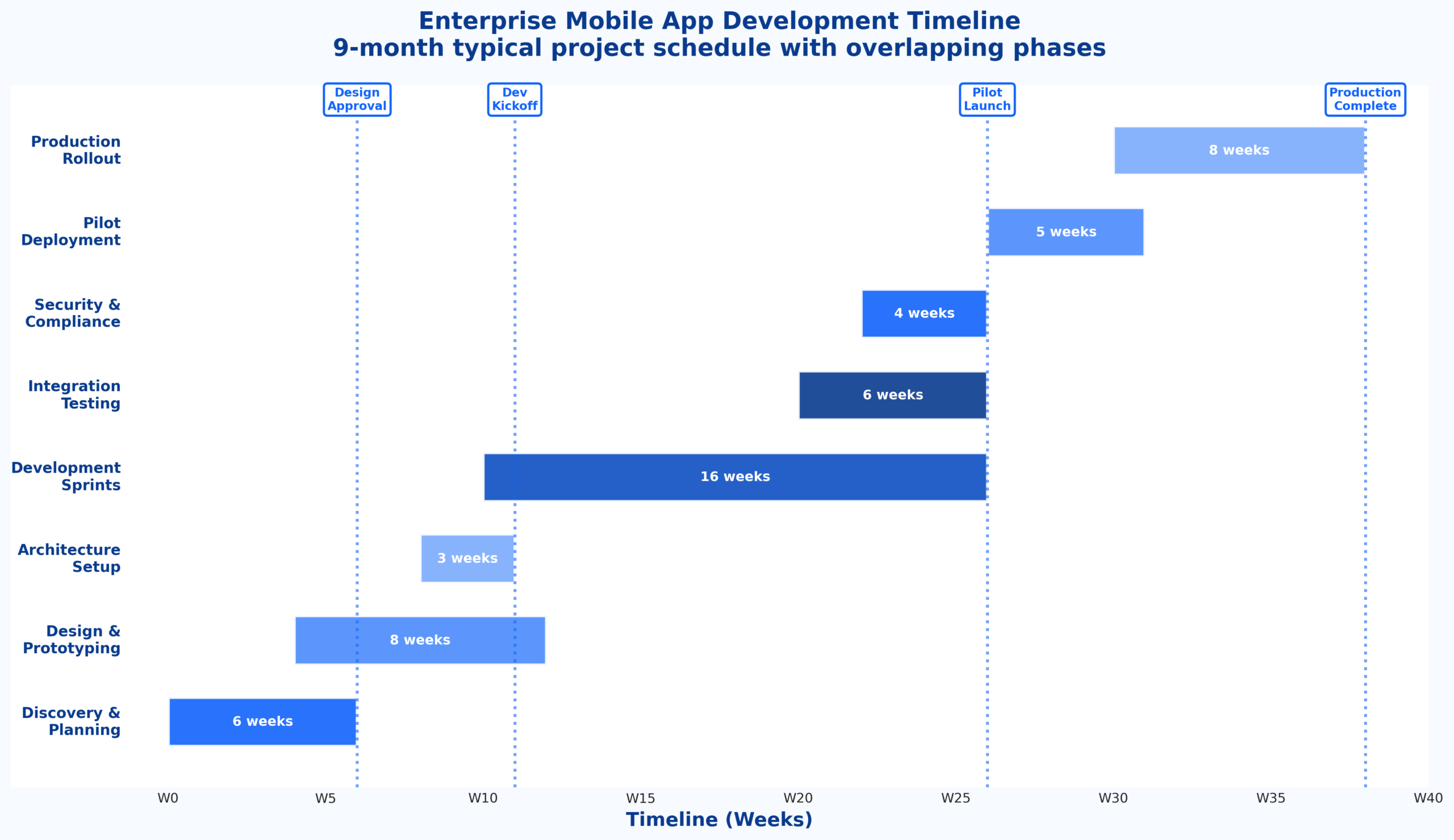
Enterprise mobile app development timeline phases:
- Discovery and Planning (4-6 weeks): Requirements workshops, user research, technical assessment, vendor selection
- Design and Prototyping (6-8 weeks): Information architecture, wireframes, high-fidelity designs, interactive prototypes, usability testing
- Architecture and Infrastructure (2-3 weeks): Technical architecture design, infrastructure provisioning, CI/CD setup, security framework
- Development and Integration (12-20 weeks): Sprint-based development, API integration, testing, security hardening
- QA and Security Testing (4-6 weeks): Functional testing, performance testing, penetration testing, compliance validation
- Pilot Deployment (4-6 weeks): Pilot user onboarding, monitoring, feedback collection, issue resolution
- Production Rollout (6-12 weeks): Phased departmental rollout, training delivery, change management, monitoring
Total timeline: 38-61 weeks (9-14 months) for comprehensive enterprise application. Acceleration opportunities: cross-platform frameworks (save 4-6 weeks), existing design systems (save 2-3 weeks), managed backend services (save 3-4 weeks), pre-built integration adapters (save 2-4 weeks per integration).
Future-Proofing Your Enterprise Mobile Investment
Emerging Technologies: AI, IoT, and Edge Computing
AI-first architecture dominates 2025 mobile enterprise applications. On-device machine learning (Core ML for iOS, ML Kit for Android) enables real-time predictions without cloud latency—visual quality inspection detecting manufacturing defects (95% accuracy), healthcare diagnostic assistance analyzing medical images, retail personalization providing product recommendations offline. Natural language processing powering voice-driven workflows for field workers, sentiment analysis for customer service apps, document understanding extracting structured data from invoices.
IoT integration transforms operational visibility. Manufacturing: real-time machine monitoring (vibration sensors, temperature sensors) feeding predictive maintenance apps. Logistics: asset tracking (GPS, BLE beacons) providing real-time shipment visibility. Healthcare: patient monitoring devices (glucose meters, blood pressure monitors) syncing to care coordination apps. Edge computing processes IoT sensor data locally, reducing cloud bandwidth 80-90% while enabling millisecond latency for time-critical decisions.
Preparing for Platform Evolution and Updates
iOS and Android release major versions annually (typically September) with breaking API changes requiring app updates. Preparation strategies: maintain SDK version compatibility matrix (support current + 2 previous versions), allocate 10-15% annual budget for platform updates, participate in beta programs (Apple/Google release betas 3 months early), modular architecture (update components independently), comprehensive automated testing (catch regressions immediately), deprecation planning (monitor platform announcements, migrate deprecated APIs proactively).
Third-party dependency management: audit dependencies quarterly (vulnerabilities, abandonware), maintain alternative vendor relationships (avoid single points of failure), contribute to open-source dependencies (influence direction, ensure maintenance), build abstraction layers (isolate vendor-specific code enabling replacement). Technology refresh cycles: mobile frameworks (3-4 years), backend platforms (5-7 years), databases (7-10 years), cloud infrastructure (continuously evolved by providers).
Measuring ROI and Success Metrics
| Metric Category | Example Measurements |
|---|---|
| Operational Efficiency | Task completion time reduction (%), manual data entry hours eliminated, process steps removed, approval cycle time reduction |
| Cost Reduction | Labor cost savings (hours × rate), printing/paper elimination, error correction cost reduction, overtime reduction |
| Revenue Impact | Sales cycle reduction (days), deal size increase (%), win rate improvement, customer lifetime value increase |
| User Satisfaction | Net Promoter Score (NPS), daily active users (DAU), feature adoption rate (%), support ticket reduction (%) |
| Compliance and Risk | Audit findings reduction, regulatory compliance score, data breach incidents, policy violation reduction |
Financial services ROI case study: Loan processing app investment $650K. Results measured at 12 months: processing time reduced 4 days to 6 hours (83% faster—30,000 loans annually × 3.75 days × $200/day labor = $22.5M value), customer satisfaction 72% to 91% (NPS +34 points), operational costs reduced $2.4M annually (eliminated manual data entry, reduced error correction, overtime elimination). Total quantified annual value: $24.9M. ROI: 3,730%. Payback period: 3.2 months. Five-year NPV: $122M.
Nadcab Labs: Enterprise Mobile App Development Services
With 500+ projects delivered across 10+ countries and 100-1600+ experts spanning blockchain, AI/ML, cloud infrastructure, and mobile development, Nadcab Labs transforms enterprise operations through scalable, secure mobile enterprise application platform solutions. Our proven enterprise mobile apps development methodology, agile practices, and global delivery model (Indian development centers + UK project management) have delivered measurable results: healthcare patient intake time reduced 60%, financial services loan processing accelerated 83%, manufacturing quality defects eliminated 40%.
Comprehensive app development for enterprise services: Native iOS/Android development (Swift, Kotlin), cross-platform solutions (React Native, Flutter), enterprise mobile application development (SAP, Oracle, Salesforce integration), cloud-native architecture (AWS, Azure, Google Cloud), AI/ML integration (TensorFlow, PyTorch, on-device inference), blockchain implementation (smart contracts, DApps, Web3), DevOps and CI/CD (automated testing, deployment pipelines), security and compliance (HIPAA, GDPR, SOC 2), custom enterprise app development, mobile enterprise software solutions, ongoing maintenance and evolution.
Contact Nadcab Labs for enterprise mobile application development services consultation. Receive comprehensive technical assessment, architecture recommendations, detailed cost estimates, and project timeline aligned with your business objectives.
Enterprise Mobile Development Success Framework
Enterprise mobile app development for 2026 demands strategic architecture selection, comprehensive risk management, realistic cost of building a mobile app budgeting, and measurable ROI planning. Organizations investing $500,000-$1 million in enterprise-grade applications must navigate complex integration requirements (legacy systems, modern APIs), stringent security standards (encryption, authentication, authorization), evolving compliance regulations (GDPR, HIPAA, industry-specific), and user experience excellence driving adoption. Many companies also build specialized apps for different industries. For example, businesses that target sports fans and teams often invest in custom platforms for live updates, fan engagement, and performance tracking. In such cases, sports app development helps brands create powerful mobile solutions for leagues, clubs, and sports communities
Success framework for enterprise mobile apps development:
- → Architecture selection aligned with requirements (native for performance-critical, cross-platform for cost efficiency, hybrid for content-focused applications)
- → Proven design patterns implementation (MVVM, microservices, API-first, cloud-native) enforcing maintainability and scalability
- → Proactive risk management through architecture reviews, security testing, integration validation, performance benchmarking
- → Comprehensive budgeting including development, integration, security, compliance, hidden costs, ongoing maintenance (15-20% annually)
- → ROI measurement through operational metrics (efficiency gains, cost reductions, revenue impact) demonstrating business value
- → Experienced partner selection capable of navigating enterprise mobile application development complexity (Nadcab Labs 500+ projects, 10+ countries)
The mobile enterprise application platform landscape evolves rapidly with AI-first architecture, edge computing, IoT integration, and cloud-native solutions reshaping development approaches. Organizations investing strategically in mobile app development for enterprise, architecting for scalability from inception, managing risks proactively, and maintaining agile evolution processes position themselves for sustainable competitive advantage in mobile-first business environments. Enterprise mobile application development services from proven partners like Nadcab Labs accelerate time-to-value while mitigating risks inherent in complex enterprise mobile apps development initiatives.
FAQ
Q1.What is the typical cost of building an enterprise mobile app in 2026?
Enterprise-grade mobile apps in 2025 cost $500,000-$1 million for comprehensive solutions. Basic apps (login, CRUD, reports) range $150K-$300K over 3-4 months. Intermediate apps (integrations, workflows, analytics) cost $300K-$600K over 5-7 months. Advanced apps (AI/ML, blockchain, AR/VR, complex integrations) require $600K-$1M+ over 8-12 months. Additional costs: security/compliance (+20-30%), legacy system integration ($30K-$150K per system), annual maintenance (15-20% of initial investment).
Q2.Should we choose native, cross-platform, or hybrid architecture for our enterprise mobile app?
Choose native (Swift/Kotlin) for performance-critical apps requiring complete device API access—AR/VR, real-time analytics, IoT integration ($500K-$1M, 6-9 months). Select cross-platform (React Native, Flutter) for business applications prioritizing cost efficiency and faster time-to-market—reduces costs 30-40%, delivers in 4-6 months ($300K-$600K). Consider hybrid/PWA for content-heavy apps with limited device requirements—fastest delivery 3-4 months ($150K-$300K) but restricted hardware access (60% versus 95-100% native).
Q3.How long does enterprise mobile app development typically take from planning to production?
Comprehensive enterprise mobile app development spans 9-14 months (38-61 weeks): Discovery and planning (4-6 weeks), design and prototyping (6-8 weeks), architecture and infrastructure (2-3 weeks), development and integration (12-20 weeks), QA and security testing (4-6 weeks), pilot deployment (4-6 weeks), phased production rollout (6-12 weeks). Acceleration possible with cross-platform frameworks (save 4-6 weeks), existing design systems (2-3 weeks), managed backend services (3-4 weeks), pre-built integration adapters (2-4 weeks per integration).
Q4.What are the biggest risks in enterprise mobile app development and how do we mitigate them?
Critical risks include scalability failures (monolithic architecture hitting limits at 5,000 users—mitigate with load testing at 3x peak, horizontal scaling design), integration surprises (undocumented legacy APIs extending timelines 2-4 months—mitigate with early proof-of-concept), security vulnerabilities (data breaches, compliance failures—mitigate with architecture reviews, penetration testing), poor user adoption (60% failure rate—mitigate involving end users in design, measuring adoption metrics weekly), budget overruns (25-40% average—mitigate with 20% contingency, monthly variance reviews, formal change control).
Q5.Should we build our enterprise mobile app in-house or outsource development?
In-house offers full control, knowledge retention, security comfort but faces challenges: competitive talent markets ($150K-$200K per senior developer), skills gaps, fixed costs, 3-6 month ramp-up. Outsourcing provides specialized expertise, faster time-to-market, 30-50% cost savings but requires managing communication overhead, timezone coordination, IP governance. Hybrid approach optimal: in-house product ownership (strategy, architecture) with outsourced execution (implementation, testing). Nadcab Labs’ model combines Indian development centers (cost efficiency, 100-1600+ experts) with UK project management (timezone alignment, quality oversight).
Q6.How do we integrate our enterprise mobile app with existing legacy systems like SAP or Oracle?
Modern integration patterns: RESTful APIs for real-time data exchange ($10K-$20K per system), GraphQL for efficient data fetching, message queues (RabbitMQ, Kafka) for asynchronous processing, webhooks for event-driven updates. Legacy systems (SOAP, custom protocols, mainframe) require specialized middleware costing $30K-$150K per integration due to complexity. Implementation requires: API documentation analysis, data transformation logic, comprehensive error handling, retry mechanisms, integration testing environment, fallback strategies for system unavailability. Common enterprise integrations: CRM (Salesforce, Dynamics), ERP (SAP, Oracle), HRIS (Workday, SuccessFactors).
Q7.How do we measure ROI and success of our enterprise mobile app investment?
easure across five categories: Operational efficiency (task completion time reduction %, manual data entry hours eliminated, process steps removed, approval cycle acceleration), cost reduction (labor savings, printing elimination, error correction cost reduction, overtime elimination), revenue impact (sales cycle reduction days, deal size increase %, win rate improvement, customer lifetime value growth), user satisfaction (Net Promoter Score, daily active users, feature adoption rate %, support ticket reduction), compliance and risk (audit findings reduction, regulatory compliance score, data breach incidents). Example: Financial services app—$650K investment achieved 83% faster processing, $2.4M annual operational savings, 3.2 month payback, $24.9M annual quantified value.
Explore Services
Related Services
Reviewed by

Aman Vaths
Founder of Nadcab Labs
Aman Vaths is the Founder & CTO of Nadcab Labs, a global digital engineering company delivering enterprise-grade solutions across AI, Web3, Blockchain, Big Data, Cloud, Cybersecurity, and Modern Application Development. With deep technical leadership and product innovation experience, Aman has positioned Nadcab Labs as one of the most advanced engineering companies driving the next era of intelligent, secure, and scalable software systems. Under his leadership, Nadcab Labs has built 2,000+ global projects across sectors including fintech, banking, healthcare, real estate, logistics, gaming, manufacturing, and next-generation DePIN networks. Aman’s strength lies in architecting high-performance systems, end-to-end platform engineering, and designing enterprise solutions that operate at global scale.