Ai Overview
Proper planning is essential A clear business strategy and roadmap are required before launching your MLM company. Choose a genuine and high-demand product that delivers real value to customers. Set a balanced pricing and commission structure to ensure sustainability and profitability. This means you will repurchase unused, marketable inventory from a quitting distributor for at least 90% of what they paid, for inventory bought in the last 12 months.
Launching your own multi-level marketing company is a serious business venture. It is not a quick or easy project, but with careful planning and a focus on legality and ethics, it is an achievable goal. This guide will walk you through the first and most critical phases of the process.
We will use simple, direct language to explain the steps that form the foundation of any successful MLM business. The insights here are informed by observing industry best practices over time, including the technical expertise required to build these companies, as seen in firms like Nadcab Labs, which has focused on developing software for network marketing and blockchain-based systems for over eight years.
Before you do anything else, you must clearly understand what you are building. Multi-level marketing is a business model where a company sells products directly to consumers through a network of independent distributors.
Distributors earn money in two primary ways:
It is essential to know the key difference between a legal MLM and an illegal pyramid scheme. The difference lies in the focus.
A Legal MLM makes its real money from selling actual, valuable products to end consumers. Recruitment is a method to build a larger sales force.
A Pyramid Scheme makes its money primarily from recruiting people who pay to join. The sale of products is either non-existent, minimal, or serves as a disguise for the recruitment focus.
The U.S. Federal Trade Commission and other global regulators are very clear on this point. A legitimate MLM’s success should depend on moving products to the public, not just on signing up new distributors. A simple test is to ask: “Would this product sell even if there was no business opportunity attached?” If the answer is no, you have a fundamental problem.
Read Also: What is MLM? Meaning, Types, Earnings, and Global Legality
Your product is not just an item you sell. It is the heart of your entire company. If the product is weak, your business will fail, no matter how clever your marketing or compensation plan might be.
You need to choose a product or service that people actually want, need, and will buy repeatedly. Look for these characteristics:
The best MLM products are used up and reordered. This creates reliable, recurring revenue. Think of vitamins, skincare serums, coffee, or household cleaners.
The product must work as promised. Your early customers and distributors will be your most important reviewers. If the quality is poor, word will spread fast and kill your reputation.
You should believe in what you are selling. Your genuine enthusiasm will be contagious and help you build a brand story.
The price must reflect the value and be competitive in the broader market, while still allowing room for your company’s costs and distributor commissions.
Avoid the trap of choosing a product solely because it has a huge profit margin. A high-margin, low-value item is a hallmark of a short-lived scheme. Ask yourself honestly: “Is this something I would buy with my own money, even if I wasn’t involved in the business?” Your answer should be a confident yes.
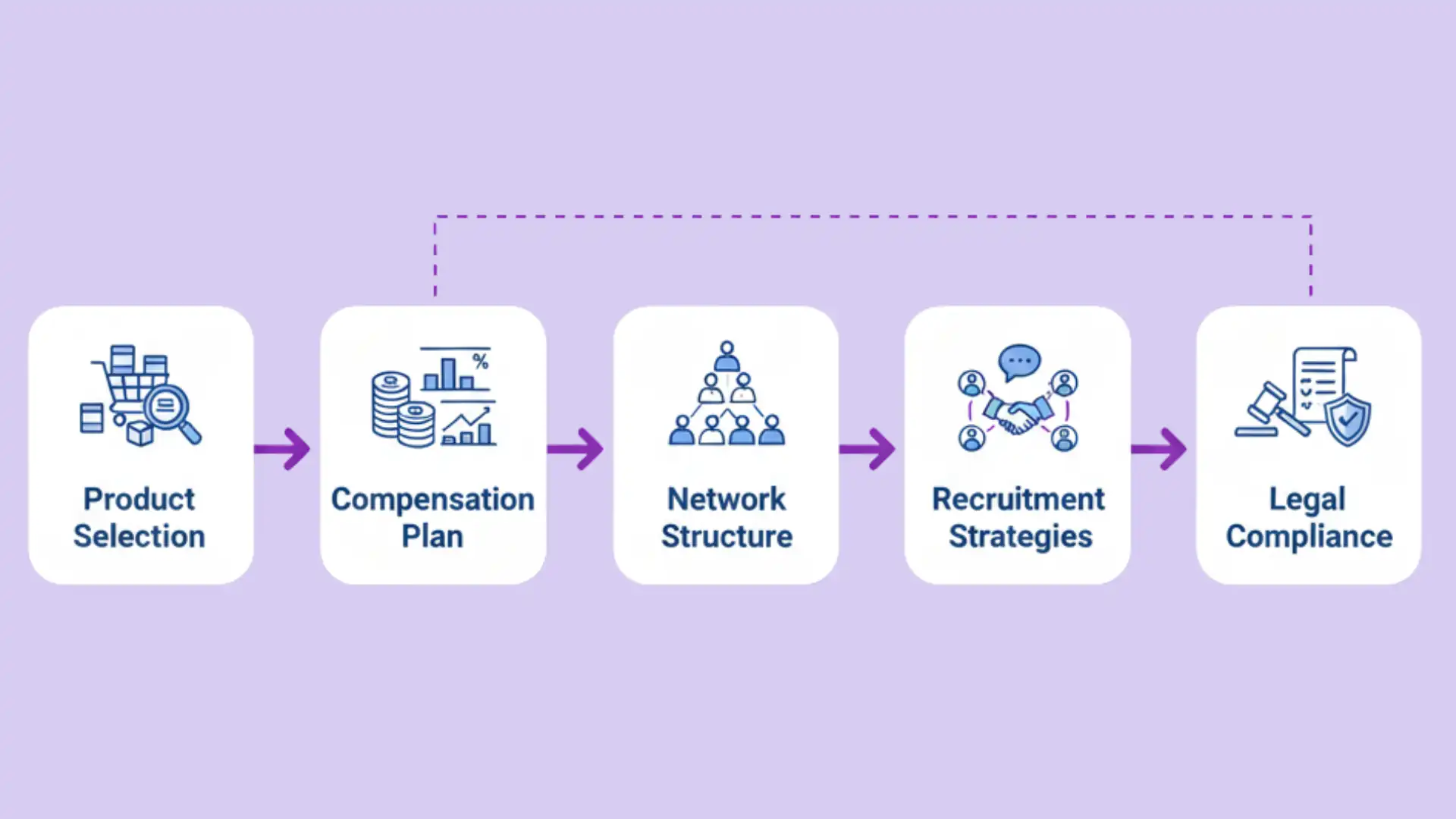
Once you have your product, you need to decide how your business will operate. This is your business model. It defines how sales happen and how your network will be structured.
First, decide on the sales method. Will distributors sell primarily online, at in-home parties, through one-on-one meetings, or a mix of all three? Your product type often decides this. For example, cosmetics often suit demonstration-based models, while educational courses work well online.
Next, and most critically, you must select your compensation plan structure. This is the rulebook for how distributors earn from team sales. Here are the most common types:
For most new companies, a Unilevel or simple Binary plan is often the most manageable to start. The plan must be mathematically sound. If it pays out too much in commissions relative to actual product revenue, the company will run out of money. This is where expertise in systems, like that developed over years at firms specializing in this area, becomes crucial to model and test the plan before launch.
This is the step you cannot afford to get wrong. Legal failures can end your business permanently and lead to personal financial ruin.
Do not operate as a sole proprietorship. Form a Limited Liability Company (LLC) or a Corporation. This legally separates you from the business, protecting your personal assets (like your home or savings) if the company is sued. Consult a business attorney to choose the best structure for your location and goals.
Obtain an Employer Identification Number (EIN) from the IRS. Understand that your distributors are independent contractors, not employees. You will not withhold taxes for them, but you must provide them with proper tax forms (like 1099s in the U.S.) if they earn over a certain amount.
This is a specialized field of law.
FTC Rules: You must have a buyback policy. This means you will repurchase unused, marketable inventory from a quitting distributor for at least 90% of what they paid, for inventory bought in the last 12 months. You must also ensure your income claims are truthful and typical for your distributors.
State Laws: In the United States, many states have specific “Business Opportunity” or “Pyramid Scheme” laws. Some, like Utah and Georgia, require specific disclosures in your distributor contract or even state registration. The Direct Selling Association website is a resource for understanding these landscapes.
International Laws: If you plan to sell in other countries, research is mandatory. For instance, the model is heavily restricted in Germany, and China has a completely separate set of direct selling regulations.
Hiring an attorney who specializes in direct selling law is not an expense. It is your most important startup investment. They will help you draft compliant distributor agreements and ensure your entire business model is built on solid legal ground from day one.
This is the one step in company registration you cannot afford to get wrong. Legal and compliance failures can permanently shut down your business and even put your personal finances at serious risk.
This is the most accessible start for a new founder. You find an established manufacturer with a proven product, and you put your own brand label on it.
Pros: Very low startup cost and inventory risk. Fast to launch. The supplier often handles fulfillment (drop-shipping).
Cons: Little control over formula or quality. Your product may be identical to other new brands. Profit margins are lower.
You work directly with a manufacturer to create a unique product from scratch.
Pros: Full control over quality, ingredients, and branding. Higher profit potential and true product differentiation.
Cons: High upfront costs for research, development, and minimum order quantities (MOQs). Long timeline to launch. Complex logistics.
For most first-time MLM founders, starting with a reputable white-label supplier is the most practical choice. It allows you to test the market and your operations with less capital at risk. Your focus at this stage should be on finding a supplier known for consistent quality and reliable delivery, not just the lowest price.
This is where your MLM business moves from a concept to a functioning system. Your price structure and compensation plan are the economic engine. They determine how money flows through your company, how your distributors earn, and ultimately, whether your business is sustainable or will collapse. Get this wrong, and nothing else will work.
First, you must establish your pricing. This is not guesswork. It is a calculated formula that must account for all costs and leave room for growth. Your pricing has three main layers:
A typical, sustainable structure for a consumable product might look like this:
This leaves a 15-20% buffer as the commissionable volume or pool from which all bonuses and override commissions are paid. This pool is sacred; if your costs creep too high, this pool vanishes, and you cannot pay your distributors.
Now, the Compensation Plan. This is the rulebook that defines how distributors earn from the commissionable volume. A plan must be attractive, understandable, and, above all, mathematically sound. A common mistake is creating a plan that pays out more than the company takes in, which is a fast path to bankruptcy.
You cannot run an MLM with spreadsheets and manual calculations. It is operationally impossible. Your software platform is the central nervous system of your company. It automates the complexity, ensures accuracy, and provides the interface for your entire network.
Choosing the right software is a decision that will define your daily operations for years. There are two main paths:
These are pre-built platforms where you subscribe to a monthly service. You configure your plan rules within their existing framework.
Pros: Faster and cheaper to launch. The provider handles updates, security, and hosting.
Cons: Limited customization. You must adapt your business model to their system’s capabilities. It may not scale elegantly with complex future plans.
This is a platform developed specifically for your company’s unique compensation plan and business processes.
Pros: Complete control. Perfect fit for your model. Can integrate deeply with other tools and scale without restriction.
Cons: Significant upfront investment (tens of thousands of dollars). Longer development time. You are responsible for maintenance, updates, and security.
For a new company, a robust off-the-shelf solution is usually the correct starting point. However, you must choose one that can handle your specific chosen plan (Unilevel, Binary, etc.) and has a proven track record.
The expertise required to implement and manage this software is substantial. Companies that have been in the technical space, such as Nadcab Labs with its focus on secure network marketing systems, understand that the software is not just a tool but the operational backbone. Security is paramount, as is the system’s ability to run commission cycles flawlessly. A single calculation error can destroy distributor trust instantly.
Your distributors are your partners, not your employees. Most will join with enthusiasm but limited experience. Your job is to equip them with the tools and knowledge to succeed ethically and effectively. Their success is your success.
This is their initial package. It can be digital, physical, or both.
Physical Kit (if used): Includes product samples, catalogs, order forms, and quick-start guides.
Digital Welcome Pack: This is more critical and cost-effective. It should include digital versions of all sales materials, access to the backoffice, and immediate entry into your training system.
This is not a single video. It is an organized curriculum that lives on a dedicated training portal or a secure section of your backoffice. Structure it in phases:
By providing a clear path and professional tools, you empower your distributors and build a culture of professionalism. This reduces attrition and increases the likelihood of product movement to real customers.
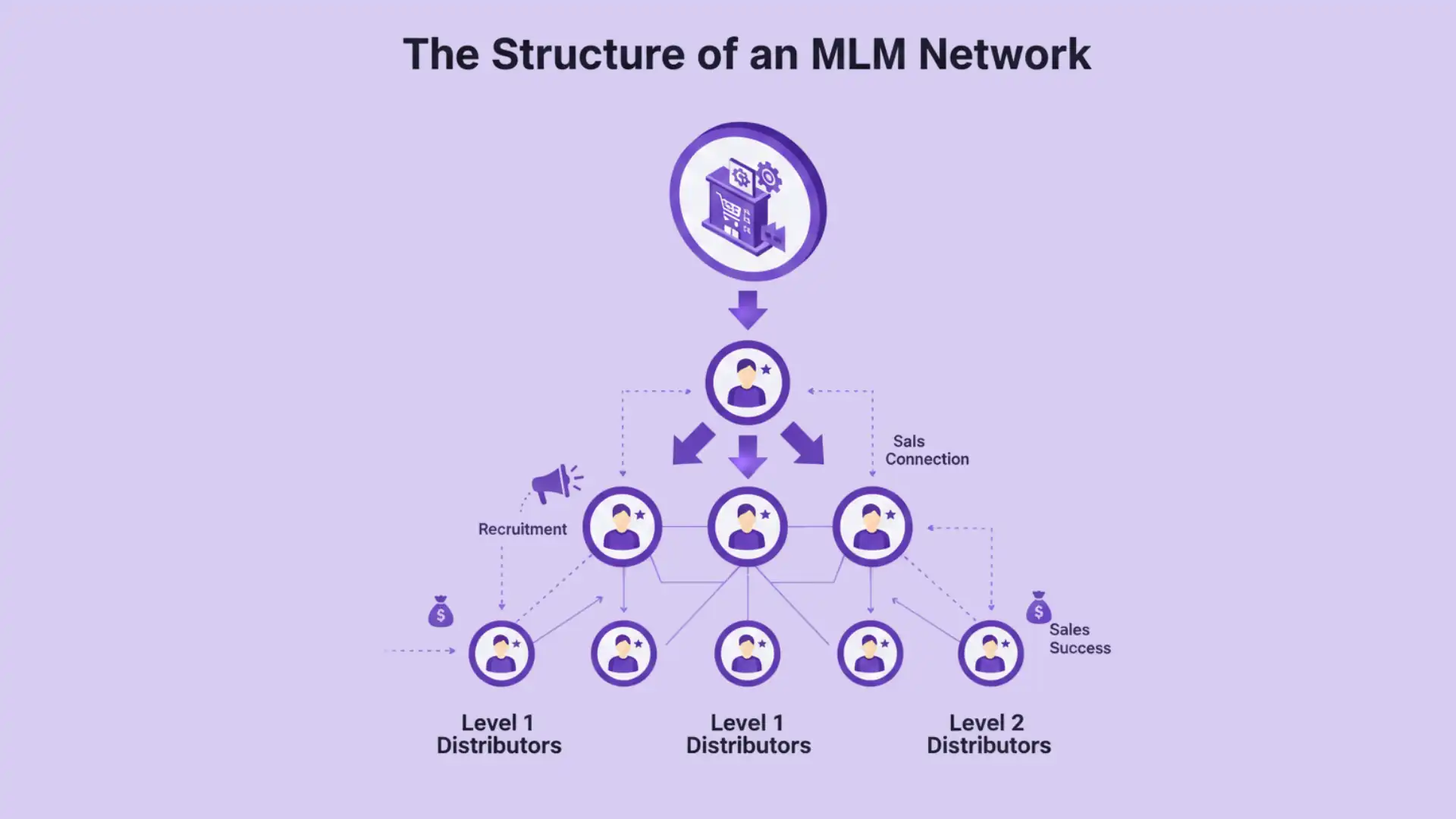
Your marketing must serve two distinct audiences: the end consumer and the potential distributor. The strategies for each are different, but they must both be grounded in authenticity and compliance.
This is about building a brand and moving inventory. Your goal is to create demand outside the distributor network.
This is about attracting the right kind of builders to your team. The primary marketers here should be your existing distributors, sharing their genuine experience.
Every piece of marketing must be structured to lead with the product or the authentic personal experience. Avoid get-rich-quick language. Show real people using real products. Highlight customer testimonials about the product more loudly than distributor testimonials about income.
By implementing these four pillars—a solvent compensation plan, a robust software system, comprehensive training, and strategic marketing—you transition your MLM from a theoretical framework into a living, breathing organization. These systems work together to create a professional environment where products can move, distributors can be rewarded fairly, and sustainable growth becomes possible. The focus is always on building a real business, not just a recruitment chain.
The launch is not the finish line. It is the starting gate. Your ongoing success depends entirely on what you do next. The period after launch is about shifting from building systems to building people. Your focus must move to training your network and fostering a genuine sense of community. This is what turns a fragile startup into a durable company.
Effective training does not stop with the initial welcome kit. It evolves. You must establish a rhythm of continuous education. This means moving past basic “how-to” videos and into developing real skills.
Create a monthly training calendar. Each month, focus on one core skill. For example, Month One could be “Mastering the Product Story.” Host two live workshops that month, breaking down how to talk about each product’s benefits in a natural, relatable way. Month Two could focus on “Introduction to Social Media Storytelling,” teaching distributors how to share their experience without resorting to spammy tactics. This structured approach prevents overwhelm and builds competency slowly.
The goal is to create self-sufficient leaders, not just followers. Identify your most engaged distributors early. Invest extra time in them. Teach them how to host their own team meetings, how to mentor new members, and how to troubleshoot common problems. When your leaders can train others, your growth becomes organic and scalable.
People stay for the community long after the initial excitement of the business opportunity fades. You must actively build this.
Start a private Facebook group or forum exclusively for your distributors. But do not let it become just a place for corporate announcements. Facilitate connection. Encourage distributors to post their wins, ask questions, and share support. Have leaders host weekly “office hours” there. Spotlight a “Distributor of the Week” to highlight effort, not just top sales.
Host regular virtual events. A monthly “All Hands” video call where you share company news, answer questions live, and recognize achievements makes people feel seen and valued. Consider an annual in-person convention when feasible. These gatherings transform online connections into real relationships, creating intense loyalty.
Ensure your platform is secure, scalable, and compliant before taking your network live.
Your most critical ongoing job is to constantly reinforce the company culture. In every communication, webinar, and policy, emphasize integrity, product focus, and mutual support. Quickly and publicly address any behavior that contradicts this, such as income hype or false product claims. Protecting your community’s culture is protecting your entire business.
Launching your own MLM company is a significant entrepreneurial journey. It is a path that demands more than just a good idea. It requires a commitment to legality, a belief in a real product, and a dedication to building people up.
This guide has walked you through the essential steps: from choosing a legitimate product and securing your legal foundation, to designing a sustainable compensation plan and implementing the necessary software. We have covered the importance of equipping your team with training and building a marketing strategy that focuses on genuine value.
The difference between a fleeting scheme and a lasting business is found in these details. It is in the choice to hire the lawyer, to model the compensation plan for sustainability, to invest in proper software, and to create a community that values ethics as much as earnings.
The leap is substantial. It requires capital, time, and resilience. But it is a leap you can make with confidence if you build on the solid groundwork outlined here. Do not rush. Focus on creating a company where the product is the hero, the distributors are respected partners, and the customer is always the final judge of your success.
Selecting your software is a decision that will define your operations for years. The true cost isn’t just the subscription fee; it’s the lost trust during a platform migration when you outgrow your initial system. This scalability challenge is a core focus at Nadcab Labs. With 8+ years of experience, we architect network marketing platforms to handle exponential growth from the start, ensuring the technical backbone never hinders your commercial vision.Your dream of MLM ownership is achievable. Approach it not as a way to get rich quick, but as a way to build a real brand, provide real value, and create real opportunities. That is the only foundation that lasts.
Frequently Asked Questions
Q1.What do I need to start my own MLM company?
To start your own MLM company, you need several foundational elements in place. These include a legitimate product or service, a legally compliant compensation plan, company registration such as an LLC or corporation, reliable MLM software, wholesale or manufacturing partners, and structured distributor training materials. Legal and technical preparation is essential before launch.
Q2.Is starting an MLM business legal?
Starting an MLM business is legal in many countries, including the United States, provided it follows strict regulations. A legal MLM must generate revenue primarily from product sales to end customers, not from recruitment fees. Compliance with FTC guidelines, truthful income claims, and buyback policies is mandatory for long-term legitimacy.
Q3.What is the difference between an MLM and a pyramid scheme?
The main difference between an MLM and a pyramid scheme lies in how money is earned. A legitimate MLM earns revenue from selling real products to consumers, while a pyramid scheme focuses mainly on recruiting new members who pay to join. Pyramid schemes are illegal and collapse quickly once recruitment slows.
Q4.How much does it cost to launch an MLM company?
The cost to launch an MLM company depends on product type, software choice, legal requirements, and marketing strategy. On average, startups spend between $10,000 and $100,000 or more. Major expenses include product sourcing, legal compliance, MLM software, branding, inventory, and initial marketing campaigns.
Q5.What is the best compensation plan for a new MLM company?
For new MLM companies, Unilevel and Binary compensation plans are often the most practical options. These plans are easier to explain, simpler to manage, and more adaptable during early growth stages. The best plan is one that is mathematically sustainable, compliant with regulations, and rewarding without overpaying commissions.
Q6.Do I need MLM software to run my business?
Yes, MLM software is essential for running a professional and scalable MLM business. It automates distributor enrollment, genealogy tracking, commission calculations, e-commerce orders, and reporting. Manual systems quickly become inaccurate and unmanageable as the network grows, leading to mistrust and operational failures.
Q7.Can I start an MLM business without holding inventory?
Yes, many MLM startups begin without holding physical inventory by using white-label or drop-shipping suppliers. In this model, products are shipped directly from the manufacturer to customers. This reduces upfront costs and inventory risk, making it a popular choice for first-time MLM founders.
Q8.How do MLM distributors make money?
MLM distributors earn income through two primary methods: retail profits from selling products to customers and commissions based on the sales volume generated by their recruited team. Ethical MLM businesses emphasize product sales first, ensuring income is tied to real customer demand rather than recruitment alone.
Q9.How can I keep my MLM business compliant with FTC rules?
To stay compliant with FTC rules, your MLM must focus on product sales, avoid exaggerated income claims, provide a buyback policy, and issue income disclosure statements. Distributors should be trained on what they can and cannot say when promoting the business or products to avoid legal violations.
Q10.How long does it take to build a successful MLM company?
Building a successful MLM company typically takes one to three years of consistent effort. This includes refining the compensation plan, training distributors, improving product awareness, and strengthening community engagement. Long-term success depends on ethical leadership, strong systems, and continuous support for distributors and customers.
Explore Services
Related Services
Reviewed by

Aman Vaths
Founder of Nadcab Labs
Aman Vaths is the Founder & CTO of Nadcab Labs, a global digital engineering company delivering enterprise-grade solutions across AI, Web3, Blockchain, Big Data, Cloud, Cybersecurity, and Modern Application Development. With deep technical leadership and product innovation experience, Aman has positioned Nadcab Labs as one of the most advanced engineering companies driving the next era of intelligent, secure, and scalable software systems. Under his leadership, Nadcab Labs has built 2,000+ global projects across sectors including fintech, banking, healthcare, real estate, logistics, gaming, manufacturing, and next-generation DePIN networks. Aman’s strength lies in architecting high-performance systems, end-to-end platform engineering, and designing enterprise solutions that operate at global scale.