Ai Overview
Decentralized Finance has transformed traditional financial services by removing intermediaries and enabling permissionless access to lending, borrowing, and trading. Blue-chip assets like ETH might require 133% collateralization (allowing 75% loan-to-value), while volatile altcoins might demand 200% or higher. These ratios determine when liquidations trigger, with most protocols initiating auctions when positions approach 110% to 120% collateralization, providing a safety margin before true insolvency.
Key Takeaways
- ▸ DeFi collateral auctions are automated mechanisms that liquidate undercollateralized positions to maintain protocol solvency and protect lenders from losses.
- ▸ Smart contracts execute the entire auction lifecycle without intermediaries, ensuring transparency, speed, and censorship resistance in collateral liquidation processes.
- ▸ Different auction models including Dutch auctions, English auctions, and fixed price liquidations each offer unique advantages for price discovery and efficiency.
- ▸ Liquidators play a critical role in maintaining protocol health by participating in auctions and receiving incentives through liquidation bonuses and penalty fees.
- ▸ Price oracles are essential components that provide accurate market pricing for triggering liquidations and determining fair collateral values during auctions.
- ▸ Overcollateralization ratios and liquidation thresholds vary across protocols, typically requiring 120% to 150% collateral coverage to buffer against market volatility.
- ▸ Market volatility presents significant risks to auction outcomes, potentially leading to bad debt accumulation when collateral values drop faster than liquidations can process.
- ▸ Major protocols like MakerDAO, Aave, and Compound have pioneered different approaches to collateral management and auction mechanisms, each with proven track records.
- ▸ Understanding liquidation penalties, gas costs, and timing considerations is crucial for participants seeking to profit from DeFi collateral auctions.
- ▸ Emerging innovations in auction design and cross-chain liquidation systems are shaping the future evolution of DeFi liquidation mechanisms.
Introduction to DeFi Collateral Auctions
Decentralized Finance has transformed traditional financial services by removing intermediaries and enabling permissionless access to lending, borrowing, and trading. At the core of this revolution lies a critical mechanism that ensures protocol stability and protects participant funds: DeFi collateral auctions. These automated systems serve as the backbone of risk management in decentralized lending protocols, maintaining the delicate balance between capital efficiency and security.
When borrowers deposit collateral to secure loans in DeFi protocols, they enter into trustless agreements governed by smart contracts. However, cryptocurrency markets are notoriously volatile, and collateral values can fluctuate dramatically within minutes. DeFi collateral auctions provide an elegant solution to this challenge by automatically liquidating undercollateralized positions, converting at-risk collateral into stable assets, and protecting lenders from potential losses. This mechanism operates continuously, 24/7, without human intervention or centralized oversight.
Understanding how these auctions function is essential for anyone participating in DeFi ecosystems, whether as a borrower managing collateral ratios, a lender assessing protocol safety, or a liquidator seeking profit opportunities. The sophistication of modern liquidation mechanisms reflects years of protocol evolution, incorporating lessons learned from market crashes, network congestion events, and innovative auction theory adapted for blockchain environments.
What Are Collateral Auctions in DeFi?
Collateral auctions in DeFi represent automated liquidation processes triggered when a borrower’s position falls below the required collateralization threshold. Unlike traditional finance where courts and intermediaries manage foreclosures and asset liquidations over weeks or months, DeFi collateral auctions execute within minutes through predetermined smart contract logic. These auctions convert seized collateral into the borrowed asset, restoring protocol solvency while minimizing losses for all participants.
The process begins when an oracle reports updated asset prices that push a borrowing position into undercollateralized territory. Smart contracts immediately flag this position as eligible for liquidation, making it visible to specialized network participants called liquidators. These liquidators compete to purchase the collateral at a discount, repaying the outstanding debt and earning a profit from the liquidation bonus. The entire sequence operates transparently on-chain, with all transactions publicly verifiable and irreversible once confirmed.
Different protocols implement varying auction mechanisms, but all share the common goal of quickly converting collateral to stable value while providing economic incentives for timely liquidations. The auction design must balance several competing objectives: maximizing recovered value for the protocol, providing fair opportunities for liquidators, minimizing losses for borrowers, and maintaining system stability during extreme market conditions. Achieving this balance requires sophisticated mechanism design informed by both economic theory and practical blockchain constraints.
Why Collateral Auctions Are Critical to DeFi Protocols?
The importance of collateral auctions extends far beyond simple debt recovery, forming the foundation of trust and stability in DeFi lending markets. Without effective liquidation mechanisms, protocols would quickly accumulate bad debt during market downturns, eroding lender confidence and potentially triggering death spirals where withdrawals exceed available liquidity. Collateral auctions prevent this scenario by ensuring that every loan remains adequately backed, even as market conditions fluctuate.
These auctions serve multiple stakeholders simultaneously. For lenders, they provide assurance that deposited funds remain protected against borrower default and market volatility. For borrowers, properly designed auction systems offer warnings and grace periods to add more collateral before liquidation occurs. For liquidators, auctions create profit opportunities that incentivize maintaining protocol health. For the broader protocol, successful auctions maintain the peg stability of stablecoins, preserve reserve ratios, and demonstrate system resilience during stress tests.
The track record of DeFi collateral auctions during major market events underscores their criticality. During the March 2020 crash, the May 2021 correction, and the 2022 bear market, well-designed auction systems processed billions in liquidations, preventing cascading failures and maintaining protocol solvency. Protocols with robust liquidation mechanisms emerged stronger, while those with weaknesses suffered exploits, insolvencies, or user flight. This real-world testing has refined auction designs and highlighted the non-negotiable importance of reliable liquidation infrastructure.
How DeFi Collateral Auctions Work Step by Step
The lifecycle of a DeFi collateral auction follows a systematic sequence that transforms undercollateralized positions into recovered assets. Understanding each step reveals the elegant interplay between price oracles, smart contracts, and economic incentives that makes decentralized liquidation possible.
Position Monitoring
Smart contracts continuously monitor all open borrowing positions, comparing the current collateral value against the debt value plus required overcollateralization buffer. This monitoring happens automatically with every oracle price update, typically occurring every few minutes or when price movements exceed specific thresholds. The system calculates health factors or collateralization ratios that determine position safety.
Liquidation Triggering
When a position’s health factor drops below the liquidation threshold, the smart contract marks it as liquidatable. This change in status makes the position visible to liquidators monitoring the protocol. Some systems implement grace periods or allow partial liquidations to minimize borrower losses, while others execute immediate full liquidations depending on the severity of undercollateralization.
Auction Initiation
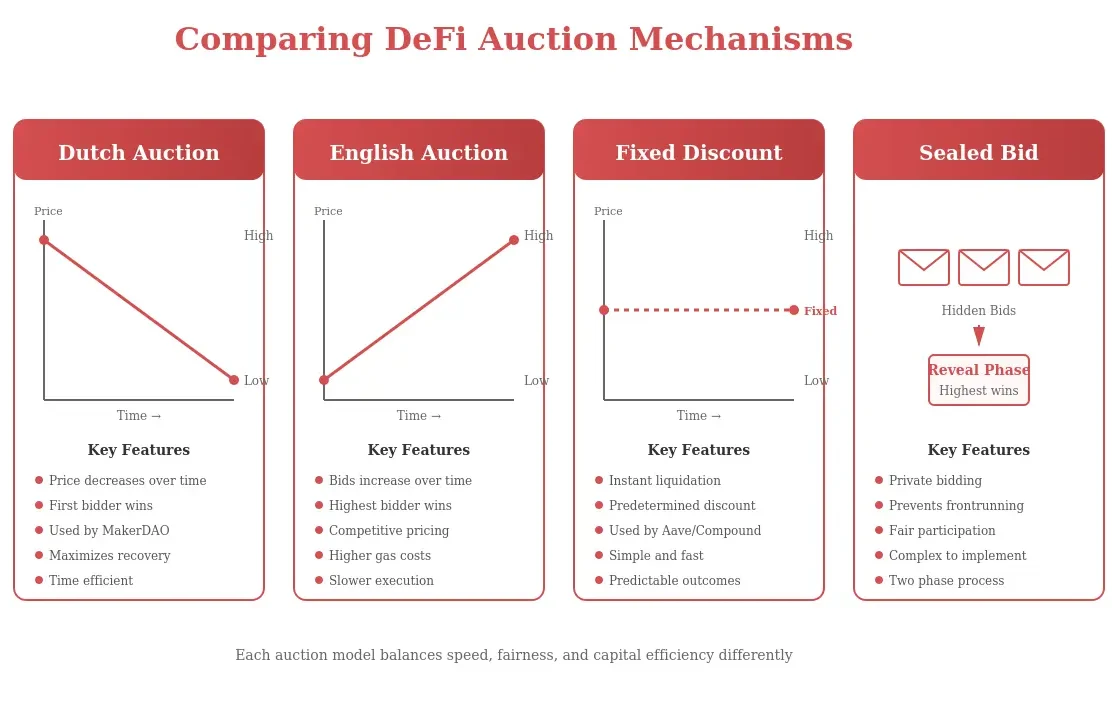
The protocol initiates an auction by announcing the available collateral, required debt repayment, and auction parameters. Different mechanisms handle this differently with Dutch auctions starting at high prices that decrease over time, English auctions accepting competing bids, or fixed discount systems offering immediate purchase at predetermined rates. The chosen mechanism significantly impacts liquidation speed and recovered value.
Liquidator Participation
Liquidators submit transactions to purchase the collateral, repaying the debt plus accrued interest. In competitive environments, liquidators employ sophisticated strategies including MEV (Maximum Extractable Value) techniques, flash loans for capital efficiency, and automated bots for rapid execution. The first successful transaction or highest bid wins the collateral depending on the auction model.
Settlement and Distribution
Upon successful liquidation, the smart contract transfers collateral to the liquidator, sends repaid debt back to the lending pool, distributes liquidation penalties between the protocol and liquidator, and closes or adjusts the borrower’s position. Any remaining collateral after debt repayment and penalties returns to the borrower, though in severe undercollateralization scenarios, borrowers may receive nothing.
Role of Digital Contracts in Collateral Auctions
Smart contracts serve as the autonomous enforcement mechanism that makes DeFi collateral auctions possible without centralized oversight. These self-executing programs encode all auction rules, liquidation logic, and settlement procedures directly into blockchain code, ensuring consistent application regardless of market conditions or participant identity. The trustless nature of smart contract execution eliminates counterparty risk and removes human discretion from the liquidation process.
Within the auction workflow, smart contracts handle multiple critical functions simultaneously. They monitor oracle feeds for price updates, calculate position health continuously, trigger liquidations when thresholds breach, validate liquidator transactions, verify sufficient repayment, transfer collateral ownership, distribute penalties, and update protocol accounting. All these operations occur atomically, meaning either the entire liquidation succeeds or completely reverts, preventing partial executions that could leave the protocol in an inconsistent state.
The immutability and transparency of smart contracts provide crucial benefits for auction integrity. Participants can audit the exact liquidation logic before engaging with a protocol, understanding precisely how their collateral might be liquidated under various scenarios. This transparency builds confidence in DeFi systems, as users need not trust a company’s promises but can verify the mathematical certainty of smart contract execution. However, this same immutability means bugs or design flaws in liquidation contracts can have catastrophic consequences, making thorough auditing and testing essential.
Gas efficiency represents a critical consideration for liquidation smart contracts. During network congestion, high transaction fees can make small liquidations unprofitable, potentially leaving positions unliquidated and accumulating bad debt. Well-designed contracts optimize gas consumption through efficient data structures, batch processing where possible, and careful selection of computational operations. Some protocols implement keeper networks or privileged liquidators to ensure liquidations proceed even when gas prices spike dramatically.
Types of Collateral Used in DeFi Auctions
DeFi protocols accept diverse collateral types, each presenting unique liquidation challenges and opportunities. The choice of accepted collateral significantly impacts protocol risk profiles, capital efficiency, and auction dynamics. Understanding collateral characteristics helps participants assess liquidation risks and opportunities across different protocols.
Blue-Chip Cryptocurrencies. Major assets like Bitcoin (wrapped as WBTC) and Ethereum dominate DeFi collateral due to their deep liquidity, established price discovery, and relatively stable valuations compared to smaller tokens. These assets typically command the highest loan-to-value ratios because liquidators can easily convert them to stablecoins during auctions without significant slippage. Their widespread acceptance across protocols also enables efficient liquidation strategies using flash loans and cross-protocol arbitrage.
Stablecoins as Collateral. Using stablecoins like USDC or DAI as collateral might seem counterintuitive, but protocols accept them to enable leveraged trading strategies and cross-currency borrowing. Stablecoin collateral carries lower liquidation risk due to minimal price volatility, allowing higher leverage ratios. However, smart contract vulnerabilities, depeg events, or regulatory actions affecting specific stablecoins can trigger mass liquidations despite nominal price stability.
Governance and Utility Tokens. Protocol governance tokens and DeFi utility tokens increasingly serve as collateral, enabling token holders to maintain exposure while accessing liquidity. These assets typically require higher overcollateralization due to elevated volatility and potentially thin liquidity. Liquidating large governance token positions can impact the collateral’s own price, creating recursive pricing challenges that sophisticated auction designs must address.
Liquid Staking Derivatives. Assets like stETH, rETH, and other liquid staking tokens represent a growing collateral category combining base asset exposure with staking yields. These derivatives introduce unique liquidation considerations including price discounts relative to underlying assets, withdrawal periods that may delay final settlement, and smart contract risks specific to the staking protocol. Auctions must account for these factors when pricing liquidated positions.
LP Tokens and Synthetic Assets. Liquidity provider tokens from automated market makers and synthetic assets tracking commodities or stocks represent more exotic collateral types. These assets present liquidation challenges including complex pricing mechanisms, potentially illiquid secondary markets, and smart contract dependencies. Protocols accepting such collateral typically implement specialized auction mechanisms and stricter collateralization requirements to manage associated risks.
Overcollateralization and Liquidation Thresholds
Overcollateralization forms the safety buffer protecting DeFi protocols from volatile market swings and sudden collateral devaluations. By requiring borrowers to deposit collateral worth significantly more than their loan amount, protocols create cushions that absorb price movements before positions become truly insolvent. The precise overcollateralization ratio represents a delicate balance between capital efficiency for borrowers and safety margins for lenders.
Most DeFi lending protocols implement tiered collateralization requirements based on asset risk profiles. Blue-chip assets like ETH might require 133% collateralization (allowing 75% loan-to-value), while volatile altcoins might demand 200% or higher. These ratios determine when liquidations trigger, with most protocols initiating auctions when positions approach 110% to 120% collateralization, providing a safety margin before true insolvency. The spread between maximum borrowing capacity and liquidation threshold incentivizes borrowers to maintain healthy positions.
Liquidation thresholds must account for multiple risk factors beyond simple price volatility. Network congestion can delay liquidation transactions, allowing positions to become more deeply underwater before resolution. Oracle latency means smart contracts operate on slightly stale price data, potentially missing rapid price movements. Market liquidity considerations affect how much collateral liquidators can profitably purchase, with illiquid assets requiring wider safety margins. Protocols must also consider correlated liquidation cascades where widespread liquidations of one asset depress its price further, triggering additional liquidations in a negative feedback loop.
Dynamic collateralization represents an emerging approach where protocols adjust requirements based on real-time market conditions. During high volatility periods, thresholds might tighten automatically, requiring borrowers to maintain higher buffers or face earlier liquidations. Conversely, stable market periods might allow reduced margins, improving capital efficiency. Some protocols implement credit delegation or undercollateralized borrowing for trusted users, though these systems require robust reputation mechanisms and typically limit exposure to prevent systemic risk.
Auction Models Used in DeFi Protocols
Different auction mechanisms offer distinct tradeoffs regarding speed, fairness, capital efficiency, and recovered value. Protocol designers select auction models based on their priorities and the characteristics of accepted collateral. Understanding these models helps participants choose protocols aligned with their risk preferences and provides insights into likely liquidation outcomes.
| Auction Model | Mechanism | Advantages | Disadvantages |
|---|---|---|---|
| Dutch Auction | Price starts high and decreases over time until a liquidator accepts | Maximizes recovered value, incentivizes quick liquidation, simple to implement | Can take longer during low liquidity, vulnerable to timing manipulation |
| English Auction | Competing bids increase price until auction closes | Price discovery through competition, potentially higher recovery | Slower process, requires multiple transactions, higher gas costs |
| Fixed Discount | Immediate liquidation at predetermined discount rate | Extremely fast, predictable for borrowers, low complexity | May not optimize recovery value, can favor well-connected liquidators |
| Sealed Bid | Liquidators submit private bids, highest bid wins | Prevents frontrunning, fair for all participants | Complex implementation, requires reveal phase, slower execution |
Dutch Auctions in Detail. The Dutch auction model, popularized by protocols like MakerDAO, begins with collateral priced above market rates and gradually decreases the price following a predetermined curve. Liquidators monitor these auctions and execute purchases when the discounted price makes the transaction profitable after accounting for gas fees, capital costs, and market risk. This mechanism naturally finds the market-clearing price while incentivizing rapid liquidation to minimize protocol exposure to bad debt.
Fixed Discount Systems. Protocols like Compound and Aave implement fixed liquidation bonuses, offering immediate purchase of collateral at a predetermined discount, typically 5% to 10%. This approach prioritizes speed over optimal price recovery, accepting slightly worse outcomes in exchange for certainty and simplicity. Liquidators compete through transaction speed rather than pricing, often employing sophisticated MEV strategies to capture profitable liquidations first.
Hybrid Approaches. Some protocols combine auction mechanisms, starting with fixed discounts for small liquidations but transitioning to Dutch auctions for larger positions. Others implement partial liquidations where only enough collateral to restore health is auctioned, allowing borrowers to retain maximum collateral. These hybrid systems attempt to balance competing objectives but introduce additional complexity that must be carefully managed to avoid unexpected behaviors during extreme market conditions.
Lifecycle of a DeFi Collateral Auction
The complete auction lifecycle encompasses multiple phases from position monitoring through final settlement. Each phase presents distinct technical requirements, economic incentives, and potential failure modes that protocol designers must address to ensure reliable liquidation operations.
Pre-Liquidation Monitoring Phase. Before liquidation triggers, protocols continuously track position health using oracle price feeds. Advanced systems implement early warning mechanisms notifying borrowers via on-chain events or off-chain notification services when positions approach danger zones. Some protocols offer automated collateral top-up services or allow users to preset liquidation preferences, attempting to minimize forced liquidations through proactive position management.
Liquidation Initiation Phase. Upon threshold breach, smart contracts transition positions to liquidatable status and emit on-chain events that liquidator bots monitor. This phase is time-critical, as the protocol becomes exposed to potential losses while positions remain unliquidated. Network congestion during this phase poses significant risks, potentially preventing liquidation transactions from confirming quickly enough to prevent bad debt accumulation.
Active Auction Phase. During the auction itself, liquidators compete to acquire collateral under the protocol’s chosen mechanism. This phase exhibits intense competition in mature protocols, with sophisticated liquidators employing flash loans, advanced DeFi strategies, and priority gas fees to capture profitable opportunities. The auction phase must balance providing adequate time for fair participation against minimizing the window of protocol exposure to collateral volatility.
Settlement and Post-Liquidation Phase. After successful liquidation, smart contracts settle all transfers atomically, updating protocol accounting, distributing penalties, and closing or adjusting the borrower’s position. Post-liquidation, protocols must handle edge cases including partial liquidations that leave positions open, situations where liquidation proceeds fail to cover debt, and mechanisms for handling any surplus collateral that should return to borrowers. Proper settlement design prevents accounting errors that could compromise protocol integrity.
Liquidation Failure Scenarios. Not all auctions succeed, particularly during extreme market conditions. Failed liquidations where no liquidator finds the terms acceptable can leave protocols holding underwater positions. Some systems implement backstop mechanisms like protocol-owned liquidator bots, treasury purchases, or debt socialization across all lenders as last resorts. Understanding these failure modes helps participants assess tail risks in different protocols.
Popular DeFi Protocols Using Collateral Auctions
Several prominent protocols have pioneered different approaches to collateral liquidation, collectively processing hundreds of billions in auction volume. Examining these implementations reveals diverse design philosophies and the practical tradeoffs inherent in liquidation mechanism selection.
MakerDAO and the Collateral Auction System. As the pioneering DeFi lending protocol, MakerDAO developed sophisticated auction mechanisms that have evolved through multiple iterations. The protocol’s Liquidations 2.0 system implements Dutch auctions with exponentially decreasing prices, optimizing for capital efficiency while maintaining safety. MakerDAO’s multi-collateral approach requires managing auctions across diverse asset types, each with customized parameters reflecting risk profiles. The protocol has processed over $10 billion in liquidations, providing extensive real-world validation of the auction design.
Aave’s Liquidation Incentive Structure. Aave employs a fixed liquidation bonus model where liquidators receive predetermined discounts when repaying debt and seizing collateral. The protocol allows partial liquidations, enabling liquidators to repay up to 50% of the borrowed amount to restore position health. This approach minimizes borrower losses while ensuring positions receive attention before becoming completely insolvent. Aave’s massive TVL (Total Value Locked) and battle-tested implementation demonstrate the viability of fixed discount mechanisms at scale.
Compound’s Efficient Liquidation Model. Compound pioneered the “instant liquidation” model where any user can immediately liquidate undercollateralized positions at a fixed discount, typically 8%. This simplicity has made Compound extremely robust during market turmoil, with liquidations processing smoothly even during the highest network congestion. The protocol’s permissionless liquidator participation ensures competitive markets and efficient capital allocation, though concerns about MEV extraction and fairness remain active research areas.
Venus Protocol and Cross-Chain Considerations. Operating on BNB Chain, Venus demonstrates how liquidation mechanisms adapt to different blockchain environments with varying transaction costs and finality guarantees. Lower gas fees on BNB Chain enable profitable liquidation of smaller positions uneconomical on Ethereum, while faster block times reduce the window for price manipulation. Cross-chain protocols face unique challenges coordinating liquidations across multiple networks with different security assumptions.
Incentives for Liquidators and Bidders
Liquidators form the crucial workforce maintaining DeFi protocol health, and their participation depends on carefully calibrated economic incentives. Understanding liquidator economics reveals why certain positions liquidate quickly while others languish, and how protocols can optimize incentive structures to ensure reliable liquidation services.
Liquidation Bonuses and Penalty Distribution. Most protocols reward liquidators with bonuses ranging from 3% to 15% of the liquidated collateral value. These bonuses compensate liquidators for capital risk, gas costs, oracle risk, and opportunity costs of deploying capital in liquidation operations rather than other yield opportunities. The bonus percentage typically scales with collateral risk, with volatile or illiquid assets commanding higher incentives to ensure liquidator interest even during difficult market conditions.
Capital Requirements and Flash Loan Strategies. Professional liquidators must balance capital efficiency against opportunity capture. Large liquidations might require millions in capital, but flash loans enable liquidators to borrow necessary funds within the same transaction, execute the liquidation, repay the loan plus fees, and pocket the net profit. This innovation dramatically lowered barriers to liquidator participation, transforming liquidation from a capital-intensive business to one accessible to anyone with sufficient technical skill and transaction execution speed.
Gas Wars and MEV Considerations. During volatile periods, profitable liquidations attract intense competition leading to “gas wars” where liquidators bid up transaction fees to ensure priority inclusion. This competition can push gas costs to hundreds or thousands of dollars per transaction, making only the largest liquidations profitable. MEV strategies including frontrunning, backrunning, and sandwich attacks further complicate liquidator economics, with sophisticated operators capturing value through transaction ordering manipulation.
Risks Faced by Liquidators. Liquidation is not risk-free profit. Liquidators face several risks including price slippage when converting acquired collateral to stablecoins, oracle manipulation attacks that make apparently profitable liquidations unprofitable, failed transactions that waste gas fees, and regulatory uncertainty around liquidation activities. Successful liquidators must carefully model these risks and only pursue opportunities with sufficient safety margins to remain profitable across many transactions.
Price Oracles and Fair Market Pricing
Price oracles serve as the bridge connecting DeFi protocols to real-world market data, making them absolutely critical to liquidation mechanism integrity. The quality, reliability, and manipulation resistance of oracle systems directly determines whether liquidations trigger appropriately and whether auction pricing reflects true market values. Understanding oracle mechanics is essential for assessing protocol safety and liquidation fairness.
Oracle Types and Trade-offs. DeFi protocols employ various oracle approaches including centralized price feeds from providers like Chainlink, decentralized oracle networks aggregating multiple sources, on-chain automated market maker prices from protocols like Uniswap, and time-weighted average prices (TWAPs) that smooth out short-term volatility. Each approach offers different balances of latency, accuracy, manipulation resistance, and cost. Centralized oracles provide fast updates but introduce trust assumptions, while on-chain oracles eliminate off-chain dependencies but may lag market reality during rapid moves.
Oracle Update Frequency and Liquidation Fairness. The frequency of oracle updates creates tension between cost efficiency and liquidation fairness. More frequent updates increase operational expenses and network load but reduce the window for price manipulation and ensure liquidations reflect current market conditions. Many protocols update oracles every 1-5 minutes under normal conditions, with more frequent updates triggered by large price movements. This approach balances cost against accuracy while protecting borrowers from unjust liquidations based on stale prices.
Oracle Manipulation and Security. Oracle systems represent attractive attack vectors where manipulating reported prices enables profitable liquidation of healthy positions or prevents liquidation of insolvent ones. Famous oracle manipulation attacks have drained millions from DeFi protocols through flash loan price manipulation, exploiting low-liquidity price feeds, or compromising off-chain infrastructure. Robust oracle design employs multiple data sources, excludes easily manipulated markets, implements maximum price change limits, and uses cryptographic proofs to verify data integrity.
Fallback Mechanisms and Circuit Breakers. Well-designed protocols implement circuit breakers that pause liquidations if oracle systems behave anomalously, preventing cascading liquidations from erroneous data. Fallback oracles provide redundancy if primary systems fail, while sanity checks compare oracle prices against reasonable bounds. These safety mechanisms add complexity but proved crucial during incidents where oracle failures might otherwise have caused massive inappropriate liquidations and user losses.
Risks and Challenges of DeFi Collateral Auctions
Despite sophisticated designs, DeFi collateral auctions face numerous risks and challenges that can lead to suboptimal outcomes, user losses, or even protocol failures. Understanding these risks helps all participants make informed decisions and highlights areas requiring continued innovation and improvement.
Network Congestion and Failed Liquidations. Ethereum’s variable transaction throughput creates scenarios where urgent liquidations cannot process due to network congestion. During the March 2020 crash, gas prices spiked above 200 gwei, making smaller liquidations unprofitable while larger positions faced delayed execution. Failed liquidations accumulate as bad debt, eventually requiring protocol treasury interventions or debt socialization across all users. Layer 2 solutions and alternative chains partially address this but introduce their own technical challenges and security tradeoffs.
Liquidation Cascades and Death Spirals. Correlated liquidations create dangerous feedback loops where large position liquidations depress collateral prices, triggering additional liquidations that further suppress prices. These cascades can rapidly transform manageable liquidation events into systemic crises. Protocols must carefully calibrate liquidation parameters, implement partial liquidation mechanisms, and maintain adequate safety buffers to prevent cascades. However, no design perfectly eliminates cascade risk, particularly for less liquid collateral assets.
Smart Contract Vulnerabilities. Liquidation contracts represent attractive targets for exploits given the value they control and their complexity. Bugs in liquidation logic have enabled attackers to steal funds, block legitimate liquidations, or manipulate auction outcomes. Thorough auditing, formal verification, bug bounties, and gradual rollouts with caps help mitigate these risks, but the rapid pace of DeFi innovation means new untested code constantly enters production, maintaining inherent risk levels.
Centralization Risks in Liquidator Networks. While theoretically permissionless, practical liquidation often concentrates among sophisticated operators with technical expertise, capital access, and proprietary strategies. This centralization raises concerns about censorship resistance, fair access to liquidation opportunities, and single points of failure if major liquidators experience technical issues. Some protocols attempt to address this through keeper networks, privileged liquidators, or dutch auction mechanisms that naturally decentralize participation over time.
Impact of Market Volatility on Auction Outcomes
Market volatility profoundly affects liquidation mechanisms, testing their robustness and revealing design weaknesses that remain hidden during calm periods. The relationship between volatility and auction outcomes determines whether protocols maintain solvency during crises or accumulate bad debt that threatens their survival.
Volatility Clustering and Liquidation Timing. Cryptocurrency markets exhibit volatility clustering where calm periods suddenly give way to extreme turbulence. This characteristic challenges liquidation systems designed for average conditions. During volatility spikes, collateral values can drop 20% to 50% within hours, leaving insufficient time for gradual liquidations. Protocols must maintain larger safety buffers during volatile regimes, but predicting regime changes remains difficult, creating inherent tradeoffs between capital efficiency and safety.
Liquidity Evaporation During Crashes. Market makers and liquidity providers often withdraw during extreme volatility, precisely when liquidators most need deep markets to convert collateral. This liquidity evaporation forces liquidators to accept larger price impacts, reducing net proceeds from auctions and potentially rendering some liquidations unprofitable. Protocols integrating with multiple decentralized exchanges and implementing smart order routing can partially mitigate this, but cannot eliminate the fundamental challenge of reduced market depth during stress.
Correlation Between Collateral Assets. Many DeFi protocols accept multiple collateral types, but these assets often correlate positively during downturns. When ETH crashes, most DeFi tokens crash harder, meaning liquidations of multiple collateral types occur simultaneously, straining liquidator capital and exchange liquidity. This correlation amplifies systemic risk and means diversified collateral provides less protection than might appear from historical volatility analysis during normal times.
Historical Liquidation Events and Lessons. Major market crashes provide valuable natural experiments revealing protocol resilience. The March 2020 crash saw MakerDAO accumulate $4 million in bad debt due to zero-bid auctions during network congestion. The May 2021 correction tested newer protocols, with most performing well but some experiencing oracle issues. The 2022 bear market’s sustained volatility stressed protocols differently than flash crashes, revealing vulnerabilities in long-term position management. Each event drives improvements in liquidation design, though new protocols must often learn these lessons firsthand.
Best Practices for Participating in Collateral Auctions
Successfully participating in DeFi collateral auctions requires technical knowledge, risk management discipline, and understanding of market dynamics. Whether acting as a borrower managing liquidation risk or a liquidator seeking profit opportunities, following best practices significantly improves outcomes.
For Borrowers: Maintaining Healthy Positions. Borrowers should maintain collateralization ratios well above liquidation thresholds, typically targeting 200% or higher for volatile assets. Setting up automated alerts for approaching liquidation levels, maintaining buffer stablecoins for quick collateral additions, and understanding exactly how the protocol calculates health factors prevents surprise liquidations. During high volatility, consider reducing leverage proactively rather than waiting for forced liquidation that guarantees losses through penalties.
For Liquidators: Risk Assessment and Execution. Prospective liquidators must thoroughly understand target protocol mechanics, develop automated monitoring systems to detect opportunities quickly, secure access to sufficient capital or flash loan arrangements, and implement robust execution strategies handling failed transactions and gas price volatility. Starting with well-established protocols featuring high liquidity and moving to more specialized markets as expertise develops provides a learning curve that manages risk while building capabilities.
Technical Infrastructure Requirements. Serious liquidation operations require dedicated infrastructure including multiple RPC endpoints for redundancy, sophisticated transaction management handling nonce conflicts and gas estimation, integrated monitoring across protocols and blockchains, and automated systems making split-second decisions without human intervention. Cloud infrastructure with low latency connections to blockchain nodes provides competitive advantages in time-sensitive liquidation races.
Understanding Protocol-Specific Nuances. Each protocol implements unique liquidation mechanics, from partial liquidation limits to collateral-specific parameters to gas optimization strategies. Thoroughly reading protocol documentation, studying smart contract code, testing strategies on testnets, and starting with small liquidations builds the protocol-specific knowledge necessary for profitable operations. Joining protocol Discord channels and following governance discussions provides early warning of parameter changes affecting liquidation strategies.
Regulatory Perspective on DeFi Liquidation Mechanisms
As DeFi grows in scale and mainstream adoption, regulatory attention increasingly focuses on liquidation mechanisms and their consumer protection implications. Understanding the evolving regulatory landscape helps protocols design compliant systems while maintaining decentralization benefits, and helps users assess regulatory risks affecting their participation.
Consumer Protection Considerations. Regulators across jurisdictions express concerns about whether DeFi liquidations provide adequate consumer protections compared to traditional finance. Issues include lack of pre-liquidation warnings, absence of grace periods or workout arrangements, automated execution without human oversight, and potentially opaque calculations determining liquidation timing. Protocols implementing voluntary consumer protection features like notification systems, longer liquidation windows, or partial liquidations may preempt regulatory mandates while improving user experience.
Market Manipulation and Fairness Rules. Oracle manipulation, front-running liquidations, and MEV extraction raise questions about market fairness and manipulation applicable to DeFi auctions. Securities regulators consider whether activities like liquidating positions through coordinated price manipulation constitute illegal market manipulation, even when executed through smart contracts rather than traditional trading. Clear documentation of liquidation mechanics and manipulation-resistant oracle designs help demonstrate good faith efforts to maintain fair markets.
Cross-Border Liquidation Challenges. DeFi’s global, permissionless nature creates regulatory ambiguity about jurisdiction when liquidations involve participants across multiple countries. Questions arise about which laws govern auction processes, where liquidation services are “provided,” and which regulator has authority over disputes. Protocols must navigate these uncertainties carefully, potentially implementing geographic restrictions or obtaining licenses in key jurisdictions, though such measures conflict with decentralization ideals.
Future Regulatory Developments. Ongoing regulatory developments will shape liquidation mechanism evolution. Proposed frameworks like MiCA in Europe and various US legislative efforts include provisions affecting DeFi operations. Protocols should monitor these developments closely, participate in policy discussions where appropriate, and design systems with regulatory flexibility enabling adaptation to new requirements without complete redesigns. Proactive compliance and regulatory engagement position protocols favorably compared to reactive approaches after enforcement actions.
Future of Collateral Auctions in DeFi
Collateral auction mechanisms continue evolving as protocols learn from past events, researchers propose innovations, and new technologies enable previously impossible designs. Several trends point toward the future direction of DeFi liquidation systems, promising improved efficiency, fairness, and resilience.
Cross-Chain Liquidation Infrastructure. As DeFi expands across multiple blockchains and Layer 2 networks, cross-chain liquidation becomes increasingly important. Future systems may enable liquidators on one chain to purchase collateral stored on another, dramatically expanding liquidator pools and improving capital efficiency. Technologies like cross-chain messaging protocols, wrapped assets with reliable bridges, and unified liquidity layers will enable this evolution, though cross-chain security remains a fundamental challenge requiring continued innovation.
Machine Learning and Predictive Liquidation. Advanced protocols may incorporate machine learning models predicting liquidation probability, enabling proactive interventions like automated position adjustments, dynamic collateralization requirements, or early warning systems. While introducing centralization concerns around model training and deployment, these systems could significantly reduce liquidation frequency and improve user experience. Balancing automation benefits against decentralization principles remains an ongoing design challenge.
Social Liquidation and Community Mechanisms. Some protocols experiment with social mechanisms where community members can rescue near-liquidation positions through collective action, creating insurance pools, or offering emergency loans to prevent liquidations. These approaches introduce game theory challenges and require careful incentive design to prevent exploitation, but could reduce liquidation frequency while strengthening community bonds. Decentralized autonomous organizations (DAOs) governing liquidation parameters represent another social innovation direction.
Real World Asset Integration. As DeFi incorporates real-world assets like real estate, commodities, or securities, liquidation mechanisms must adapt to assets with different liquidity profiles, legal frameworks, and settlement periods. Traditional auction house connections, legal liquidation processes, and hybrid on-chain/off-chain systems may emerge, creating bridges between DeFi efficiency and traditional finance infrastructure. Successfully integrating these systems expands DeFi’s addressable market while introducing new complexity and regulatory considerations.
Zero-Knowledge Proofs for Privacy-Preserving Auctions. Privacy-focused DeFi protocols require liquidation mechanisms protecting borrower confidentiality while maintaining auction fairness. Zero-knowledge proof systems enable verifying liquidation eligibility and bid validity without revealing sensitive information like position sizes or borrower identities. As privacy technology matures and regulatory frameworks clarify privacy expectations, these systems may become standard features balancing transparency with confidentiality.
Expert DeFi Solutions from Industry Leaders
Implementing robust collateral auction systems requires deep technical expertise, a comprehensive understanding of economic mechanisms, and extensive experience navigating the complexities of decentralized protocols. Nadcab Labs brings over 8 years of specialized experience in DeFi protocol architecture, having designed and deployed liquidation mechanisms that have processed billions in transaction volume while maintaining security and efficiency throughout extreme market conditions.
Our team combines blockchain engineering excellence with quantitative finance expertise, enabling us to architect liquidation systems that balance competing objectives: capital efficiency for borrowers, safety margins for lenders, profitable opportunities for liquidators, and systemic stability for protocols. We understand the subtle tradeoffs between different auction models, the critical importance of oracle design, and the gas optimization techniques essential for profitable liquidation operations even during network congestion.
Whether launching a new lending protocol, upgrading existing liquidation infrastructure, implementing cross-chain auction systems, or conducting security audits of liquidation contracts, Nadcab Labs delivers production-ready solutions backed by rigorous testing, formal verification where appropriate, and operational support throughout deployment. Our track record includes partnerships with leading protocols that trust us to handle mission-critical infrastructure protecting hundreds of millions in user funds. We don’t just build systems; we architect resilient liquidation mechanisms that withstand the harshest market conditions while maintaining fairness and efficiency for all participants.
Frequently Asked Questions
Q1.How much time do borrowers have before their collateral gets liquidated?
Most DeFi protocols initiate liquidation immediately when positions breach thresholds, with actual liquidation completion depending on auction design and liquidator activity. Some protocols implement grace periods ranging from 15 minutes to several hours, while others like Compound offer instant liquidation at fixed discounts. Borrowers should maintain significant buffers above liquidation thresholds and set up monitoring alerts rather than relying on grace periods during volatile markets.
Q2.Can I participate in liquidations without significant capital?
Yes, flash loans enable capital-efficient liquidation strategies where you borrow funds, execute the liquidation, repay the loan plus fees, and keep the profit all within a single transaction. This innovation democratized liquidation participation, though successful execution requires technical expertise in smart contract development, transaction optimization, and rapid opportunity identification. Starting with small liquidations and gradually scaling as you gain experience helps manage the learning curve.
Q3.What happens to my remaining collateral after liquidation?
Protocols typically return surplus collateral after repaying debt and liquidation penalties, though the exact amount depends on collateral value at liquidation time, debt size, penalty percentages, and auction design. In partial liquidation systems, only enough collateral to restore position health is seized, leaving the remainder under your control. However, if your position becomes severely underwater, liquidation proceeds may not cover the full debt, leaving no surplus. Always maintain healthy collateralization ratios to avoid total collateral loss.
Q4.Are DeFi liquidations regulated or subject to legal recourse?
The regulatory status of DeFi liquidations remains evolving and varies by jurisdiction. Currently, most DeFi protocols operate without explicit regulatory oversight, meaning liquidations proceed according to smart contract rules without legal intermediation. However, as regulatory frameworks develop, protocols may face consumer protection requirements, disclosure obligations, or operational restrictions. Users should understand that participating in DeFi involves accepting smart contract execution as final, with limited legal recourse compared to traditional financial services.
Q5.How do protocols prevent oracle manipulation affecting liquidations?
Robust protocols employ multiple defense layers including aggregating prices from numerous independent oracles, implementing time-weighted averages that smooth manipulation attempts, setting maximum price change limits that pause liquidations during anomalies, excluding low-liquidity price sources vulnerable to manipulation, and using cryptographic proofs verifying data integrity. Despite these protections, oracle security remains an ongoing challenge, and users should assess oracle quality when selecting protocols, preferring those using established oracle networks like Chainlink with proven manipulation resistance.
Q6.Why do liquidation penalties exist and who receives them?
Liquidation penalties serve multiple purposes: compensating liquidators for capital risk and operational costs, incentivizing timely position monitoring by borrowers, contributing to protocol insurance funds protecting against bad debt accumulation, and covering gas costs during network congestion. Penalty distribution varies by protocol, with typical splits allocating 5% to 8% to liquidators as bonuses, 1% to 3% to protocol reserves, and occasionally directing portions to governance token stakers or insurance pools. These penalties make liquidation economically viable for liquidators while funding protocol sustainability.
Q7.Can liquidations fail or be reversed once initiated?
Once a liquidation transaction confirms on-chain, blockchain immutability makes reversal impossible. However, liquidations can fail before completion if liquidator transactions revert due to insufficient gas, price slippage exceeding tolerance, or bugs in liquidation contracts. Failed liquidations waste liquidator gas fees but leave positions unliquidated, potentially accumulating as bad debt if no profitable liquidation opportunity exists. Protocols cannot reverse confirmed liquidations even if executed due to oracle errors or bugs, emphasizing the importance of thorough testing and auditing of liquidation infrastructure.
Q8.What is the difference between partial and full liquidation?
Partial liquidation seizes only enough collateral to restore a position to healthy collateralization, leaving the remainder under borrower control and preserving their position. Full liquidation seizes all collateral, completely closing the position. Partial liquidation minimizes borrower losses and reduces market impact of large liquidations, but increases protocol complexity and may leave positions vulnerable to repeated liquidations during volatility. Protocols like Aave implement partial liquidation capped at 50% of debt repayment per transaction, while Compound employs full liquidation for simplicity and faster bad debt resolution.
Q9.How do cross-chain protocols handle liquidations across different blockchains?
Cross-chain liquidation faces unique challenges coordinating actions across networks with different finality guarantees and security assumptions. Current approaches include maintaining separate liquidation systems per chain with isolated risk pools, using bridges to transfer liquidated assets to a primary chain for auction, implementing cross-chain messaging protocols like LayerZero or Wormhole for coordinated liquidation triggering, or restricting borrowing against collateral held on different chains. Each approach involves tradeoffs between capital efficiency, security, and complexity, with the field rapidly evolving as cross-chain infrastructure matures.
Q10.What should I do if I disagree with a liquidation outcome?
DeFi liquidations execute according to immutable smart contract logic, leaving no appeal process or dispute resolution mechanism in most protocols. If you believe a liquidation resulted from bugs, oracle manipulation, or protocol errors, you can report the issue to protocol governance forums, but recovering lost funds remains extremely unlikely given blockchain immutability. The best protection involves thoroughly understanding protocol liquidation mechanics before borrowing, maintaining conservative collateralization ratios, implementing monitoring and alert systems, and selecting protocols with strong track records, thorough audits, and battle-tested liquidation infrastructure. Prevention far exceeds any post-liquidation remedies.
Explore Services
Related Services
Reviewed by

Aman Vaths
Founder of Nadcab Labs
Aman Vaths is the Founder & CTO of Nadcab Labs, a global digital engineering company delivering enterprise-grade solutions across AI, Web3, Blockchain, Big Data, Cloud, Cybersecurity, and Modern Application Development. With deep technical leadership and product innovation experience, Aman has positioned Nadcab Labs as one of the most advanced engineering companies driving the next era of intelligent, secure, and scalable software systems. Under his leadership, Nadcab Labs has built 2,000+ global projects across sectors including fintech, banking, healthcare, real estate, logistics, gaming, manufacturing, and next-generation DePIN networks. Aman’s strength lies in architecting high-performance systems, end-to-end platform engineering, and designing enterprise solutions that operate at global scale.