Ai Overview
A DApp, or decentralized application, is a type of software that runs its core logic on a blockchain instead of a centralized server. This planning phase revealed that 60% of planned on-chain operations could be moved off-chain, reducing their estimated gas costs by 70% and their audit scope by half. Your test suite should achieve 100% line and branch coverage.
Key Takeaways
A DApp on Ethereum runs on smart contracts, giving users trustless, permissionless interactions without any central authority controlling data or logic.
Ethereum’s Layer 2 ecosystem in 2026 dramatically reduces gas fees, making it practical to deploy scalable DApps for real consumer audiences globally.
Solidity smart contracts must be rigorously tested on Sepolia testnet before mainnet deployment to prevent costly, irreversible security vulnerabilities.
Hardhat and Foundry are the two leading frameworks for Ethereum DApp creation; choosing the right one early accelerates your entire build workflow.
OpenZeppelin’s audited contract libraries save hundreds of hours and reduce critical risk when building ERC-20, ERC-721, or governance-based DApps.
Wallet connectivity via MetaMask and Ethers.js is the critical bridge between your frontend UI and on-chain smart contract logic on Ethereum.
Businesses in the USA, UK, UAE, and Canada increasingly require smart contract audits as a baseline compliance step before any public launch.
Re-entrancy attacks, integer overflows, and improper access control are the top three smart contract vulnerabilities that cost DApp teams millions annually.
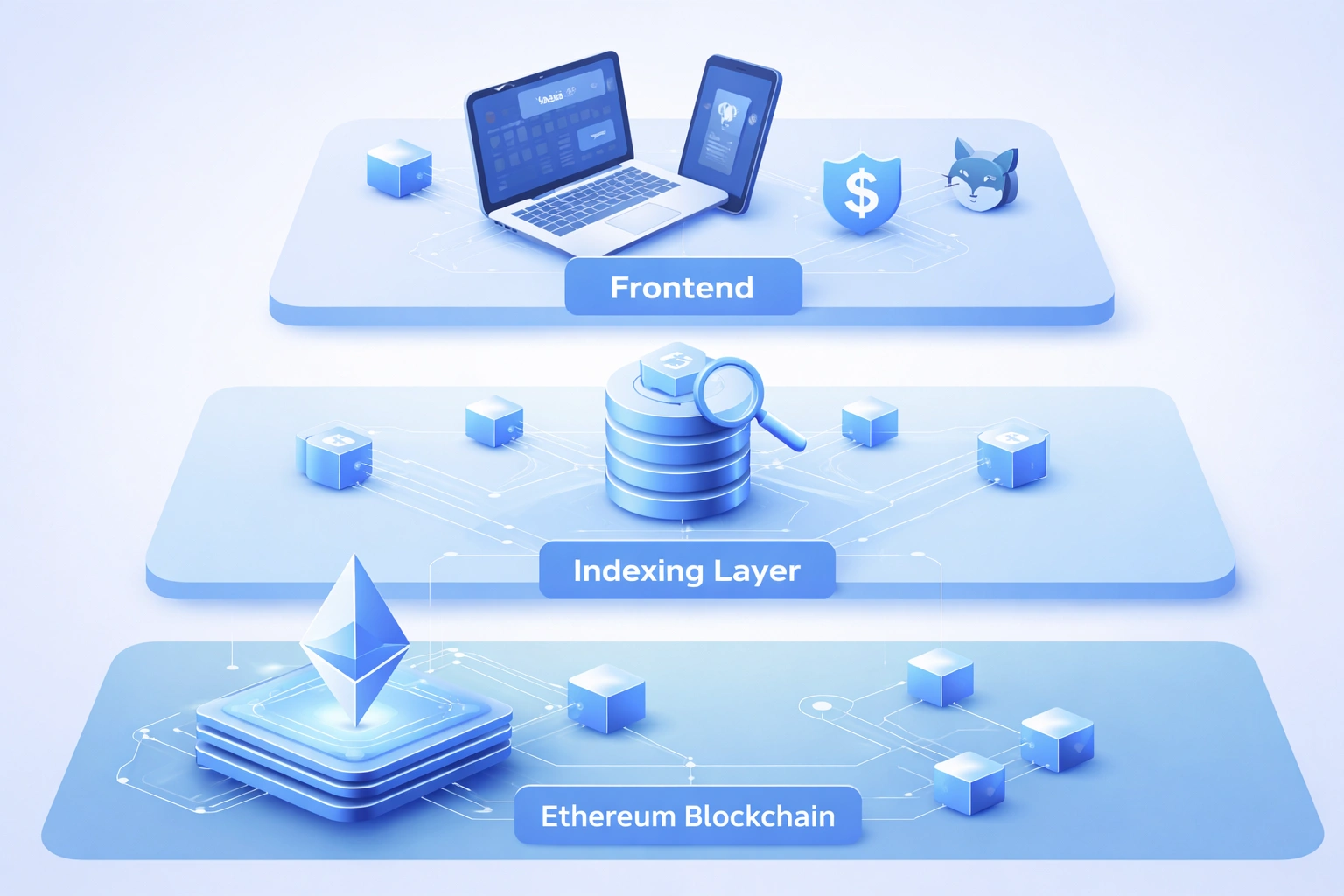
A well-planned Ethereum DApp architecture separates concerns clearly: smart contract layer, indexing layer, and a responsive React-based frontend.
Building your first DApp on Ethereum is achievable in 4–8 weeks with the right stack, clear scope, and a structured step-by-step approach.
The global blockchain application market has evolved rapidly. From DeFi platforms handling billions in daily transactions to NFT ecosystems redefining digital ownership, decentralized applications (DApps) are no longer experimental ideas; they are now real-world production systems.
In 2026, businesses across the USA, UK, UAE, and Canada are actively investing in ethereum DApp development to build solutions that eliminate intermediaries, reduce operational costs, and offer truly user-owned digital experiences. This shift clearly highlights why more startups and enterprises are learning how to build a DApp on Ethereum. With over eight years of hands-on experience in DApp development, our team has helped startups and enterprises successfully navigate every stage; from idea validation to deployment. Along the way, we’ve identified what works, what fails, and what separates scalable decentralized apps from those that never move beyond the testnet stage.
In this guide, we’ll walk you through a clear, practical, and step-by-step approach to building your first DApp on ethereum in 2026. Whether you’re a founder exploring a new idea or a developer planning a blockchain project, this resource will help you understand the process with clarity and confidence.
What is a DApp and How Does It Work?
A DApp, or decentralized application, is a type of software that runs its core logic on a blockchain instead of a centralized server. In traditional applications, data and operations are controlled by a single entity, which means they can be modified, restricted, or even shut down. In contrast, a DApp on Ethereum relies on smart contracts that execute automatically based on predefined rules. These smart contracts are deployed on the Ethereum blockchain and cannot be changed easily once live. Any updates require a transparent and agreed process. This makes Ethereum DApp development more secure and trustworthy, since no single authority has full control over how the application behaves. This is one of the key reasons why many businesses are choosing to build a DApp on Ethereum.
A typical DApp architecture consists of three main layers. The first layer is the Ethereum blockchain, where smart contracts are stored and executed. The second layer is the indexing layer, often powered by tools like The Graph, which helps retrieve blockchain data efficiently. The third layer is the frontend, which is the user interface. This is usually built using web technologies and connected to the blockchain through wallets like MetaMask and libraries such as Ethers.js.
When a user interacts with a DApp, for example by swapping tokens or minting an NFT, the process follows a clear flow. The user’s wallet signs a transaction and sends it to the Ethereum network. This transaction is then validated and added to the blockchain. Once confirmed, the smart contract executes the required logic, and the result is permanently recorded.
This is what makes a DApp on Ethereum reliable. Instead of relying on a central authority, the outcome is determined by code running on the blockchain, ensuring transparency, security, and trust. [1]
Why Build a DApp on Ethereum in 2026?
Ethereum in 2026 is very different from what it was a few years ago. With upgrades like the Merge, the growth of Layer 2 networks, and EIP-4844, the platform has addressed major concerns such as high energy usage, expensive gas fees, and limited scalability. Today, building a DApp on Ethereum gives you access to a more efficient and scalable ecosystem. The network now supports thousands of active applications and billions in total value locked, making it one of the most trusted blockchain ecosystems globally. For any team planning to build a DApp on Ethereum, this level of maturity provides confidence, stability, and long-term viability.
Another key advantage is regulatory clarity. In regions like the USA and UK, Ethereum is often referenced in regulatory discussions by authorities such as U.S. Securities and Exchange Commission and Financial Conduct Authority. Its widely adopted standards, including ERC-20, ERC-721, and ERC-1155, are already aligned with many compliance frameworks. Regulatory bodies in regions like the UAE and Canada have also introduced guidance that closely fits Ethereum’s architecture. This makes launching a DApp on Ethereum a more practical and safer choice for businesses that care about compliance.
The developer ecosystem has also evolved significantly. Tools like Hardhat, Foundry, Remix, and Scaffold-ETH 2 have made the development process faster and more efficient. Along with this, a strong global developer community ensures that most technical challenges already have well-documented solutions. All of these factors together explain why Ethereum DApp development continues to lead the market. For startups and enterprises alike, choosing to build a DApp on Ethereum means working with a platform that combines scalability, security, and long-term ecosystem support. This is also why many businesses prefer to collaborate with an experienced dapp development company to speed up development and reduce risks.
Key Benefits of Ethereum DApp Creation
When businesses from cities like Toronto, Dubai, London, and San Francisco evaluate blockchain platforms, one question comes up consistently. Why choose Ethereum over other networks? Based on real project experience, the answer lies in a set of core advantages that directly impact performance, scalability, and long-term success.
If you are planning to build a DApp on Ethereum, these benefits explain why it remains the preferred choice for startups and enterprises.
Battle-Tested Security
Ethereum operates on a Proof of Stake consensus mechanism and has undergone years of real-world testing. This makes it one of the most secure environments for deploying smart contracts. For any team building a DApp on Ethereum, this level of security reduces the risk of vulnerabilities and protects user assets effectively.
Massive Ecosystem
Ethereum offers access to a large and well-established ecosystem. Protocols like Chainlink, Uniswap, and Aave can be integrated directly into your application. This allows you to extend functionality without building everything from scratch.
Layer 2 Scalability
Scalability is no longer a limitation. Layer 2 solutions such as Arbitrum, Base, and Optimism allow developers to build applications with lower transaction costs while still benefiting from Ethereum’s security. This makes launching a DApp on Ethereum more practical for real-world users.
Largest Dev Community
Ethereum has one of the largest developer communities in the blockchain space. This means better tools, faster problem-solving, and easier hiring. For businesses, this significantly reduces development risk and speeds up the overall build process.
Token Standards
Ethereum supports widely adopted token standards such as ERC-20, ERC-721, ERC-1155, and ERC-4626. These standards are already compatible with most wallets, exchanges, and protocols, making integration seamless and efficient.
Regulatory Clarity
Ethereum has more regulatory references and documentation compared to most other blockchain platforms. This makes it easier for businesses to align with compliance requirements and launch products with greater confidence.
Choosing Ethereum DApp development is not just a technical decision. It is a strategic move that provides security, scalability, and long-term ecosystem support. This is why many organizations continue to build and scale their DApp on Ethereum.
Prerequisites for Building a DApp
Before you start writing smart contracts, it is important to build a strong foundation. Many teams rush into development and try to build a DApp on Ethereum without proper preparation. This often leads to costly architectural mistakes that are difficult to fix after deployment.
Based on real project experience, having the right technical and product prerequisites can significantly improve your chances of building a successful DApp.
Technical Prerequisites
To get started with Ethereum DApp development, your team should have:
- Solid understanding of JavaScript or TypeScript (intermediate to advanced level)
- Basic knowledge of blockchain concepts: wallets, transactions, gas, blocks, and consensus
- Familiarity with command-line tools and Node.js environment setup
- Understanding of REST APIs and asynchronous programming patterns
- Basic knowledge of Solidity syntax for writing smart contracts
Product Prerequisites
Beyond technical skills, having a clear product vision is equally important when planning a DApp on Ethereum:
- A well-defined use case that solves a real user problem
- Clear understanding of what data should be stored on-chain and off-chain
- A tokenomics plan if your application includes tokens or NFTs
- Selection of the right network, such as Ethereum mainnet or Layer 2 solutions
Teams in Canada and UAE who skip the product prerequisite phase often over-engineer their smart contracts for features that users never adopt. We strongly recommend running a lightweight off-chain prototype or user research sprint before committing to any contract architecture.
5 Things to Consider While Building an Ethereum DApp
Over the past eight years of working on real-world projects, we have identified a few key factors that consistently determine whether a product succeeds or fails. These are not just technical decisions. They are strategic choices that directly impact scalability, cost, and user adoption.
If you are planning to build a DApp on Ethereum, these considerations should be part of your decision-making process from the very beginning.
On-Chain vs Off-Chain Data Strategy
Not all data should be stored on the blockchain. Keeping large files on-chain increases costs and reduces performance. A better approach is to store only essential data on Ethereum and use tools like IPFS for larger files. This helps keep your DApp efficient and cost-effective.
Upgradeability Pattern Selection
Smart contracts cannot be easily changed after deployment. If you want flexibility in the future, you need to plan for it early. Using upgradeable contract patterns with tools from OpenZeppelin can help you manage updates without rebuilding everything.
Gas Optimization from Day One
Every transaction on Ethereum has a cost. Inefficient code can make your DApp expensive for users. Focus on writing optimized smart contracts and test gas usage during development. This will improve the overall experience of your DApp on Ethereum.
Security Audit Budgeting
A professional smart contract audit from firms like Trail of Bits, Certik, or Consensys Diligence costs between $15,000 and $80,000. For any DApp handling user funds, this is not optional. Build audit costs into your budget from the project kick-off, especially if you are targeting regulated markets in the USA, UK, or UAE.
User Experience and Wallet Abstraction
User experience plays a major role in adoption. Many users are not comfortable managing wallets and private keys. Using modern solutions like smart wallets can simplify onboarding and make your DApp on Ethereum easier to use.
Decentralized Apps – Architecture, Use Cases, Development Process & Best Practices
Essential Tools for DApp Creation
The Ethereum tooling ecosystem in 2026 is rich and well-documented. Selecting the right tools early accelerates your build cycle and reduces debugging time significantly. Below is the complete toolkit our agency uses across every Ethereum DApp creation project, organized by category and function.
Best Frameworks and Tools for Building dApps in 2026
Choosing the Right Tech Stack for Your DApp
Choosing the right tech stack is one of the most important decisions when building a DApp on Ethereum. Unlike traditional applications, smart contracts cannot be easily changed after deployment. A wrong choice at this stage can lead to delays, higher costs, and unnecessary rework.
To avoid this, it is important to select a stack that is reliable, scalable, and well-supported by the developer ecosystem.
Frontend Layer
Next.js 15 with TypeScript is our default. Server-side rendering improves SEO for public DApp pages while React hooks handle dynamic wallet states elegantly.
Contract Layer
Solidity 0.8.x with Hardhat for standard DApps. Foundry for projects requiring deep fuzz testing and invariant checks. OpenZeppelin for all standard patterns.
Indexing Layer
The Graph subgraph for complex event queries. Moralis or Alchemy’s SDK for simpler data requirements where a full subgraph is overkill for the project scope.
Storage Layer
IPFS via Pinata or web3.storage for NFT metadata and media. Arweave for permanent, censorship-resistant document storage where permanence is a product requirement.
Agency Insight: Model Stack Selection
If you are new and want to quickly build a DApp on Ethereum, using a pre-configured starter kit can save a lot of time. Tools like Scaffold-ETH 2 combine frontend, smart contracts, and wallet integration into a single setup. This allows your team to focus on building features instead of configuring tools from scratch.
Step-by-Step Guide: How to Build a DApp on Ethereum
This is the core of the guide. The following six-step process reflects the exact workflow our team uses to deliver Ethereum DApp creation projects for clients across the USA, UK, UAE, and Canada. Follow each step in order; skipping phases creates downstream problems that are always more expensive to fix than to prevent.
Step 1: Planning Your DApp Idea
Planning is the most undervalued phase of ethereum DApp creation. Start with a clear problem statement. What on-chain action provides value that cannot be replicated more cheaply off-chain? Define your user personas, the transactions they will perform, and the data that must live on the blockchain versus off. Create a contract interaction diagram that maps user actions to smart contract function calls. Define your token model if applicable. Choose your target network: Ethereum mainnet for high-value DeFi protocols, or a Layer 2 for high-frequency, lower-value user interactions.
Real-World Example
A UK-based fintech team planning a decentralized invoice financing DApp mapped out 12 distinct contract interactions before writing any code. This planning phase revealed that 60% of planned on-chain operations could be moved off-chain, reducing their estimated gas costs by 70% and their audit scope by half.
Step 2: Writing Smart Contracts
With your architecture planned, open Remix IDE or your Hardhat project and begin writing Solidity smart contracts. Start with the core business logic contract. Use OpenZeppelin’s base contracts for ownership, access control, and token standards. Always use Solidity 0.8.x or higher, as it includes built-in overflow protection. Structure your contracts following the checks-effects-interactions pattern to prevent re-entrancy. Keep individual contracts focused on a single responsibility; composability through multiple contracts is safer than monolithic designs. Document every function with NatSpec comments to support future auditors and frontend developers reading your ABI.
Use events liberally. Emitting events for every state change creates an auditable log that your frontend can query efficiently via Ethers.js or The Graph, and they cost far less gas than storing equivalent data in storage variables.
Step 3: Testing Smart Contracts
Testing is non-negotiable for any DApp on Ethereum. Smart contracts are immutable after deployment; bugs are permanent. Your test suite should achieve 100% line and branch coverage. Write unit tests for every function, covering expected behavior, edge cases, and failure modes. Use Hardhat’s mainnet forking feature to test interactions with real protocols like Uniswap or Aave in your local environment without spending real ETH. Run Slither static analysis and Mythril symbolic execution to catch common vulnerabilities automatically before any manual review.
Smart Contract Testing Lifecycle
Step 01 – Unit Testing
Each smart contract function tested in isolation with expected inputs, outputs, and revert conditions.
Step 02 – Integration Testing
Multi-contract interactions verified against forked mainnet state to simulate real-world protocol conditions.
Step 03 – Fuzz Testing
Foundry’s fuzz testing engine generates thousands of random inputs to find unexpected edge-case failures.
Step 04 – Static Analysis
Slither and MythX scan compiled bytecode for known vulnerability patterns including re-entrancy and integer issues.
Step 4: Deploying on Ethereum
Before touching mainnet, always deploy and validate on Sepolia testnet. Sepolia is Ethereum’s canonical testnet in 2026 and mirrors mainnet behavior closely. Get Sepolia ETH from a faucet, run a complete end-to-end test of your DApp including all frontend interactions, and resolve any issues. When ready for mainnet, use Hardhat’s deployment scripts with proper constructor arguments and verify your contract source code on Etherscan immediately after deployment. Verification builds trust with users and is required by most launchpads and DEXs for listing.
For Layer 2 deployments, the process is identical but you target a different RPC endpoint and chain ID. Arbitrum One uses chain ID 42161; Optimism Mainnet uses 10; Base uses 8453. Your Hardhat config can support multiple networks simultaneously, allowing you to deploy to all target networks from a single command.
Step 5: Building the Frontend
Your frontend is the interface between users and the Ethereum blockchain. Initialize a Next.js 15 project with TypeScript. Install Wagmi v2 and Viem for type-safe contract interactions, and RainbowKit for a polished wallet connection modal that supports MetaMask, WalletConnect, Coinbase Wallet, and more. Import your contract ABI from your Hardhat artifacts directory. Use Wagmi’s useReadContract and useWriteContract hooks to read data from and write transactions to your deployed contracts. Handle loading states, transaction confirmations, and error messages gracefully. Users expect clear feedback at every step of a blockchain interaction, which often involves multi-second waits for transaction inclusion.
Real-World Example
A UAE-based NFT marketplace we built for a digital art platform saw 3x higher mint conversion rates after we added real-time transaction status indicators, estimated confirmation times, and a “transaction pending” toast notification. UX polish directly drives DApp adoption metrics in competitive markets.
Step 6: Connecting Wallet and Blockchain
Wallet connection is the entry point of every user’s DApp experience. With RainbowKit and Wagmi, this is largely handled by the library, but your team needs to implement proper connect/disconnect lifecycle management, chain switching detection, and account change handling. When a user switches accounts mid-session, your DApp should gracefully update all on-chain data displayed. Implement EIP-1193 event listeners for accountsChanged and chainChanged events. For applications requiring a specific network, prompt users to switch chains automatically using wallet_switchEthereumChain or wallet_addEthereumChain RPC calls.
For DApps targeting mainstream audiences in the USA and UK, consider implementing Account Abstraction via Safe’s AA SDK or Privy. This allows users to log in with email or social accounts, with the smart contract wallet handling key management invisibly. The result is a Web2-like onboarding experience with full Web3 ownership properties underneath.
Cost of Building a DApp on Ethereum
Cost is one of the most common questions we receive from clients in the USA, UK, UAE, and Canada who are evaluating their first Ethereum DApp creation project. The honest answer is that cost varies enormously based on scope, team composition, and audit requirements. The table below reflects market rates as of 2026.
| DApp Type | Typical Cost (USD) | Build Time | Audit Required? |
|---|---|---|---|
| Simple DApp (ERC-20 token + basic UI) | $5,000 – $18,000 | 2–4 weeks | Optional |
| NFT Marketplace (ERC-721 + frontend) | $20,000 – $55,000 | 6–10 weeks | Recommended |
| DeFi Protocol (AMM, lending, staking) | $60,000 – $150,000 | 3–6 months | Mandatory |
| Enterprise DApp (governance, compliance) | $150,000 – $500,000 | 6–12 months | Mandatory |
Beyond build costs, factor in deployment gas fees ($50–$500 on mainnet depending on contract complexity), ongoing node provider costs ($50–$500/month), and smart contract monitoring services like OpenZeppelin Defender ($200–$1,000/month for enterprise features). Teams in Canada and the UAE should also budget for local legal review of their DApp’s compliance obligations before launch.
Best Practices for Secure and Scalable DApps
Security and scalability are not afterthoughts in Ethereum DApp creation; they are architectural commitments. The following best practices represent the professional standard our agency applies to every engagement, regardless of project size or budget tier.
Principle 1: Minimal Privilege
Every admin function should require the minimum permissions necessary. Never use a single owner address for all privileged operations; use role-based access control and multisig wallets for critical admin functions like treasury management and contract upgrades.
Principle 2: Fail-Safe Defaults
Default contract behavior should deny access, not permit it. Require explicit permission grants rather than relying on the absence of restrictions. Implement emergency pause mechanisms using OpenZeppelin’s Pausable contract for any DApp handling significant user funds.
Principle 3: Separation of Concerns
Keep logic, storage, and token contracts separate. A modular architecture allows individual components to be upgraded, audited, or replaced without rebuilding the entire system. The Diamond Standard (EIP-2535) provides a formal framework for this pattern in complex DApps.
Principle 4: On-Chain Monitoring
Deploy OpenZeppelin Defender Sentinels to monitor for anomalous transaction patterns in real-time. Set alerts for unusual volume spikes, large transfers, and failed transactions above threshold levels. Early detection of exploit attempts has saved DApps tens of millions in assets.
Principle 5: Timelock Governance
All significant contract parameter changes should go through a timelock contract with a minimum 48-72 hour delay. This gives users time to review and exit positions before changes take effect, building the trust that drives long-term DApp adoption in mature markets like the USA and UK.
Principle 6: Formal Verification
For DApps managing over $5M in user assets, formal verification using Certora Prover or the K Framework provides mathematical proof of contract correctness. While expensive, it represents the gold standard of smart contract security and is increasingly expected by institutional DeFi users.
✅ Pre-Launch Compliance and Governance Checklist
Ready to Launch Your DApp on Ethereum?
Partner with our 8-year Ethereum DApp agency. From smart contract audit to full-stack launch, we deliver compliant, scalable DApps for global markets.
Frequently Asked Questions
Q1.What is a DApp on Ethereum?
A DApp on Ethereum is a decentralized application that runs on the Ethereum blockchain rather than centralized servers. Unlike traditional apps, DApps use smart contracts written in Solidity to execute logic autonomously without intermediaries. They are open-source, transparent, and censorship-resistant. Businesses in the USA, UK, UAE, and Canada are increasingly building DApps for finance, gaming, healthcare, and supply chain use cases, making Ethereum DApp creation one of the most sought-after technical capabilities in the blockchain industry today.
Q2.How long does it take to build a DApp on Ethereum?
The time required to build a DApp on Ethereum varies based on complexity. A simple DApp with basic smart contract functionality can take two to four weeks. A mid-level DApp with wallet integration, a custom frontend, and multiple contracts typically requires six to twelve weeks. Enterprise-grade DApps with complex tokenomics, governance modules, and security audits may take four to six months. Planning your architecture carefully before writing any code significantly reduces rework time and helps teams in fast-moving markets deliver faster.
Q3.What programming languages are used for Ethereum DApp creation?
Ethereum DApp creation primarily involves Solidity for writing smart contracts, as it is the most mature and widely supported language for the Ethereum Virtual Machine. JavaScript and TypeScript are used for the frontend, typically paired with frameworks like React or Next.js. Ethers.js or Web3.js libraries facilitate communication between the frontend and blockchain. Developers in the UK and USA often also use Hardhat or Foundry for smart contract testing and Vyper as an alternative contract language for security-critical applications.
Q4.What tools do I need to build a DApp on Ethereum?
To build a DApp on Ethereum, you need a code editor like VS Code, a smart contract framework such as Hardhat or Foundry, and the MetaMask browser extension for wallet interaction. The Infura or Alchemy API provides reliable node access without running your own Ethereum node. OpenZeppelin libraries give you audited contract templates. For the frontend, React combined with Ethers.js is the most popular choice. Remix IDE is excellent for beginners to write and test Solidity smart contracts directly in a browser environment.
Q5.How much does it cost to build a DApp on Ethereum?
The cost to build a DApp on Ethereum depends on scope and team location. Freelance builds for basic DApps range from USD 5,000 to USD 20,000. Mid-tier DApps with security audits and polished UI typically cost USD 30,000 to USD 80,000. Enterprise DApps with custom tokenomics and compliance features can exceed USD 150,000. Gas fees for deploying smart contracts on Ethereum mainnet range from USD 50 to USD 500 depending on network congestion. Teams in Canada and UAE markets often factor in audit costs as a mandatory line item.
Q6.Is Ethereum still the best blockchain for DApp creation in 2026?
Yes, Ethereum remains the leading blockchain for DApp creation in 2026. With the maturation of Layer 2 networks like Arbitrum, Optimism, and Base, gas fees have dropped dramatically while retaining Ethereum’s security guarantees. The ecosystem has the largest developer community, most audited smart contract libraries, and deepest institutional support. Competitors like Solana and BNB Chain offer lower fees but lack Ethereum’s trust, tooling maturity, and regulatory acceptance, making Ethereum the preferred choice for businesses targeting USA, UK, UAE, and Canadian markets.
Q7.What are the most common mistakes when building a DApp on Ethereum?
The most common mistakes include skipping proper smart contract audits before deployment, hardcoding gas limits that break under network congestion, and failing to handle wallet connection errors gracefully in the frontend. Many teams also underestimate the importance of testing on testnets like Sepolia before mainnet launch. Poor key management, re-entrancy vulnerabilities in Solidity code, and not planning for contract upgradeability are critical pitfalls. Experienced Ethereum DApp specialists always conduct threat modeling, write extensive unit tests, and follow established security patterns from OpenZeppelin before any production deployment.
Explore Services
Related Services
Reviewed by

Aman Vaths
Founder of Nadcab Labs
Aman Vaths is the Founder & CTO of Nadcab Labs, a global digital engineering company delivering enterprise-grade solutions across AI, Web3, Blockchain, Big Data, Cloud, Cybersecurity, and Modern Application Development. With deep technical leadership and product innovation experience, Aman has positioned Nadcab Labs as one of the most advanced engineering companies driving the next era of intelligent, secure, and scalable software systems. Under his leadership, Nadcab Labs has built 2,000+ global projects across sectors including fintech, banking, healthcare, real estate, logistics, gaming, manufacturing, and next-generation DePIN networks. Aman’s strength lies in architecting high-performance systems, end-to-end platform engineering, and designing enterprise solutions that operate at global scale.