Ai Overview
Understanding how blockchain powers Web3 begins with recognizing why this technology is not merely an option but the essential foundation for decentralized applications. Traditional backends offer simplicity, speed, and low cost but require users to trust the operator. On-chain components benefit from decentralization and immutability but cost gas for every operation. Blockchain storage is expensive: storing 1KB on Ethereum costs roughly $50-500 depending on gas prices.
Key Takeaways
- Blockchain technology and Web3 are fundamentally connected: blockchain provides the decentralized infrastructure that makes trustless applications possible
- How blockchain powers Web3 involves three layers: frontend interfaces, smart contracts for logic, and blockchain networks for state and consensus
- Blockchain for Web3 developers means learning new paradigms including gas optimization, wallet integration, and on-chain state management
- The relationship between blockchain and Web3 extends beyond simple data storage to include programmable money, verifiable computation, and composable protocols
- Blockchain in Web3 applications requires balancing on-chain and off-chain components for optimal cost, speed, and decentralization
- Role of blockchain in Web3 includes consensus, immutability, transparency, and enabling trustless interactions between parties
- Web3 blockchain technology continues evolving with Layer 2 solutions, zero-knowledge proofs, and modular architectures improving scalability and user experience
- Security remains paramount: smart contract vulnerabilities have caused billions in losses, making audits and testing essential
Why Blockchain Is the Core of Web3 Applications?
Understanding how blockchain powers Web3 begins with recognizing why this technology is not merely an option but the essential foundation for decentralized applications. While traditional applications rely on centralized servers controlled by single entities, Web3 applications distribute trust across networks of participants. This fundamental shift in architecture creates the properties that define Web3: censorship resistance, transparency, and user sovereignty.
Role of blockchain in Web3 architecture
The role of blockchain in Web3 architecture is multifaceted: it serves as the state layer that maintains application data, the consensus layer that validates state changes, and the execution layer that runs smart contract logic. Unlike traditional backends where a company’s servers hold authority over application state, blockchain distributes this authority across thousands of nodes that independently verify every operation.
This architecture means that Web3 applications inherit the security and availability of the underlying blockchain. An application deployed on Ethereum benefits from the economic security of billions of dollars in staked ETH and years of battle-tested infrastructure. No startup could replicate this security independently.
Why developers rely on blockchain for decentralization
Blockchain for Web3 developers provides something no other technology offers: credible neutrality. When application logic runs on blockchain, no single party can modify rules, censor users, or shut down the application. This isn’t just philosophical preference; it enables new categories of applications that require this trust model, from decentralized finance to governance systems.
The alternative approaches to decentralization, like federated systems or peer-to-peer networks, lack the strong consistency guarantees that blockchain consensus provides. For applications handling value, having a single source of truth that all participants agree on is essential.
Blockchain vs traditional backend systems
Traditional backends offer simplicity, speed, and low cost but require users to trust the operator. Blockchain backends offer trustlessness and transparency but introduce complexity, latency, and costs. Understanding this tradeoff is crucial: not every application needs blockchain, but those that do cannot achieve their goals without it.
Important: Blockchain technology and Web3 applications introduce significant paradigm shifts from traditional development. Building production-ready Web3 applications requires understanding not just the technology but also the economic, security, and user experience implications of decentralization.
Web3 Application Architecture Explained for Developers
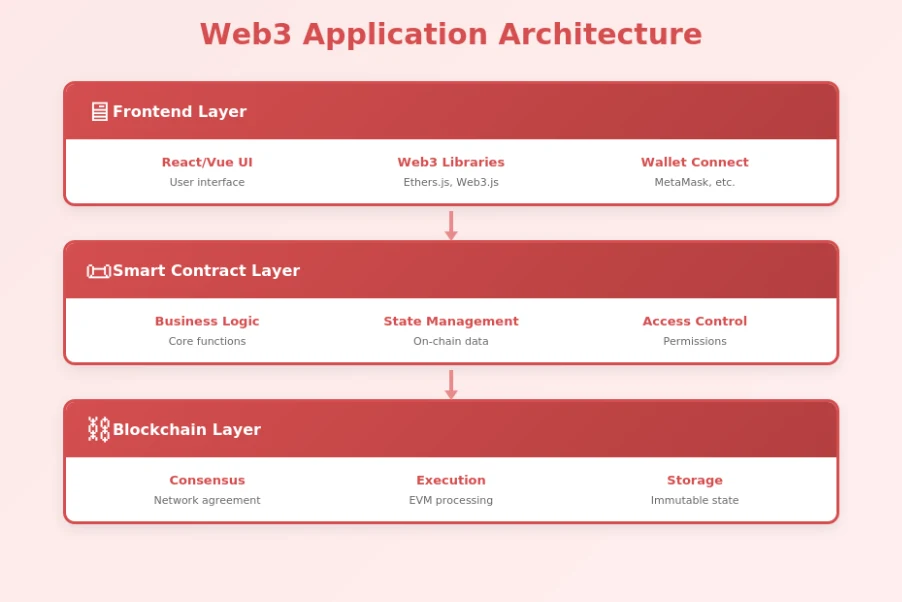
Web3 application architecture combines familiar web technologies with blockchain-specific components. Understanding how blockchain powers Web3 at an architectural level helps developers design applications that leverage blockchain’s strengths while mitigating its limitations.
Frontend, smart contracts, and blockchain layers
A typical Web3 application consists of three main layers. The frontend, built with familiar technologies like React or Vue, handles user interface and connects to wallets. Smart contracts deployed on blockchain contain application logic and manage state. The blockchain network itself provides consensus, storage, and execution infrastructure.
The frontend communicates with smart contracts through wallet connections (like MetaMask) that sign transactions and Web3 libraries (like Ethers.js) that format and submit calls. This architecture differs fundamentally from traditional apps where the frontend talks directly to a backend API.
On-chain vs off-chain components
Effective Web3 architecture balances on-chain and off-chain components. On-chain components benefit from decentralization and immutability but cost gas for every operation. Off-chain components offer traditional web performance and costs but sacrifice some decentralization guarantees.
A common pattern stores critical state (token balances, ownership records, protocol parameters) on-chain while keeping large data (images, metadata, user preferences) off-chain with hash references stored on-chain for verification. Organizations building professional crypto exchange platforms apply these architectural principles to balance performance and decentralization.
Data flow in blockchain-powered Web3 apps
Data flows differently in Web3 applications. Read operations query blockchain state through RPC nodes and return instantly. Write operations require transaction signing, network submission, block inclusion, and confirmation, introducing latency from seconds to minutes depending on the network and fee paid.
Smart Contracts as the Logic Layer of Web3
Smart contracts are the programmable heart of blockchain in Web3 applications. They encode the rules, manage state, and execute operations that define how decentralized applications function. Understanding smart contracts is essential for any developer entering the Web3 space.
How smart contracts power Web3 functionality
Smart contracts execute deterministically: given the same inputs and state, they always produce the same outputs. This predictability enables trustless interactions because users can verify exactly what will happen before submitting transactions. The code is the contract, with no interpretation or discretion.
When a user calls a smart contract function, the transaction is broadcast to the network, included in a block, and executed by every node. The resulting state change is permanently recorded on the blockchain, creating an immutable audit trail.
Common smart contract use cases
Token contracts (ERC-20, ERC-721) manage fungible and non-fungible assets. DeFi contracts handle lending, borrowing, and trading. Governance contracts enable decentralized decision-making. Access control contracts manage permissions. Each use case demonstrates how blockchain powers Web3 with programmable, trustless logic.
Smart contract execution and gas mechanics
Gas is the unit measuring computational effort on Ethereum and similar networks. Every operation (computation, storage, external calls) consumes gas, and users pay gas prices to compensate validators. Understanding gas mechanics helps developers write efficient contracts and estimate transaction costs accurately.
Blockchain Networks Used in Web3 Applications
The relationship between blockchain and Web3 includes choice of network, as different blockchains offer different tradeoffs. Selecting the right network significantly impacts application performance, costs, and user experience.
Ethereum and EVM-compatible chains
Ethereum remains the primary platform for Web3 blockchain technology, with the largest ecosystem of tools, developers, and deployed applications. EVM-compatible chains like Polygon, Arbitrum, Optimism, BSC, and Avalanche can run the same smart contracts with lower costs or higher throughput.
Layer 2 networks for Web3 scalability
Layer 2 networks process transactions off-chain while posting proofs or data to Ethereum for security. Arbitrum and Optimism use optimistic rollups; zkSync and StarkNet use zero-knowledge rollups. L2s offer 10-100x cost reduction while maintaining Ethereum security guarantees.
Choosing the right blockchain for Web3 apps
Selection criteria include transaction costs (critical for high-frequency applications), finality time (important for user experience), ecosystem maturity (tooling, liquidity, users), and security guarantees (especially for high-value applications).
| Network | Type | Typical Cost | Best For |
|---|---|---|---|
| Ethereum | Layer 1 | $1-50+ | High-value, security-critical |
| Arbitrum | Optimistic Rollup | $0.01-0.50 | DeFi, general apps |
| Polygon | Sidechain/L2 | $0.001-0.01 | Gaming, NFTs |
| zkSync | ZK Rollup | $0.01-0.10 | Privacy, scaling |
How Developers Interact with Blockchain in Web3?
Blockchain for Web3 developers requires mastering new tools and patterns for blockchain interaction. These skills bridge the gap between traditional web interfaces and decentralized backend systems.
Web3 libraries and SDKs (Web3.js, Ethers.js)
Ethers.js has become the preferred library for most new projects, offering a cleaner API and better TypeScript support than the older Web3.js. These libraries handle connection to RPC endpoints, transaction formatting, contract interaction, and event listening. They abstract the low-level JSON-RPC protocol into developer-friendly interfaces.
Wallet integration and user authentication
Wallets like MetaMask serve as both key storage and transaction signing interfaces. Unlike traditional authentication where servers verify passwords, Web3 authentication uses cryptographic signatures that prove wallet ownership without revealing private keys. Libraries like wagmi and Web3Modal simplify wallet integration.
Sending transactions and reading blockchain data
Reading blockchain data is free and fast; writing requires gas and confirmation time. Developers must design UIs that handle transaction pending states, potential failures, and confirmation delays. Event logs provide efficient ways to query historical data without scanning every block.
Data Storage in Blockchain-Powered Web3 Apps
Data storage strategy significantly impacts application costs and decentralization. Understanding storage options helps developers make appropriate tradeoffs for their specific requirements.
On-chain data storage limitations
Blockchain storage is expensive: storing 1KB on Ethereum costs roughly $50-500 depending on gas prices. This makes on-chain storage impractical for large data. Applications must minimize on-chain storage to essential state while storing references to off-chain data.
Off-chain storage using IPFS and decentralized storage
IPFS provides content-addressed storage where files are identified by their hash. Arweave offers permanent storage with one-time payment. Filecoin adds economic incentives to IPFS. These solutions store NFT metadata, application assets, and large datasets that would be cost-prohibitive on-chain.
Linking blockchain data with external storage
The standard pattern stores content hashes on-chain while keeping actual content on IPFS or similar systems. This provides verification (hash proves content hasn’t changed) without the cost of full on-chain storage. Teams building comprehensive trading platforms implement these hybrid storage approaches for optimal performance.
Security Considerations for Web3 Developers
Security is paramount in Web3 blockchain technology because smart contract vulnerabilities can result in immediate, irreversible loss of funds. The stakes are higher than traditional development where bugs can often be patched.
Smart contract security risks
Common vulnerability categories include reentrancy attacks (where malicious contracts repeatedly call back during execution), access control failures (functions callable by unauthorized parties), and economic exploits (manipulating prices or states for profit). The immutable nature of deployed contracts makes these especially dangerous.
Common vulnerabilities and best practices
Best practices include using established patterns (OpenZeppelin contracts), following check-effects-interactions ordering, implementing reentrancy guards, and using safe math operations. Solidity 0.8+ includes overflow protection by default, but many other risks remain.
Auditing and testing Web3 applications
Professional audits are essential for any contract handling significant value. Testing should include unit tests, integration tests, fuzzing, and formal verification where appropriate. Bug bounties provide additional security through crowdsourced review.
| Risk | Description | Prevention |
|---|---|---|
| Reentrancy | Recursive calls before state update | CEI pattern, reentrancy guards |
| Access Control | Unauthorized function access | Role-based access, onlyOwner |
| Oracle Manipulation | Price feed manipulation | TWAP, Chainlink oracles |
| Front-Running | Transaction ordering exploits | Commit-reveal, MEV protection |
Scalability Challenges and Solutions
Scalability remains a critical challenge in blockchain in Web3 applications. Understanding scaling solutions helps developers choose appropriate architectures for their throughput requirements.
Blockchain scalability limitations
Layer 1 blockchains face the blockchain trilemma: tradeoffs between decentralization, security, and scalability. Ethereum processes roughly 15 transactions per second, far below the thousands required for mass adoption. This limitation drives innovation in scaling solutions.
Layer 2 scaling solutions
Layer 2 solutions execute transactions off the main chain while posting proofs or data to Layer 1 for security. Optimistic rollups assume transactions are valid unless challenged. ZK rollups use cryptographic proofs to verify transaction validity. Both approaches achieve significant throughput improvements.
Sidechains and rollups for Web3 apps
Sidechains like Polygon PoS operate independently with their own consensus but bridge to Ethereum. Rollups maintain stronger security guarantees by posting all transaction data or proofs to Layer 1. The choice depends on security requirements and cost sensitivity.
Interoperability in Blockchain-Powered Web3 Applications
As Web3 expands across multiple chains, interoperability becomes essential for developers building applications that span ecosystems.
Cross-chain communication for developers
Cross-chain bridges enable asset transfers and message passing between different blockchains. Developers must understand bridge security models, finality requirements, and the technical implementation of cross-chain calls.
Interoperability tools and protocols
Chainlink CCIP, LayerZero, and Wormhole provide messaging infrastructure. Each has different security models and chain coverage. Protocol selection depends on which chains need connection and security requirements.
Building multi-chain Web3 applications
Multi-chain applications deploy to multiple networks, either as separate instances or coordinated systems. This approach accesses liquidity and users across ecosystems but adds complexity in deployment, state synchronization, and user experience.
Developer Tools and Frameworks for Web3
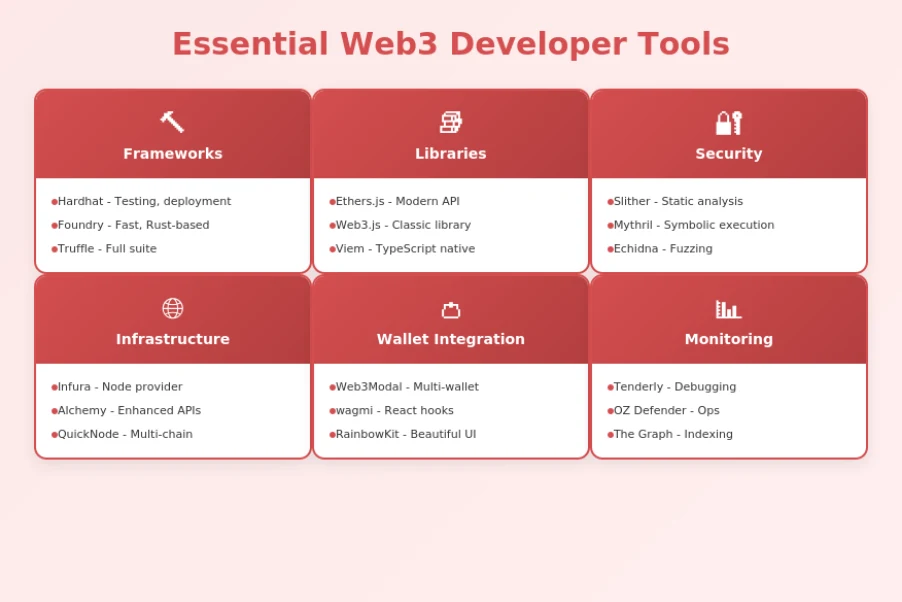
Mature tooling significantly improves Web3 developer experience. Familiarity with these tools is essential for productive blockchain for Web3 developers.
Smart contract tools (Hardhat, Truffle)
Hardhat has become the dominant framework, offering TypeScript support, excellent debugging, and a rich plugin ecosystem. Foundry provides a Rust-based alternative with fast compilation and testing. Both handle compilation, testing, deployment, and verification workflows.
Testing, deployment, and monitoring tools
Testing frameworks include Hardhat’s built-in testing, Foundry’s fuzzing capabilities, and Echidna for property-based testing. Deployment tools like Hardhat Ignition and scripts manage reproducible deployments. Monitoring services like Tenderly and OpenZeppelin Defender track production contracts.
Debugging blockchain-powered Web3 apps
Debugging distributed systems requires different approaches than traditional applications. Transaction tracers show execution step-by-step. Event logs help reconstruct state changes. Tenderly provides simulation and debugging for mainnet transactions.
Essential Web3 Developer Tools
- Frameworks: Hardhat, Foundry, Truffle
- Libraries: Ethers.js, Web3.js, Viem
- Testing: Chai, Mocha, Foundry fuzz
- Security: Slither, Mythril, Echidna
- Monitoring: Tenderly, OpenZeppelin Defender
- Infrastructure: Infura, Alchemy, QuickNode
Real-World Web3 Application Examples
Examining successful applications illustrates how blockchain powers Web3 in practice. These examples demonstrate the patterns and architectures that work in production.
DeFi applications powered by blockchain
Uniswap demonstrates automated market making through smart contracts. Aave shows decentralized lending and borrowing. MakerDAO illustrates algorithmic stablecoins and governance. Each represents billions in value secured entirely by smart contract logic.
NFT platforms and marketplaces
OpenSea and Blur facilitate NFT trading through marketplace contracts. Platforms handle listing, bidding, and settlement on-chain while storing metadata on IPFS. Teams building professional digital asset exchange platforms incorporate similar architectural patterns for NFT functionality.
DAO and governance systems
DAOs like Compound Governance and Snapshot demonstrate on-chain and off-chain voting mechanisms. Governor contracts manage proposal creation, voting, and execution. These systems enable decentralized decision-making for protocol upgrades and treasury management.
Building Production-Ready Web3 Applications
Moving from prototype to production requires attention to deployment, operations, and maintenance that development environments don’t expose.
Development workflow for Web3 projects
Effective workflows include local testing, testnet deployment, staged rollouts, and mainnet launch. Upgradeable contracts require additional consideration for proxy patterns and migration procedures. Version control and reproducible builds ensure consistency.
Deployment and network selection
Deployment decisions include choosing networks (mainnet, testnet, L2), configuring gas strategies, verifying contracts on block explorers, and setting up multi-sig ownership. Each network has deployment nuances developers must understand.
Monitoring and maintaining Web3 applications
Production applications need monitoring for contract events, unusual transaction patterns, and gas price spikes. Incident response plans should address potential exploits. Upgrade mechanisms (where appropriate) enable bug fixes and improvements.
| Phase | Stage | Activities | Output |
|---|---|---|---|
| 1 | Design | Architecture, contract interfaces, security model | Specifications |
| 2 | Implement | Smart contracts, frontend, integration | Working code |
| 3 | Test | Unit tests, integration, audit, testnet | Verified contracts |
| 4 | Deploy | Mainnet deployment, verification, ownership | Live contracts |
| 5 | Operate | Monitor, maintain, upgrade as needed | Production system |
Blockchain-Powered Web3 Solutions for Businesses
Businesses entering Web3 need partners who understand both the technology and business requirements. Professional services bridge this gap.
Custom Web3 application solutions
Custom solutions tailor blockchain capabilities to specific business needs. This includes smart contract architecture, frontend design, infrastructure selection, and security implementation. Professional teams building complete exchange and trading infrastructure bring this comprehensive expertise.
Enterprise blockchain integration
Enterprise integration connects existing systems with blockchain capabilities. This includes wallet infrastructure, compliance tooling, reporting systems, and user management that enterprises require for production deployments.
Web3 solutions for startups and enterprises
Solution scope varies by organization size and maturity. Startups may need rapid prototyping and MVP builds. Enterprises require thorough security review, compliance integration, and long-term support. Both benefit from experienced guidance.
Future Trends Developers Should Watch
Web3 blockchain technology evolves rapidly. Understanding emerging trends helps developers prepare for and leverage coming capabilities.
Modular blockchains and Web3 stacks
Modular architectures separate execution, settlement, consensus, and data availability into specialized layers. This enables optimization of each component and creates new composition possibilities. Celestia, EigenDA, and similar projects lead this trend.
Zero-knowledge proofs in Web3 apps
ZK proofs enable private computation, scalable verification, and trustless bridges. ZK rollups already provide scaling; future applications include private transactions, identity verification, and cross-chain security. Developer tooling for ZK is rapidly maturing.
Evolution of developer tooling in Web3
Tooling continues improving: better debugging, faster compilation, improved testing frameworks, and more accessible security tools. AI-assisted development is emerging for contract generation and vulnerability detection. The developer experience gap with Web2 is closing.
Build Your Web3 Application
Partner with experts to create blockchain-powered applications with proven architecture and security.
Understanding how blockchain powers Web3 is essential for developers building the next generation of applications. The relationship between blockchain and Web3 encompasses architecture, security, scalability, and tooling considerations that differ significantly from traditional development. As the ecosystem matures, developers who master these fundamentals will be well-positioned to build the decentralized applications that define the future of the internet.
Frequently Asked Questions
Q1.How does blockchain power Web3 applications?
Blockchain provides the decentralized infrastructure that Web3 applications run on, replacing traditional centralized servers with distributed networks. Smart contracts deployed on blockchains execute application logic automatically, handling everything from token transfers to complex DeFi operations. This architecture ensures that Web3 apps operate without single points of failure and with transparent, verifiable code.
Q2.Which blockchain is best for building Web3 applications?
Ethereum remains the most popular choice due to its mature ecosystem, tooling, and network effects. However, the best choice depends on your requirements: Polygon and Arbitrum offer lower costs, Solana provides high throughput, and chains like Avalanche offer subnet customization. Consider transaction costs, speed requirements, and ecosystem resources when choosing.
Q3.How do Web3 developers interact with blockchain?
Developers use libraries like Web3.js and Ethers.js to connect frontends to blockchain networks through RPC endpoints. They deploy smart contracts using frameworks like Hardhat or Truffle, which compile and publish code to the network. Users interact through wallets like MetaMask that sign transactions, which are then broadcast to the blockchain for execution.
Q4.How do layer 2 solutions help Web3 applications?
Layer 2 solutions process transactions off the main blockchain (Layer 1) while inheriting its security, dramatically reducing costs and increasing throughput. Solutions like Arbitrum and Optimism use rollups to batch many transactions into single L1 submissions. This enables Web3 applications to scale to millions of users without prohibitive gas costs.
Q5.What security risks do Web3 developers need to consider?
Smart contract vulnerabilities like reentrancy attacks, integer overflows, and access control issues can lead to significant fund losses. Developers must also consider front-running, oracle manipulation, and economic exploits. Rigorous testing, formal verification, and professional audits are essential before deploying contracts that handle value.
Explore Services
Related Services
Reviewed by

Aman Vaths
Founder of Nadcab Labs
Aman Vaths is the Founder & CTO of Nadcab Labs, a global digital engineering company delivering enterprise-grade solutions across AI, Web3, Blockchain, Big Data, Cloud, Cybersecurity, and Modern Application Development. With deep technical leadership and product innovation experience, Aman has positioned Nadcab Labs as one of the most advanced engineering companies driving the next era of intelligent, secure, and scalable software systems. Under his leadership, Nadcab Labs has built 2,000+ global projects across sectors including fintech, banking, healthcare, real estate, logistics, gaming, manufacturing, and next-generation DePIN networks. Aman’s strength lies in architecting high-performance systems, end-to-end platform engineering, and designing enterprise solutions that operate at global scale.