Ai Overview
Breach scale is alarming: Over 846 million patient records were compromised in the U. Healthcare breaches are the most expensive: Each incident costs an average of $10. In the United States alone, more than 5,100 health data breaches affected nearly 489 million records between 2013 and 2023. In recent years, the average cost of a breach in healthcare was approximately $10.
Key Takeaways – Blockchain Healthcare Data Security
- Breach scale is alarming: Over 846 million patient records were compromised in the U.S. between 2009 and 2024, highlighting systemic weaknesses in healthcare data protection.[1]
- Healthcare breaches are the most expensive: Each incident costs an average of $10.93 million, exceeding breach costs in all other industries.
- Patient records have lasting value: Medical data contains permanent identifiers that do not expire, making it highly valuable for identity theft and fraud.[3]
- Traditional systems have critical flaws: Centralized databases create single points of failure where one breach can expose millions of records, often remaining undetected for long periods.[4]
- Blockchain ensures data immutability: Once data is recorded on a blockchain, it cannot be altered without network consensus, making tampering immediately visible.
- Real-time threat detection is possible: Blockchain detects unauthorized access instantly through hash mismatches rather than delayed audits.[5]
- Patients gain direct control over data: Cryptographic keys allow patients to manage who can access their medical information, reducing reliance on third-party vendors.[6]
- Third-party vendors remain a major risk: Many large-scale breaches originate from external partners, including incidents affecting tens of millions of patient records.[7]
- Blockchain is already in real-world use: Systems like Estonia’s eHealth platform, MIT’s MedRec, and BurstIQ show blockchain operating at practical healthcare scale.
- Implementation involves trade-offs: Despite stronger security, blockchain adoption faces challenges such as high costs, scalability limits, legacy system integration, and skill gaps.[9]
Understanding the Scale of Healthcare Data Breaches
Healthcare is one of the most personal parts of our lives. When we seek medical care, we trust hospitals, clinics, and health systems with our most sensitive information, including medical histories, diagnostic results, treatments, insurance details, and personal identifiers. Over the last decade, healthcare data breaches have surged. More than 846 million patient records were compromised in the United States alone between 2009 and 2024, according to the Safe Repair Project, showing how vulnerable medical data has become to unauthorized access and exposure. These breaches have exposed millions of individuals and revealed clear weaknesses in how medical information is stored and shared, highlighting the growing need for blockchain healthcare data security solutions in healthcare.
In this blog, we will explore why patient data tampering and breaches are serious issues, how often they occur, what they cause, examples of major breaches over the last ten years, and how blockchain in the healthcare industry can provide meaningful protection.
Why Patient Data Integrity Matters?
Patient data integrity means medical records stay complete, accurate, and unchanged unless updated through proper channels. Doctors depend on correct information about allergies, medications, test results, and treatment history to make safe decisions. When this information is wrong, the consequences can be serious. A missed allergy, incorrect prescription, or faulty surgical history can directly harm patients. Keeping data accurate isn’t just good practice. It’s essential for safety, which is why blockchain healthcare data security and cloud security are becoming increasingly important.
Beyond clinical care, patient data carries legal and financial weight. Healthcare providers must follow privacy laws and reporting standards, and any breach or tampering can trigger investigations, fines, and damaged trust. Patient records are also valuable on black markets because they contain permanent identifiers and detailed personal history that don’t expire like credit cards. This makes stolen health records worth more in illegal trades.
Healthcare Data Breaches: A Growing Global Problem
Over the last decade, healthcare information has become a prime target for cyber criminals and insiders. In the United States alone, more than 5,100 health data breaches affected nearly 489 million records between 2013 and 2023. These incidents expose sensitive information like names, medical record numbers, Social Security numbers, and diagnostic results. Some records have been used for identity theft or disrupted patient care. About one in four Americans reported being affected by a medical data breach in a mid-2010s survey, with half facing further identity or treatment issues. These ongoing incidents show why blockchain security is now seen as necessary.
1.) Large Scale Breaches
Healthcare data breaches often involve hundreds of thousands or millions of records in a single event.
2.) Massive Record Exposure
In recent years, over one hundred million records were compromised across hundreds of breaches.
3.) Attack-Driven Breaches
Ransomware and hacking are the leading causes of many breaches, rising sharply over time, while simple unauthorized access remains a frequent trigger.
4.) High Breach Costs
The cost associated with a healthcare breach is among the highest of all industries as measured by outside analysts.
The growth in recorded incidents is not an abstract trend. It reflects digital transformation across healthcare systems, wider internet connections, larger shared data stores, and at times, insufficient measures for access tracking and security, making blockchain in healthcare an increasingly important solution.
Examples of Significant Healthcare Data Breaches (2015 to Present)
Below are five of the most illustrative cases from the last decade. These incidents show what has gone wrong and why new technologies are needed.
1.) Anthem Data Breach (2015)
In early 2015, one of the largest healthcare breaches ever recorded affected 78.8 million people through an attack on a major health plan provider. Criminal hackers accessed names, birth dates, addresses, Social Security numbers, and other identifiers. Although clinical data were not accessed, the volume and sensitivity of personal identifiers made this event a watershed moment in healthcare security awareness. Because these identifiers are long-lasting, exposed information can lead to identity theft years after the breach.
2.) Premera Blue Cross (2015)
According to DigitalGuardian, a breach exposed over 11 million records belonging to customers of a large insurance provider. Hackers remained undetected for almost a year. This illustrates a major weakness of traditional systems: breaches can continue for extended periods without detection when there are no transparent tracking or alerting mechanisms. The key lesson was that delayed detection can be as damaging as the breach itself, highlighting the need for blockchain healthcare data security solutions that provide real-time monitoring and tamper-proof audit trails.
3.) American Medical Collection Agency Breach (2019)
A third-party vendor that worked with major laboratory providers had its systems breached. Over 25 million patient records were impacted, including medical and financial details. This case highlights how even indirect partners in healthcare supply chains can be sources of major data loss. It reinforced the risk of relying on external vendors without consistent security oversight.
4.) Change Healthcare Ransomware Attack (2024)
In one of the most recent and largest incidents, a ransomware attack on a major health technology processing organization disrupted systems across the U.S. and is believed to have affected up to 190 million individuals. Claims processing and other medical data flows were unusable for months, causing care delays and raising questions about preparedness for large-scale disruption. This event showed how data security failures can directly disrupt healthcare delivery at a national level.
5.) Covenant Health Breach (2025)
A recent example involved a breach affecting nearly 500,000 patient records through ransomware tactics. Personal details like names, addresses, birth dates, and treatment information were accessed. The breach demonstrated that ransomware continues to be an effective tactic against healthcare systems with limited defensive depth.
These examples represent a range of threats, including targeted hacking, ransomware, third-party vendor exposure, and long undetected access. Data exposed in these breaches can be used in identity theft, insurance fraud, and other unlawful activities, demonstrating why blockchain in healthcare is gaining attention as a potential security solution.
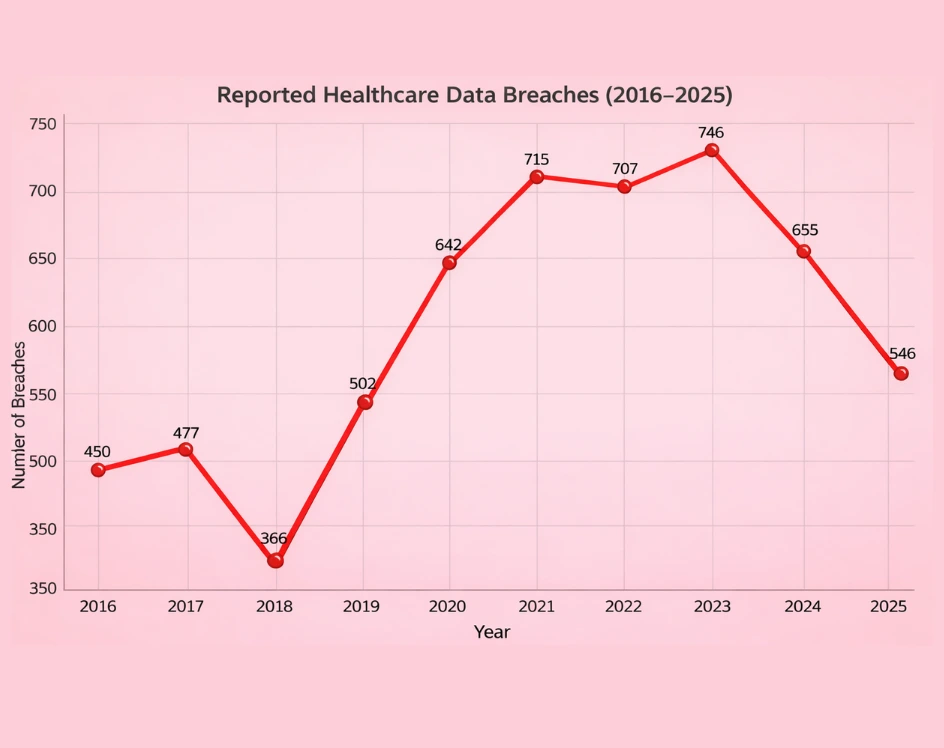
What does the chart highlight?
2016–2018: Breaches ranged between 365–477, relatively moderate.
2019–2021: Rapid escalation, peaking at 715 breaches in 2021.
2022–2023: Still high, with 746 breaches in 2023, the record peak.
2024–2025: Decline to 655 in 2024 and 546 in 2025, but still far above 2016 levels.
What Happens When Healthcare Records Are Compromised?
A breach of health data can have many consequences:
a.) Impact on Patients
When patient information is exposed or altered, the effects are often personal and long-lasting.
- Personal identifiers can be used to commit identity theft or financial fraud.
- Medical information can be altered or corrupted, which affects future care.
- Patients may be unaware that their data was exposed for months or years.
b.) Impact on Care Providers
Beyond individual patients, healthcare organizations themselves face significant operational and professional challenges following a breach.
- Breaches can disrupt daily operations and slow care delivery. In the Change Healthcare case, claims processing delays affected many hospitals.
- Organizations face costly responses, forensic investigations, and remediation.
- Providers may suffer reputational harm that reduces patient confidence.
c.) Economic Impact
The financial consequences extend beyond immediate response efforts and affect the broader healthcare industry.
Healthcare data breaches are among the most expensive for all industries. In recent years, the average cost of a breach in healthcare was approximately $10.93 million, higher than most other sectors.
This includes direct costs responding to the event and indirect costs such as legal compliance, patient support, and technology upgrades.
Comparison of Traditional vs. Blockchain-Based Healthcare Data Security
| Aspect | Traditional Healthcare Data Systems | Blockchain-Based Healthcare Systems |
|---|---|---|
| Data Storage Model | Centralized databases are stored on one or a few servers | Distributed ledger replicated across multiple nodes |
| Point of Failure | Single point of failure; breaching one system can expose all data | No single point of failure; one compromised node does not affect the network |
| Data Integrity | Data can be modified or deleted by insiders or attackers | Immutable records secured through network consensus |
| Access Control | Trust-based roles managed by administrators | Cryptographic access via private keys and smart contracts |
| Tamper Detection | Unauthorized changes may go unnoticed until audits | Any alteration is instantly detectable through hash mismatches |
| Auditability | Audit logs can be incomplete or altered | Transparent, tamper-proof audit trail |
| Insider Threat Protection | High risk if privileged access is misused | Lower risk due to decentralized validation and cryptographic proof |
| Data Sharing | Manual, slow, and fragmented across providers | Secure, real-time sharing with patient consent |
| Patient Control | Limited visibility and control over data access | Patients directly manage access permissions |
| Breach Detection Speed | Detection is often delayed | Near real-time detection of unauthorized activity |
What Blockchain Brings to Healthcare Data Protection?
Blockchain in healthcare provides a different model for how information is stored and verified. Think of it like a digital notary system combined with a chain of locks: every record is sealed, time-stamped, and visible to authorized parties, so tampering is immediately obvious.
a.) Unchangeable History (Immutability)
Modern healthcare platforms increasingly rely on blockchain development services to create linked and verifiable records of all activities. Once data is recorded, it cannot be rewritten without the entire network noticing. This means records remain untouched unless properly updated in a visible way. For patient records, this ensures that no one can secretly alter past information.
b.) Transparent Record of Activity (Auditability)
Blockchain automatically records who accessed or updated data and when it happened. This creates a permanent trace that cannot be hidden. For healthcare, this means every change to a record has a clear timestamp and identity attached.
c.) Decentralized Storage (Distributed Security)
With blockchain, data is shared across multiple network nodes. There is no single server that can be breached to access everything. Attackers would have to compromise multiple systems at once to succeed.
d.) Cryptographic Verification (Data Integrity)
Each blockchain entry is verified using cryptographic methods. If any information is changed without approval, the mismatch is immediately detected because it does not align with the recorded cryptographic fingerprint.
e.) Controlled Access Through Rules (Smart Access Management)
Blockchain platforms can use automated rules to control who can view or add information. These rules are not just stored in a database; they are enforced by the blockchain network itself.
f.) Intelligent Security and Monitoring (AI/ML Integration)
AI and machine learning services complement blockchain by detecting anomalies and potential threats in real-time. ML models can flag suspicious access or unusual data changes, while NLP can analyze logs for irregular activity. Together, they enhance tamper-proof records with proactive security monitoring.
This means a healthcare system can define who is allowed to add test results, modify a treatment plan, or view sensitive identifiers. The activity is then verified by the blockchain protocol.
Why Healthcare Providers Are Adopting Blockchain Services?
Get expert guidance to protect patient records, ensure immutable audits, control access, strengthen data integrity, reduce risks, and build trust across healthcare networks.
How Blockchain Helps Prevent Patient Data Tampering?
Blockchain is particularly useful for preventing the kinds of tampering that have affected healthcare records in real-world breaches. By making records transparent, verifiable, and resistant to unauthorized changes, blockchain helps stop both accidental and intentional manipulation.
1. Immutable Record Keeping
Because every entry remains visible and unchanged, tampering becomes much harder. Unauthorized changes stand out immediately against the permanent record of past entries.
Example: In the Excellus BlueCross BlueShield breach, attackers had undetected access to records for nearly two years. With blockchain, any attempt to alter or delete entries would have been immediately visible, preventing silent tampering.
2. True Auditability
Blockchain makes it possible to track how each record was accessed or updated. This helps institutions respond quickly to suspicious activity and meet compliance requirements.
Example: During the Anthem breach, millions of personal identifiers were accessed without proper authorization. If blockchain had been in place, each access attempt would have been logged transparently, making it easier to identify which records were at risk and who accessed them.
3. Patient Control of Data
Patients can be given tools to grant access to providers when needed and revoke access later. Blockchain healthcare data security helps align data ownership with control, giving patients direct authority over their medical information.
Example: In the American Medical Collection Agency breach, third-party access contributed to 25 million records being exposed. Blockchain would allow patients to directly control which vendors could access their information, minimizing exposure from external parties.
4. Secure Sharing Between Providers
The healthcare industry often involves multiple providers caring for the same patient. Blockchain can support secure sharing so that one provider sees the same verified records as another without permission conflicts or copying.
Example: In cases where multiple hospital systems coordinate care—such as Banner Health’s breach affecting over 3 million records—blockchain could ensure that all providers access a single verified source, reducing the chance of inconsistencies or tampering during record transfers.
5. Reducing Third-Party Risk
Many breaches occur not at hospitals or clinics, but through third-party service providers. When data exchange is verified and logged via blockchain, trust moves away from weak links in the supply chain.
Example: The Change Healthcare ransomware attack disrupted claims processing nationwide. Blockchain could have tracked and verified every external access attempt, limiting the impact of a single vendor’s compromised system.
Use Cases of Blockchain in Healthcare
Blockchain in healthcare has moved beyond theory. Several pilot programs and real implementations now show how the technology protects medical data, manages access, and improves trust across healthcare systems in practical environments.
1. National Level Health Record Protection
At the national level, blockchain is being tested to secure large-scale healthcare data such as vaccination records, lab results, consent information, and billing details without relying on a single centralized system. A prominent example is Estonia’s eHealth System, which uses blockchain technology to protect electronic health records for millions of citizens. By ensuring that records cannot be altered and that every access or update is permanently logged, the system improves transparency, accountability, and trust across healthcare providers while demonstrating that blockchain can function effectively at a national scale.
2. Hospital-Based Pilot Programs
Within hospitals and healthcare organizations, blockchain is being explored to improve credential verification, prescription tracking, and fraud prevention while enabling secure data sharing. The MedRec project, developed by MIT and piloted at Beth Israel Deaconess Medical Center, showed how blockchain can log patient record interactions such as test results, vaccination history, and prescriptions. This pilot demonstrated that blockchain can manage data across different systems and departments while preserving data integrity, maintaining visibility, and creating reliable audit trails of who accessed or updated patient information.
3. Patient-Centered Data Sharing Platforms
Patient-centered blockchain platforms focus on giving individuals greater control over their own health data while enabling secure collaboration among providers and insurers. Companies such as BurstIQ use blockchain to manage consent and data-sharing permissions, allowing patients to decide who can access their records and for what purpose. This approach enhances privacy, reduces risks associated with third-party data exposure, and supports secure data exchange across multiple stakeholders, showing how blockchain can balance usability with strong data protection.
From Concept to Practice
These real implementations show that blockchain is moving from concept to pilot studies and production-scale efforts. Together, they provide practical evidence that blockchain can help address real healthcare data challenges related to integrity, transparency, and trust.
Challenges and What Must Be Addressed in Blockchain Healthcare
While blockchain strengthens transparency and tamper resistance, healthcare adoption requires addressing practical, regulatory, and operational challenges.
| Aspect | Pros | Cons |
|---|---|---|
| Data Integrity | Immutable records prevent unauthorized data changes | Regulatory compliance challenges due to immutability requirements |
| System Architecture | No single point of failure reduces breach risk | High upfront infrastructure and development costs |
| Accountability | Transparent audit trails for all data access | Privacy concerns when handling sensitive data on distributed ledgers |
| Access Control | Patient-controlled access using cryptographic keys | Limited blockchain expertise among healthcare staff |
| Threat Response | Real-time detection of unauthorized activity | Organizational resistance to adopting new technology |
| Security Model | Reduced insider threat through decentralized verification | Integration challenges with existing electronic health record systems |
| Data Sharing | Secure data sharing across healthcare organizations | Interoperability issues with diverse healthcare IT standards |
| Performance | Trustless security based on cryptography and consensus | Scalability challenges with large volumes of daily healthcare data |
Final Thoughts
Patient data tampering and healthcare data breaches have exposed serious weaknesses in traditional systems. Over the last decade, millions of patient records have been compromised, disrupting care and damaging trust.
Blockchain offers a practical way to protect medical records by preventing unauthorized changes, improving transparency, and strengthening accountability. By establishing strong blockchain healthcare data security, healthcare organizations can safeguard patient information while supporting collaboration and care delivery.
As healthcare becomes more digital, blockchain provides a strong foundation for protecting patient information and restoring confidence in how medical data is managed.
Frequently Asked Questions
Q1.What is patient data tampering in healthcare?
Patient data tampering refers to unauthorized changes, deletion, or manipulation of medical records such as diagnoses, prescriptions, test results, or personal identifiers. Even small alterations can affect treatment decisions, billing, and patient safety.
Q2.Why is healthcare data more valuable to attackers than other data?
Healthcare records contain long term personal and medical information that cannot be easily changed, unlike credit card numbers. This makes them highly valuable for identity theft, insurance fraud, and illegal resale on black markets.
Q3.How does blockchain prevent unauthorized changes to medical records?
Blockchain creates immutable and time stamped records that cannot be altered without network consensus. Any unauthorized change becomes immediately visible, making silent data manipulation extremely difficult.
Q4.Can blockchain help detect healthcare data breaches faster?
Yes. Blockchain provides real time auditability by recording every access and modification attempt. This transparency helps healthcare organizations identify suspicious activity early and respond faster than traditional systems.
Q5.Is blockchain compliant with healthcare regulations like HIPAA or GDPR?
Blockchain can support compliance when implemented correctly, using techniques such as off chain data storage, encryption, and controlled access rules. However, regulatory alignment requires careful system design and governance.
Q6.Is blockchain already being used in real healthcare systems?
Yes. Countries like Estonia use blockchain to secure national electronic health records, and pilot programs such as MIT’s MedRec project have demonstrated blockchain based record tracking in hospital environments.
Explore Services
Related Services
Reviewed by

Aman Vaths
Founder of Nadcab Labs
Aman Vaths is the Founder & CTO of Nadcab Labs, a global digital engineering company delivering enterprise-grade solutions across AI, Web3, Blockchain, Big Data, Cloud, Cybersecurity, and Modern Application Development. With deep technical leadership and product innovation experience, Aman has positioned Nadcab Labs as one of the most advanced engineering companies driving the next era of intelligent, secure, and scalable software systems. Under his leadership, Nadcab Labs has built 2,000+ global projects across sectors including fintech, banking, healthcare, real estate, logistics, gaming, manufacturing, and next-generation DePIN networks. Aman’s strength lies in architecting high-performance systems, end-to-end platform engineering, and designing enterprise solutions that operate at global scale.