Ai Overview
Bitcoin has revolutionized the financial landscape by introducing a decentralized peer to peer payment system that operates without intermediaries. Understanding how fees work enables users to optimize their transactions for both cost and speed. At a fee rate of 20 sat/vB, the total fee would be 4,500 satoshis (approximately 0. Miners naturally prioritize transactions offering higher fee rates, as this maximizes their revenue from each block.
Key Takeaways
- Bitcoin Script is a stack based programming language that defines how bitcoins can be spent and ensures only authorized parties can access funds through cryptographic verification.
- Every Bitcoin transaction consists of inputs referencing previous outputs and new outputs specifying recipients, with Bitcoin Script governing the conditions for spending.
- Transaction fees are determined by the transaction size in bytes rather than the amount being transferred, making fee optimization crucial for cost effective transfers.
- The mempool serves as a waiting area for unconfirmed transactions where miners select transactions based on fee rates and available block space.
- SegWit (Segregated Witness) separates signature data from transaction data, effectively increasing block capacity and reducing transaction fees significantly.
- Lightning Network enables instant micropayments by creating payment channels that settle on the main blockchain only when channels are opened or closed.
- Transaction confirmation times depend on network congestion, fee levels, and block discovery intervals averaging approximately ten minutes per block.
- Replace by Fee (RBF) allows users to increase transaction fees for stuck transactions, providing a mechanism to accelerate confirmation during congestion.
- Cold storage solutions provide the highest security for Bitcoin private keys by keeping them completely offline and isolated from potential network threats.
- Understanding Bitcoin Script opcodes and transaction structure is essential for developers building secure wallets, exchanges, and blockchain applications.
Introduction to Bitcoin Transactions
Bitcoin has revolutionized the financial landscape by introducing a decentralized peer to peer payment system that operates without intermediaries. At the heart of this revolutionary technology lies Bitcoin Script, a purposefully designed programming language that secures every transaction on the network. Understanding how Bitcoin Script functions is essential for anyone seeking to grasp the fundamental security mechanisms that protect billions of dollars worth of digital assets.
The security model of Bitcoin transactions relies on cryptographic principles implemented through Bitcoin Script. Unlike traditional banking systems that depend on centralized authorities to verify transactions, Bitcoin uses mathematical proofs executed through this scripting language. Every time someone sends Bitcoin, the network validates the transaction by executing the associated scripts, ensuring that only legitimate owners can spend their coins.
This comprehensive guide explores the intricate workings of Bitcoin transactions, from creation to confirmation. We will examine how Bitcoin Script provides robust security, analyze transaction fees and optimization strategies, understand the role of miners and the mempool, and explore advanced technologies like SegWit and Lightning Network that enhance Bitcoin’s transaction capabilities. Whether you are a developer, investor, or enthusiast, this knowledge forms the foundation for safely participating in the Bitcoin ecosystem.
What Is a Bitcoin Transaction and How It Works
A Bitcoin transaction represents a digitally signed message that transfers value from one or more inputs to one or more outputs on the Bitcoin blockchain. Unlike traditional electronic transfers that move currency between accounts, Bitcoin transactions consume previous unspent outputs and create new outputs that can be spent in future transactions. This UTXO (Unspent Transaction Output) model forms the backbone of Bitcoin’s accounting system.
When you initiate a Bitcoin transaction, you are essentially creating a cryptographic proof that demonstrates ownership of the coins you wish to spend. This proof is validated against the locking script (scriptPubKey) of the previous transaction output you are spending. The unlocking script (scriptSig) you provide must satisfy the conditions set by the locking script for the transaction to be considered valid.
Bitcoin Script plays a crucial role in this process by defining the spending conditions. The most common script pattern, Pay to Public Key Hash (P2PKH), requires the spender to provide a valid signature and corresponding public key. When a node receives a transaction, it concatenates the unlocking and locking scripts and executes them. If the execution completes successfully with a TRUE value remaining on the stack, the transaction is considered valid.
The transaction validation process occurs independently on every node in the Bitcoin network. This distributed validation ensures that no single entity can approve fraudulent transactions. Each node maintains its own copy of the blockchain and verifies every transaction against the consensus rules encoded in the Bitcoin protocol. This decentralized verification is what gives Bitcoin its trustless nature.
Key Components of a Bitcoin Transaction
Understanding the structural elements of a Bitcoin transaction is fundamental to comprehending how Bitcoin Script secures the network. Each transaction contains specific fields that work together to ensure validity, prevent double-spending, and maintain the integrity of the blockchain ledger.
| Component | Description | Purpose |
|---|---|---|
| Version | 4 byte field indicating transaction format version | Enables protocol upgrades and backward compatibility |
| Input Count | Variable integer specifying number of inputs | Defines how many previous outputs are being spent |
| Inputs | References to previous transaction outputs with unlocking scripts | Provides proof of ownership and authorization to spend |
| Output Count | Variable integer specifying number of outputs | Defines how many new UTXOs are created |
| Outputs | Amount and locking script pairs for recipients | Specifies who can spend the bitcoins and under what conditions |
| Locktime | 4 byte field for time based transaction locks | Enables time locked transactions and payment channels |
| Witness Data | Segregated signature data (SegWit transactions) | Reduces transaction size and enables advanced features |
The input section of a transaction contains critical information including the transaction ID (TXID) of the previous transaction, the output index being spent, and the unlocking script (scriptSig). This unlocking script typically contains the digital signature and public key necessary to satisfy the spending conditions defined in the referenced output’s locking script.
Each output specifies an amount in satoshis (the smallest Bitcoin unit, equal to 0.00000001 BTC) and a locking script (scriptPubKey) that defines the conditions for spending. The locking script essentially poses a cryptographic puzzle that must be solved by any future transaction attempting to spend these funds. This elegant design ensures that Bitcoin Script enforces ownership rights without requiring trusted third parties.
Bitcoin Transaction Lifecycle
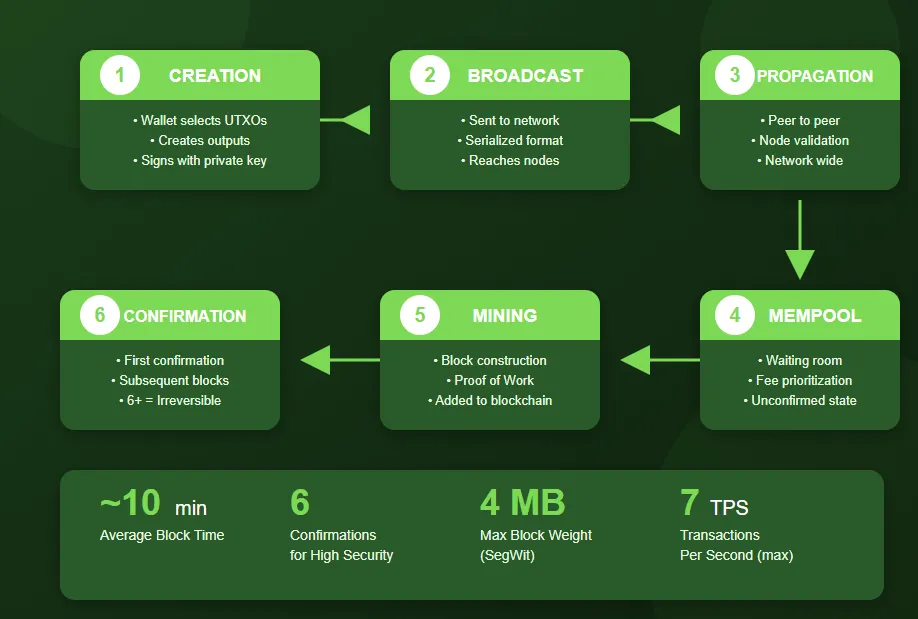
The journey of a Bitcoin transaction from creation to final settlement involves multiple stages, each playing a vital role in ensuring security and consistency across the network. Understanding this lifecycle helps users make informed decisions about fees, timing, and security considerations.
From Transaction Creation to Confirmation
The transaction lifecycle begins when a user constructs a transaction using their wallet software. The wallet selects appropriate UTXOs from previous transactions, creates outputs for the recipient and change (if necessary), and generates the required signatures using the private keys. Once assembled, the transaction is serialized into a hexadecimal format suitable for broadcast.
Upon broadcast, the transaction propagates through the peer to peer network as nodes share it with their connected peers. Each receiving node independently validates the transaction against consensus rules before adding it to their local mempool and forwarding it further. This propagation typically takes only seconds to reach most of the network.
A transaction enters the “unconfirmed” or “pending” state while it resides in the mempool. Miners select transactions from their mempools based primarily on fee rates (satoshis per byte or virtual byte) to include in candidate blocks. When a miner successfully mines a block containing the transaction, it receives its first confirmation.
Each subsequent block added to the blockchain provides an additional confirmation. Most merchants and exchanges consider six confirmations sufficient for high value transactions, as the computational cost to reorganize six or more blocks makes reversal practically impossible. For smaller amounts, fewer confirmations may be acceptable depending on the recipient’s risk tolerance.
Bitcoin Transaction Lifecycle Stages
Creation
Transaction constructed and signed
Broadcast
Sent to Bitcoin network
Propagation
Shared across nodes
Mempool
Awaiting miner selection
Mining
Included in a block
Confirmation
Secured by subsequent blocks
Bitcoin Transaction Fees Explained
Transaction fees represent a critical component of the Bitcoin ecosystem, serving as the primary incentive for miners to include transactions in blocks and securing the network against spam attacks. Understanding how fees work enables users to optimize their transactions for both cost and speed.
How Bitcoin Transaction Fees Are Calculated
Bitcoin transaction fees are calculated based on the transaction’s size in bytes (or virtual bytes for SegWit transactions) rather than the value being transferred. This means sending one million dollars costs the same as sending one dollar, assuming identical transaction structures. The fee rate is expressed in satoshis per byte (sat/B) or satoshis per virtual byte (sat/vB).
The total fee equals the transaction size multiplied by the chosen fee rate. For example, a standard single input, two output transaction might be approximately 225 virtual bytes. At a fee rate of 20 sat/vB, the total fee would be 4,500 satoshis (approximately 0.000045 BTC). During periods of high network activity, users may need to pay significantly higher fee rates to ensure timely confirmation.
Wallet software typically provides fee estimation based on current network conditions. Most wallets offer options like “economy,” “normal,” and “priority” that correspond to different confirmation time targets. Users seeking faster confirmations pay higher fees, while those willing to wait longer can save money with lower fee rates.
Transaction Size and Its Impact on Fees
Transaction size depends primarily on the number of inputs and outputs. Each input adds approximately 148 bytes (or 68 virtual bytes for SegWit), while each output adds about 34 bytes. The base transaction overhead is roughly 10 bytes, plus any witness data for SegWit transactions.
Consolidating multiple small UTXOs into larger ones during low fee periods can reduce future transaction costs. Conversely, receiving many small payments creates numerous UTXOs that will require higher fees to spend later. Businesses and frequent Bitcoin users often implement UTXO management strategies to optimize their fee expenditure over time.
Transaction Type Fee Comparison
| Transaction Type | Typical Size (vBytes) | Fee at 10 sat/vB | Fee at 50 sat/vB |
|---|---|---|---|
| Simple P2WPKH (1 in, 2 out) | 141 vB | 1,410 sats | 7,050 sats |
| Legacy P2PKH (1 in, 2 out) | 226 bytes | 2,260 sats | 11,300 sats |
| Multi input (5 in, 2 out) | 481 vB | 4,810 sats | 24,050 sats |
| Batch payment (1 in, 10 out) | 379 vB | 3,790 sats | 18,950 sats |
| 2 of 3 Multisig (1 in, 2 out) | 297 vB | 2,970 sats | 14,850 sats |
Role of Mempool in Bitcoin Transactions
The mempool (memory pool) functions as a waiting room for unconfirmed Bitcoin transactions. Each full node maintains its own mempool containing transactions it has received and validated but that have not yet been included in a block. Understanding mempool dynamics is essential for predicting confirmation times and setting appropriate fees.
When a transaction enters the mempool, it competes with other pending transactions for limited block space. Bitcoin blocks have a maximum size of approximately 4 million weight units (roughly 1.5 to 2 MB depending on transaction composition). Miners naturally prioritize transactions offering higher fee rates, as this maximizes their revenue from each block.
Mempool size fluctuates based on network activity and block production rate. During periods of high demand, the mempool can grow significantly, causing lower fee transactions to wait longer for confirmation. Conversely, during quiet periods, even minimum fee transactions may confirm quickly. Various online tools provide real time mempool visualization, helping users gauge current network conditions.
Transactions can be evicted from mempools if they remain unconfirmed for extended periods (typically 14 days) or if the mempool reaches its size limit and newer, higher fee transactions need space. However, as long as at least one node retains the transaction, it can still eventually confirm. This behavior varies slightly between different node implementations and configurations.
Bitcoin Transaction Speed and Confirmation Time
Bitcoin’s design prioritizes security and decentralization over raw transaction speed. The average block interval of approximately ten minutes represents a carefully chosen balance between network synchronization, security guarantees, and practical usability. However, actual confirmation times can vary significantly based on multiple factors.
Factors That Affect Bitcoin Transaction Speed
The most significant factor affecting transaction speed is the fee rate relative to other pending transactions. During congested periods, a transaction with an average fee might wait hours or days, while a high fee transaction confirms in the next block. Network congestion follows patterns related to geographic time zones and market activity, with weekends typically seeing lower activity.
Block discovery variance also impacts confirmation times. While blocks average ten minutes apart, the actual interval follows a Poisson distribution. Sometimes blocks arrive within seconds of each other, while other times gaps exceed an hour. This natural variance means even high fee transactions occasionally wait longer than expected simply due to block timing.
Transaction propagation speed matters for time sensitive applications. A transaction must reach miners before it can be included in a block. Using well connected nodes or broadcast services can reduce propagation delays. Some mining pools also offer transaction acceleration services for additional fees.
Unconfirmed Bitcoin Transactions
An unconfirmed transaction has been broadcast to the network but not yet included in a mined block. While visible to the network, it should not be considered final. Merchants accepting unconfirmed transactions risk double spend attacks, especially for larger amounts or when the sender might be motivated to defraud them.
The risk of unconfirmed transactions varies with the fee level and transaction characteristics. A high fee transaction from a trusted source with no Replace by Fee signal presents relatively low risk for small amounts. Conversely, a low fee RBF enabled transaction from an unknown party should never be trusted before confirmation, regardless of the amount.
How to Handle Stuck or Pending Transactions
When a transaction becomes stuck due to insufficient fees, several options exist. If the transaction was created with Replace by Fee (RBF) enabled, you can broadcast a replacement transaction with a higher fee. Most modern wallets support RBF and enable it by default for outgoing transactions.
Child Pays for Parent (CPFP) offers an alternative when RBF is unavailable. By spending the change output of the stuck transaction with a high fee, miners become incentivized to confirm both transactions together. This technique works because miners evaluate transaction packages rather than individual transactions when optimizing block composition.
Transaction accelerator services offered by some mining pools provide another option. These services accept payment (sometimes in other cryptocurrencies) to prioritize specific transactions. However, their effectiveness depends on the pool’s hash rate share, and they cannot guarantee confirmation timing.
Bitcoin Transaction Security and Verification
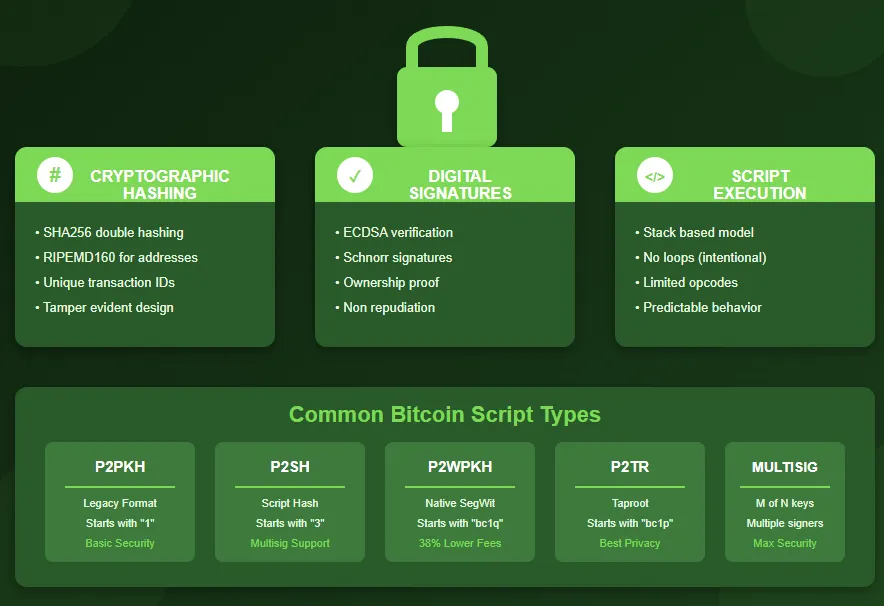
Bitcoin Script serves as the foundation of transaction security, implementing cryptographic verification that ensures only authorized parties can spend coins. The security model relies on well established cryptographic primitives including SHA256, RIPEMD160, and ECDSA (Elliptic Curve Digital Signature Algorithm) to provide mathematical guarantees rather than trust based assurances.
The verification process begins when a node receives a new transaction. The node first performs basic validation checks: proper formatting, reasonable size, valid syntax, and absence of duplicate inputs. It then verifies that each input references an existing, unspent output and that the total input value exceeds or equals the total output value (the difference becomes the transaction fee).
Script execution occurs for each input, combining the unlocking script from the spending transaction with the locking script from the referenced output. Bitcoin Script uses a stack based execution model where operations push and pop values from a stack. After execution completes, if the stack contains a single TRUE value, the input is considered valid.
The intentional limitations of Bitcoin Script contribute significantly to its security. The language lacks loops, which prevents infinite execution attacks. It has limited arithmetic capabilities and a restricted set of operations. These constraints make script behavior predictable and verifiable, essential properties for a consensus critical system processing billions of dollars in value.
Role of Miners in Processing Transactions
Miners serve as the transaction processors of the Bitcoin network, performing the critical function of assembling transactions into blocks and securing them through proof of work. Their economic incentives align with network security, as they earn block rewards and transaction fees only by producing valid blocks that other nodes accept.
When constructing a block, miners select transactions from their mempool to maximize fee revenue while staying within block size limits. This selection process creates a competitive fee market where users bid for limited block space. Miners also perform full validation on every transaction they include, as invalid transactions would cause their block to be rejected.
The proof of work mechanism requires miners to find a nonce value that produces a block hash below the current difficulty target. This computationally intensive process averages ten minutes network wide, though individual miners may go much longer between successful blocks. The difficulty adjusts every 2016 blocks (approximately two weeks) to maintain this average interval as hash rate fluctuates.
Miners play a crucial role in finality by building on top of previous blocks. Each new block makes earlier blocks more secure, as an attacker would need to redo all subsequent proof of work to alter a historical transaction. After six confirmations, the cumulative proof of work makes transaction reversal practically impossible for any entity without majority network hash rate.
Bitcoin Transaction Hash and Tracking
Every Bitcoin transaction receives a unique identifier called the transaction hash (TXID), computed by applying double SHA256 to the serialized transaction data. This 256 bit hash provides a fingerprint that uniquely identifies the transaction across the entire network and throughout blockchain history. For SegWit transactions, a separate witness transaction ID (WTXID) includes the witness data in the hash calculation.
The transaction hash serves multiple purposes in the Bitcoin ecosystem. It enables efficient lookup and reference of transactions without transmitting full transaction data. Other transactions use the TXID to reference outputs they wish to spend. Block explorers and wallets use transaction hashes to track and display transaction status and history.
How to Track a Bitcoin Transaction on Blockchain
Numerous block explorer websites provide interfaces for tracking Bitcoin transactions using their hashes. Popular explorers include mempool.space, blockstream.info, and blockchain.com. These services display comprehensive transaction details including inputs, outputs, fee paid, confirmation status, and the block containing the transaction once confirmed.
Wallet software typically provides built in transaction tracking, displaying the status of sent and received transactions. Most wallets show the number of confirmations and update in real time as new blocks are mined. Some advanced wallets also display mempool position and estimated confirmation time for pending transactions.
For programmatic access, Bitcoin nodes provide RPC commands to query transaction status. The getrawtransaction and gettransaction commands return detailed information about known transactions. Third party APIs from block explorers offer REST interfaces for applications needing transaction data without running a full node.
Bitcoin Script Types Comparison
| Script Type | Address Format | Size Efficiency | Features |
|---|---|---|---|
| P2PKH (Legacy) | Starts with 1 | Baseline | Universal compatibility, established security |
| P2SH | Starts with 3 | Variable | Multisig support, complex scripts hidden |
| P2WPKH (Native SegWit) | Starts with bc1q | ~38% smaller | Lower fees, improved scalability |
| P2WSH | Starts with bc1q (longer) | ~38% smaller | SegWit multisig, complex script support |
| P2TR (Taproot) | Starts with bc1p | Most efficient | Enhanced privacy, Schnorr signatures |
Bitcoin Transaction Limits and Block Size
Bitcoin’s block size limit directly impacts transaction throughput and is central to ongoing scalability discussions. Originally set at 1 MB by Satoshi Nakamoto as a spam prevention measure, this limit has evolved with the SegWit upgrade to a more nuanced weight based system allowing approximately 1.5 to 4 MB of data depending on transaction composition.
The weight system introduced by SegWit counts non witness data at 4 weight units per byte and witness data at 1 weight unit per byte, with a maximum block weight of 4 million units. This design incentivizes the use of SegWit transactions by making them effectively smaller, reducing fees while maintaining backward compatibility with the original size limit.
Transaction limits beyond block size include standardness rules enforced by default node policies. Standard transactions must be less than 100,000 bytes, have outputs greater than dust threshold (typically 546 satoshis for standard outputs), and use recognized script patterns. Non standard transactions can still be mined if they are valid, but propagation through the network may be limited.
Individual outputs have practical minimum values called dust limits. Spending an output costs fees, so outputs worth less than the cost to spend them are considered dust. The exact threshold depends on current fee rates and output type, but wallets typically prevent creating very small outputs to avoid future spending problems.
Bitcoin Transaction Scalability Challenges
Bitcoin’s base layer throughput of approximately 3 to 7 transactions per second presents challenges for global adoption. This limitation stems from the block size and interval constraints necessary for decentralization, as larger or faster blocks would increase node operating costs and reduce network participation.
Various proposals have addressed scalability with different philosophies. Some advocate for on chain scaling through larger blocks, accepting increased centralization pressure. Others favor maintaining base layer constraints while developing second layer solutions for everyday transactions, reserving blockchain space for high value settlements and channel operations.
The scalability trilemma describes the inherent tradeoffs between decentralization, security, and scalability. Bitcoin prioritizes decentralization and security, accepting scalability limitations as a consequence. This design philosophy views the base layer as a settlement network supporting higher layers that can process unlimited transactions with different security models.
SegWit and Its Impact on Bitcoin Transactions
Segregated Witness (SegWit), activated in August 2017, represents one of the most significant upgrades to Bitcoin’s transaction format. The protocol change separates signature (witness) data from transaction data, placing it in a new structure that legacy nodes can ignore. This clever design achieved backward compatibility while enabling substantial improvements.
The primary benefits of SegWit include effective block capacity increase, transaction malleability fix, and script versioning capabilities. By counting witness data at a discount in the weight calculation, SegWit transactions use less block weight, allowing more transactions per block. The malleability fix ensures transaction IDs remain stable, enabling secure construction of payment channels and other off chain protocols.
SegWit introduced new address formats starting with “bc1” using Bech32 encoding. These native SegWit addresses (P2WPKH for single sig, P2WSH for multisig and complex scripts) provide maximum fee savings compared to wrapped SegWit addresses that maintain backward compatibility with older wallets through P2SH wrapping.
Adoption of SegWit has grown steadily since activation, with over 80% of transactions now using SegWit inputs. This adoption has reduced average transaction fees and increased effective block capacity. Wallets and exchanges that have not yet upgraded to SegWit pay unnecessary fee premiums, incentivizing continued adoption.
Lightning Network and Faster Bitcoin Transactions
The Lightning Network represents Bitcoin’s premier second layer scaling solution, enabling instant, low cost transactions through a network of payment channels. Rather than broadcasting every transaction to the blockchain, Lightning users exchange signed transactions directly, settling the net result on chain only when opening or closing channels.
Payment channels work by locking Bitcoin in a multisignature output controlled by two parties. Channel participants can then update their relative balances by exchanging signed commitment transactions without broadcasting them. This approach enables unlimited transactions between channel partners at zero marginal cost, constrained only by channel capacity.
The network aspect of Lightning enables payments between parties without direct channels through routing. If Alice has a channel with Bob, and Bob has a channel with Carol, Alice can pay Carol by routing through Bob. Hash Time Locked Contracts (HTLCs) ensure atomic payment completion, preventing intermediate nodes from stealing funds.
Lightning transactions confirm instantly since they do not require blockchain confirmation. Fees are negligible, often fractions of a satoshi, enabling true micropayments. The network continues growing rapidly, with thousands of nodes and millions of dollars in capacity, supporting use cases from tipping to retail payments that would be impractical on the base layer.
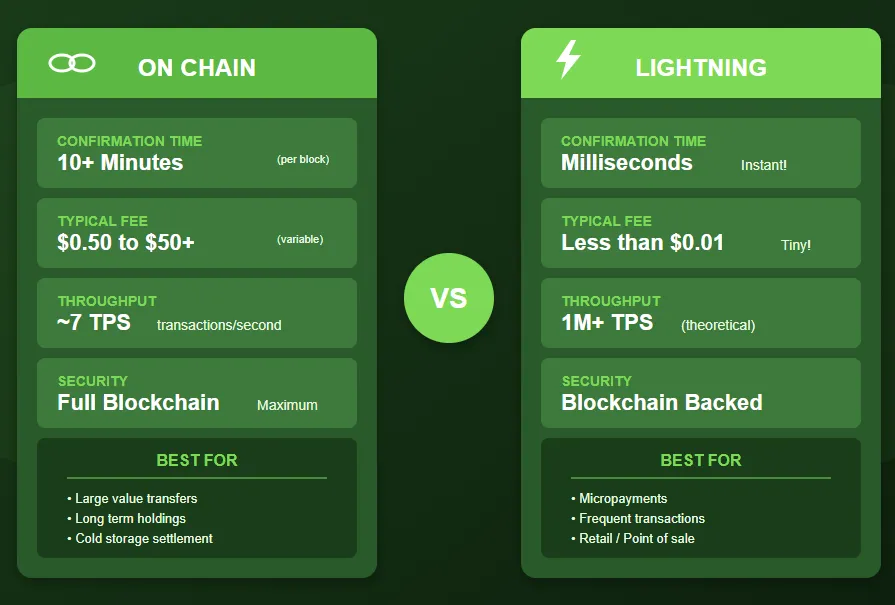
On Chain vs Lightning Network Comparison
| Characteristic | On Chain Transactions | Lightning Network |
|---|---|---|
| Confirmation Time | 10+ minutes (1 confirmation) | Milliseconds to seconds |
| Typical Fee | $0.50 to $50+ (varies) | Less than $0.01 |
| Minimum Amount | ~546 satoshis (dust limit) | 1 satoshi or less |
| Security Model | Full blockchain security | Blockchain backed with online requirements |
| Throughput | ~7 transactions per second | Millions per second (theoretical) |
| Best For | Large amounts, long term storage | Small payments, frequent transactions |
Common Bitcoin Transaction Errors to Avoid
Understanding common transaction errors helps users avoid costly mistakes and frustrating delays. The irreversible nature of Bitcoin transactions makes error prevention particularly important, as recovery options are limited once a transaction is confirmed.
Address Errors: The most serious error involves sending to an incorrect address. Always verify the destination address carefully, especially the first and last several characters. Use QR codes when possible to avoid transcription errors. Some wallets support address verification through multiple channels to prevent man in the middle attacks.
Insufficient Fees: Setting fees too low during network congestion can result in transactions remaining unconfirmed for extended periods. While the funds are not lost, they remain inaccessible until the transaction confirms or is dropped from mempools. Using wallet fee estimation and checking current mempool conditions helps avoid this issue.
Incorrect Network: Sending Bitcoin to an address on a different network (such as a Bitcoin Cash or Litecoin address) can result in permanent loss. While some address formats are unique to specific networks, others may appear valid across multiple chains. Always confirm you are using the correct wallet and network for your transaction.
Dust Outputs: Creating outputs below the dust threshold makes them uneconomical or impossible to spend later. Avoid making very small payments on chain, using Lightning Network instead for micropayments. Some wallets automatically consolidate small UTXOs to prevent dust accumulation.
Fee Sniping: In rare cases, miners might attempt to reorganize recent blocks to capture high fees from transactions. Using locktime set to the current block height provides protection against this attack and is recommended practice for wallet developers.
Best Practices for Efficient Bitcoin Transactions
Adopting best practices for Bitcoin transactions improves security, reduces costs, and ensures reliable confirmation. Whether you are a casual user or managing institutional Bitcoin holdings, these guidelines help optimize your transaction workflow.
Use Native SegWit Addresses: Addresses starting with bc1q provide the lowest fees and best efficiency for standard transactions. Ensure your wallet supports native SegWit and preferentially receive to these addresses. The fee savings compound over time, especially for frequent transactors.
Enable Replace by Fee: RBF provides flexibility to increase fees if transactions become stuck. Most modern wallets enable RBF by default. The minor increase in privacy exposure is typically worth the recovery capability, especially during volatile fee market conditions.
Batch Transactions When Possible: If making multiple payments, combining them into a single transaction with multiple outputs reduces overall fees. The fixed overhead of a transaction (inputs and base data) is shared across all outputs, making batching significantly cheaper than individual transactions.
Consolidate UTXOs During Low Fee Periods: Combine small UTXOs into larger ones when fees are low. This preparation reduces future transaction sizes and costs when you need to make payments during high fee periods. Some wallets offer automatic consolidation features.
Verify Addresses Through Multiple Channels: For significant transactions, confirm the destination address through an independent communication channel. Clipboard hijacking malware can replace addresses without your knowledge. Phone verification or using addresses from signed messages provides additional security.
Maintain Proper Backup Procedures: Secure your wallet seed phrase or private keys with multiple redundant backups stored in separate physical locations. Hardware wallets and multisignature setups provide additional protection for larger holdings. Never store seed phrases digitally or share them with anyone.
Advanced Bitcoin Script Features
Beyond simple payments, Bitcoin Script enables sophisticated transaction types that support complex financial arrangements. These advanced features underpin many of Bitcoin’s most important applications, from multisignature security to atomic swaps.
Multisignature Scripts: Multisig allows requiring multiple keys to authorize a transaction, following an M of N pattern. A 2 of 3 multisig requires any two of three designated keys to spend, enabling secure custody arrangements where no single party has complete control. This structure is popular for business accounts, inheritance planning, and exchange cold storage.
Time Locked Transactions: Bitcoin Script supports absolute and relative time locks through opcodes like OP_CHECKLOCKTIMEVERIFY and OP_CHECKSEQUENCEVERIFY. These enable transactions that cannot be spent until a specific time or block height, useful for scheduled payments, vesting arrangements, and dispute resolution mechanisms.
Hash Locked Contracts: Hash locks require providing the preimage of a hash to spend. Combined with time locks, these form Hash Time Locked Contracts (HTLCs), the fundamental building block of Lightning Network and atomic swaps. HTLCs enable trustless exchange without requiring simultaneous availability of both parties.
Taproot and Schnorr: The Taproot upgrade activated in November 2021 brought Schnorr signatures and Merkleized Alternative Script Trees (MAST) to Bitcoin. These enable more efficient multisig transactions, enhanced privacy by making complex contracts indistinguishable from simple payments, and improved smart contract capabilities.
Bitcoin Improvement Proposals and Transaction Standards
Bitcoin Improvement Proposals (BIPs) define standards that ensure interoperability across the ecosystem. Understanding key BIPs helps users and developers work effectively with Bitcoin transactions and maintain compatibility with existing infrastructure.
BIP32 Hierarchical Deterministic Wallets: This standard defines how to derive multiple keys from a single seed, enabling backup of entire wallets with a single phrase. HD wallets generate new addresses automatically while maintaining recovery capability from the seed alone.
BIP39 Mnemonic Seed Phrases: BIP39 standardizes the conversion of random entropy into human readable word sequences (typically 12 or 24 words). These seed phrases make wallet backup and recovery accessible to non technical users while maintaining strong security.
BIP44 Multi Account Hierarchy: Building on BIP32, BIP44 defines standard derivation paths for multiple accounts and cryptocurrencies. This standardization ensures wallet compatibility and enables users to recover funds in any compliant wallet using their seed phrase.
BIP141 SegWit: The Segregated Witness specification defines the new transaction format, witness structures, and weight calculation. Understanding BIP141 is essential for developers working with modern Bitcoin transactions.
BIP174 PSBT: Partially Signed Bitcoin Transactions enable secure multi party signing workflows. PSBTs allow transactions to be constructed and signed across multiple devices or parties without exposing private keys, essential for hardware wallet integration and multisig operations.
Security Considerations for Bitcoin Transactions
Transaction security extends beyond Bitcoin Script verification to encompass the entire workflow from key generation to transaction broadcast. A comprehensive security approach addresses potential vulnerabilities at each stage of the transaction lifecycle.
Private Key Security: The private key is the ultimate authority over your Bitcoin. Generate keys using cryptographically secure random number generators. Use hardware wallets for significant holdings to keep keys isolated from potentially compromised computers. Never share private keys or seed phrases with anyone under any circumstances.
Transaction Verification: Before signing, carefully verify transaction details on an independent display (hardware wallet screen or air gapped computer). Malware can modify displayed addresses while leaving the actual transaction unchanged. Hardware wallets provide this verification capability as a core security feature.
Network Security: Use trusted Bitcoin nodes for broadcasting transactions when possible. Running your own full node provides maximum privacy and security assurance. If using third party services, prefer those with strong reputations and consider using Tor for additional privacy.
Reorg Risk Management: For high value transactions, wait for sufficient confirmations before considering the transaction final. Six confirmations provide strong security against all but the most powerful adversaries. For very large amounts, additional confirmations or time based waiting periods may be prudent.
Future of Bitcoin Transactions
Bitcoin’s transaction capabilities continue evolving through careful protocol development and layer two innovation. Understanding emerging technologies helps prepare for the future of Bitcoin commerce and applications.
Taproot Adoption: As Taproot adoption increases, users will benefit from improved privacy and lower fees for complex transactions. The ability to hide unused script branches means multisig and time locked transactions will be indistinguishable from simple payments on chain.
Lightning Network Growth: Continued Lightning development focuses on improving user experience, increasing capacity, and enabling new features like atomic multipath payments and channel splicing. These improvements will make Lightning increasingly suitable for everyday commerce.
Cross Chain Capabilities: Technologies like discrete log contracts and sidechains expand Bitcoin’s utility while maintaining the security of the base layer. These approaches enable programmable financial instruments without requiring complex smart contract functionality on the main chain.
Privacy Enhancements: Ongoing work on technologies like CoinJoin implementations, PayJoin, and cross input signature aggregation aims to improve transaction privacy. Better privacy protects users from surveillance and analysis while maintaining Bitcoin’s permissionless nature.
Ready to Build Secure Bitcoin Solutions?
Partner with experts who understand Bitcoin Script and transaction security inside out.
Conclusion: Improving Bitcoin Transaction Efficiency
Bitcoin Script represents a masterpiece of conservative engineering, providing robust security guarantees through intentionally limited functionality. The scripting language’s design prioritizes predictability and safety over flexibility, making Bitcoin transactions trustworthy for securing billions of dollars in value without relying on third party intermediaries.
Understanding Bitcoin transactions—from their structure and lifecycle to fees and confirmation mechanics—empowers users to participate confidently in the Bitcoin ecosystem. Whether you are making simple payments, implementing multisignature security, or building applications on Lightning Network, the foundational knowledge of how Bitcoin Script secures transactions remains essential.
As Bitcoin continues maturing, technologies like Taproot, Lightning Network, and improved privacy tools expand what transactions can accomplish while maintaining the security principles that make Bitcoin valuable. Staying informed about these developments helps users and businesses leverage Bitcoin’s evolving capabilities
Frequently Asked Questions
Q1.Can Bitcoin Script be hacked or exploited?
Bitcoin Script itself is extremely secure due to its intentional limitations. However, poorly written scripts or implementation errors in wallets can create vulnerabilities. The language lacks loops and complex operations specifically to prevent exploitation, making direct hacking virtually impossible when scripts follow standard patterns.
Q2.What happens if I send Bitcoin to the wrong address?
Bitcoin transactions are irreversible once confirmed on the blockchain. If you send Bitcoin to an incorrect address, recovery depends entirely on whether you can contact the address owner. There is no central authority to reverse or cancel the transaction, making address verification critical before sending.
Q3.Why do some Bitcoin transactions take hours to confirm?
Transaction delays typically occur due to low fee attachment, network congestion, or large transaction sizes. During peak times, miners prioritize higher fee transactions. Using appropriate fee estimation tools and understanding current mempool conditions can help avoid extended waiting periods for confirmations.
Q4.Is it possible to cancel a Bitcoin transaction after sending?
Once a transaction is broadcast to the network, cancellation becomes extremely difficult. The only possibility is using Replace by Fee (RBF) if enabled before sending, which allows replacing the original transaction with a higher fee version directing funds back to your wallet.
Q5.How many confirmations are considered safe for Bitcoin transactions?
For most transactions, six confirmations are considered highly secure and nearly irreversible. However, smaller amounts may be accepted with fewer confirmations. Exchanges typically require between three to six confirmations depending on the transaction amount and their security policies.
Q6.Can I recover Bitcoin sent to a SegWit address from a non SegWit wallet?
Modern wallets generally support all address formats. However, some older wallets may face compatibility issues. If your wallet cannot send to SegWit addresses, updating your wallet software or using a compatible wallet is recommended to avoid transaction failures.
Q7.What is the minimum amount of Bitcoin I can send in a transaction?
The minimum sendable amount is technically one satoshi (0.00000001 BTC), but practical minimums are higher due to transaction fees. Sending amounts smaller than the transaction fee makes no economic sense, and many wallets enforce dust limits to prevent uneconomical transactions.
Q8.Do Bitcoin transaction fees go to miners or the network?
Transaction fees go entirely to miners who include your transaction in a block. These fees serve as incentives for miners to process transactions, especially as block rewards decrease over time. The network itself does not collect or distribute fees.
Q9.Can I use Bitcoin Script to create recurring payments?
Bitcoin Script does not natively support recurring payments like traditional banking systems. Each transaction requires manual initiation and signing. However, second layer solutions like Lightning Network enable payment channels that can facilitate subscription style arrangements through different mechanisms.
Q10.What is the difference between a Bitcoin address and a public key?
A Bitcoin address is a hashed and encoded version of the public key, making it shorter and including error checking features. The public key is derived from your private key and is revealed when spending Bitcoin. Addresses provide an additional security layer by hiding the actual public key until funds are spent.
Reviewed by

Aman Vaths
Founder of Nadcab Labs
Aman Vaths is the Founder & CTO of Nadcab Labs, a global digital engineering company delivering enterprise-grade solutions across AI, Web3, Blockchain, Big Data, Cloud, Cybersecurity, and Modern Application Development. With deep technical leadership and product innovation experience, Aman has positioned Nadcab Labs as one of the most advanced engineering companies driving the next era of intelligent, secure, and scalable software systems. Under his leadership, Nadcab Labs has built 2,000+ global projects across sectors including fintech, banking, healthcare, real estate, logistics, gaming, manufacturing, and next-generation DePIN networks. Aman’s strength lies in architecting high-performance systems, end-to-end platform engineering, and designing enterprise solutions that operate at global scale.