Ai Overview
IoT applications must be designed as complete end-to-end systems, not isolated device pilots. Hardware and firmware choices directly affect performance, power efficiency, and long-term reliability. MQTT is the most reliable protocol for real-world IoT communication due to its lightweight design. Network selection (Wi-Fi, LTE, NB-IoT, LoRaWAN) should match coverage, power, and data requirements.
Key Takeaways: Best Tech Stack for IoT App Development
- IoT applications must be designed as complete end-to-end systems, not isolated device pilots.
- Hardware and firmware choices directly affect performance, power efficiency, and long-term reliability.
- MQTT is the most reliable protocol for real-world IoT communication due to its lightweight design.
- Network selection (Wi-Fi, LTE, NB-IoT, LoRaWAN) should match coverage, power, and data requirements.
- Cloud platforms like AWS IoT Core simplify secure device onboarding, scaling, and lifecycle management.
- Event-driven backends handle high-frequency device data more efficiently than traditional architectures.
- Time-series databases are essential for storing and analyzing continuous sensor data.
- Real-time dashboards turn raw IoT data into actionable operational insights.
- Security must be embedded at every layer, from device identity to cloud access control.
- A future-ready IoT stack supports OTA updates, AI integration, and continuous scaling without redesign.
IoT app development is often misunderstood. Many teams believe connecting a device to the cloud and showing some data on a dashboard is “IoT.” In reality, that is only a pilot. A production-grade IoT system is a carefully designed end-to-end architecture where hardware, connectivity, software, security, and data processing work together reliably at scale.
Over the years, I’ve worked on IoT deployments across manufacturing, energy, logistics, and smart infrastructure. The biggest lesson I’ve learned is simple: your tech stack decides whether your IoT system survives real-world load or collapses after the first rollout.
This guide explains the best tech stack for IoT app development, layer by layer, with clarity on why each technology is used, how it works in the system, and what problems it solves.
1. Device & Firmware Layer: Where Everything Starts
Every IoT system begins at the edge. This layer includes sensors, microcontrollers, and the firmware running on them.
Hardware Choices
For most production systems, the best devices fall into two categories:
-
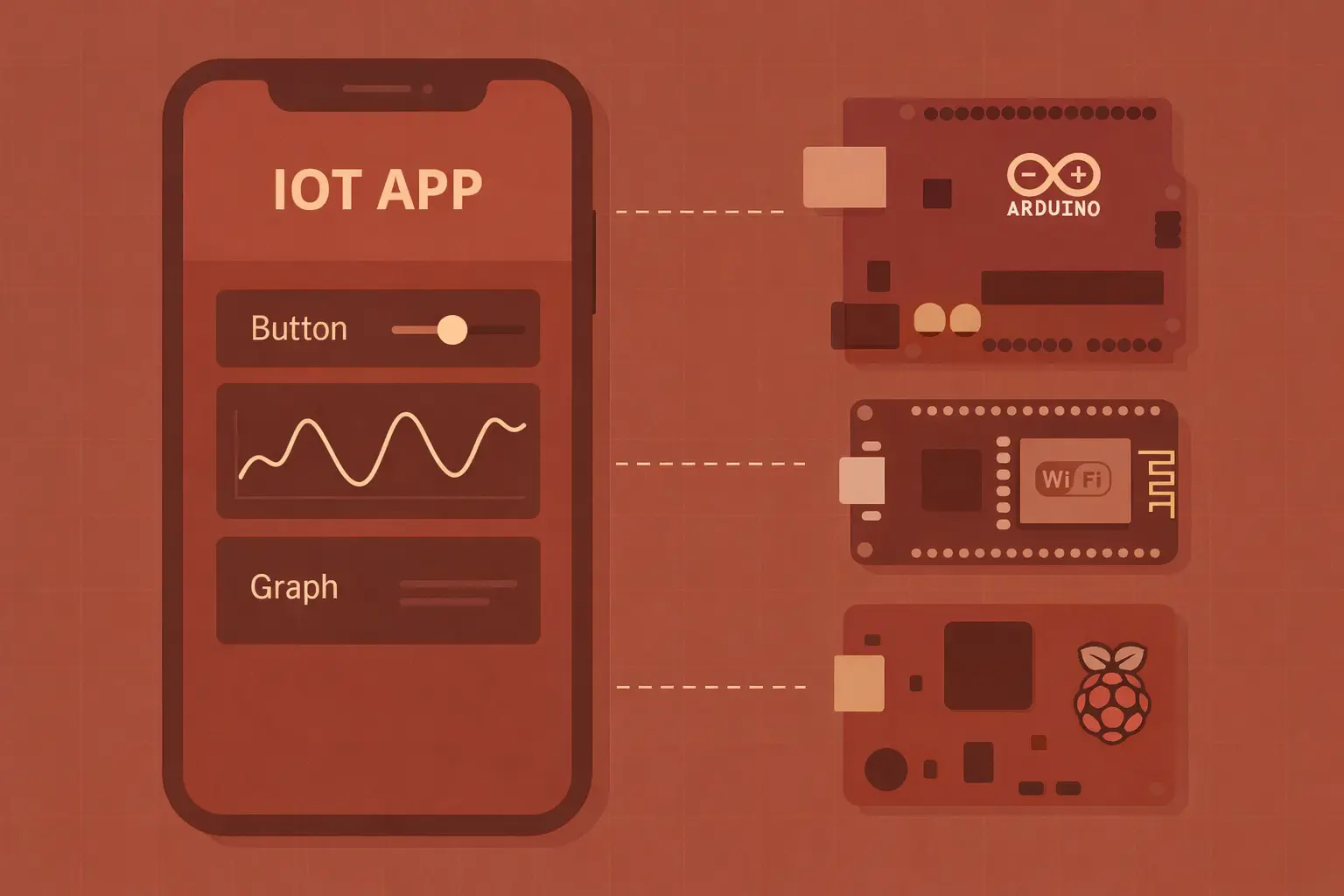
Microcontrollers (MCUs): ESP32, STM32
Best for low power, cost-efficient, always-on devices like meters, trackers, sensors. -
Edge Computers: Raspberry Pi, Jetson Nano
Used when local processing, vision, or AI inference is required.
Why these work best:
-
Proven industrial reliability
-
Strong community and vendor support
-
Wide protocol and OS compatibility
Firmware Languages
-
C / C++ → Industry standard for firmware
Used because of low latency, precise memory control, and deterministic behavior. -
MicroPython → Rapid prototyping only
-
Rust → Emerging option where memory safety is critical
Operating System (RTOS)
-
FreeRTOS or Zephyr RTOS
RTOS allows:
-
Task scheduling (sensor read, network send, OTA update)
-
Stable performance under load
-
Predictable real-time behavior
2. Connectivity & Communication Protocols
Choosing the wrong protocol is one of the most common IoT mistakes.
Best Protocols by Use Case
-
MQTT → Best overall choice
Lightweight, persistent connection, minimal bandwidth usage. -
HTTP/REST → Low-frequency, simple devices
-
CoAP → Ultra-low-power networks
-
WebSockets → Real-time UI updates
Why MQTT Is Preferred
In production systems, MQTT wins because:
-
Devices don’t constantly reconnect
-
Works reliably on unstable networks
-
Supports millions of concurrent devices
-
Enables pub/sub architecture
3. Network Layer: Getting Data Reliably
Your network choice depends on geography, power availability, and data volume.
-
Wi-Fi / Ethernet → Factories, buildings
-
4G / 5G / LTE-M → Mobile or remote assets
-
NB-IoT → Battery-powered sensors (years of life)
-
LoRaWAN → Long-range, low data rate environments
A strong IoT stack supports multiple networks simultaneously, because real systems evolve.
4. IoT Cloud Platform & Device Management
This is where most systems fail if chosen poorly.
Best Cloud Platforms
-
AWS IoT Core (most mature and scalable)
-
Azure IoT Hub (good for Microsoft ecosystem)
-
Google Cloud (analytics-heavy use cases)
I personally prefer AWS IoT Core for production systems because:
-
Scales without redesign
-
Strong security model
-
Deep integration with analytics, AI, and DevOps tools
Core Responsibilities
-
Device identity & authentication (X.509 certificates)
-
Secure message ingestion
-
Device shadows (digital twin)
-
OTA firmware updates
-
Rule-based routing
5. Backend & Application Layer
This layer turns raw device data into usable business logic.
Best Backend Technologies
-
Node.js → Real-time ingestion, event-driven logic
-
Go → High-concurrency, performance-critical services
-
Python → AI, analytics, ML pipelines
-
Java / Spring Boot → Enterprise compliance systems
Architecture Style
-
Microservices (Docker + Kubernetes)
-
Event-driven pipelines
-
Serverless for burst traffic
Why this works:
-
Independent scaling of services
-
Fault isolation
-
Easier long-term maintenance
6. Data Storage & Analytics
IoT data is not traditional data. It is time-series, continuous, and high volume.
Best Databases
-
Time-Series Data: InfluxDB, TimescaleDB
Optimized for sensor readings and trends. -
Metadata & Configurations: PostgreSQL, MongoDB
-
Large-Scale Analytics: Kafka, Spark, Athena
Why this separation matters:
-
Faster queries
-
Lower storage costs
-
Clean data lifecycle management
7. Frontend & User Experience
IoT systems fail if operators cannot understand or act on data.
Web Applications
-
React.js / Next.js
Best for real-time dashboards and enterprise portals.
Mobile Applications
-
Flutter
One codebase, high performance, perfect for IoT field apps.
Visualization Tools
-
Grafana
-
D3.js
-
Custom charts
8. Security Layer (Non-Negotiable)
In production IoT, security is architecture, not a feature.
Mandatory Security Stack
-
Device-level X.509 certificates
-
TLS encryption
-
Secure boot & firmware signing
-
Role-based access control
-
Hardware security modules (TPM)
Why this matters:
-
Prevent device spoofing
-
Protect firmware integrity
-
Meet regulatory and enterprise standards
9. AI & Edge Intelligence (Advanced Systems)
Modern IoT is moving from monitoring to decision-making.
Edge AI
-
TensorFlow Lite
-
OpenVINO
Cloud AI
-
AWS SageMaker
-
Custom ML pipelines
Use cases:
-
Predictive maintenance
-
Anomaly detection
-
Energy optimization
10. DevOps, Monitoring & Scaling
A production IoT system is never “finished.”
DevOps Tools
-
Docker + Kubernetes
-
CI/CD pipelines
-
OTA rollback strategies
Monitoring
-
CloudWatch
-
Prometheus
-
Custom device health metrics
This ensures:
-
Zero-downtime updates
-
Fast incident recovery
-
Continuous improvement
Final Recommended Enterprise Stack
-
Devices: ESP32 + FreeRTOS
-
Protocol: MQTT
-
Cloud: AWS IoT Core
-
Backend: Node.js + Go
-
Database: InfluxDB + PostgreSQL
-
Frontend: React + Flutter
-
Security: X.509, TLS, Secure Boot
FAQ : Best Tech Stack for Iot App Development
Q1.What is the best programming language for IoT app development?
C/C++ is ideal for firmware, Node.js or Go for backend processing, and React or Flutter for building real-time web and mobile IoT applications.
Q2.Why is MQTT preferred in IoT systems?
MQTT uses minimal bandwidth, maintains persistent connections, handles unstable networks well, and efficiently supports real-time communication across millions of connected IoT devices.
Q3.Which cloud platform is best for IoT?
AWS IoT Core is preferred for production systems due to its scalability, built-in security, device management, and seamless integration with analytics and AI services.
Q4.How do IoT devices authenticate securely?
Each device uses a unique X.509 certificate with TLS encryption, ensuring secure authentication, encrypted communication, and prevention of unauthorized device access.
Q5.What database should be used for IoT data?
Time-series databases like InfluxDB or TimescaleDB handle sensor data efficiently, while relational databases store device metadata, configurations, and application-level information.
Q6.Is IoT app development possible without the cloud?
Yes, but cloud platforms simplify scaling, remote device management, analytics, OTA updates, and long-term maintenance for production-grade IoT systems.
Q7.What frontend technologies work best for IoT dashboards?
React or Next.js are ideal for real-time web dashboards, while Flutter provides high-performance, cross-platform mobile apps for IoT monitoring and control.
Q8.How does OTA firmware update work in IoT?
Firmware is securely delivered from the cloud, verified on the device, installed safely, and rolled back automatically if errors occur during updates.
Q9.Can AI be integrated into IoT applications?
Yes, AI enables predictive maintenance, anomaly detection, and optimization using cloud-trained models or edge inference for real-time, low-latency decisions.
Q10.How do IoT systems scale to millions of devices?
Scalability is achieved using MQTT, cloud-native infrastructure, microservices, auto-scaling backend services, and centralized device lifecycle management.
Explore Services
Related Services
Reviewed by

Aman Vaths
Founder of Nadcab Labs
Aman Vaths is the Founder & CTO of Nadcab Labs, a global digital engineering company delivering enterprise-grade solutions across AI, Web3, Blockchain, Big Data, Cloud, Cybersecurity, and Modern Application Development. With deep technical leadership and product innovation experience, Aman has positioned Nadcab Labs as one of the most advanced engineering companies driving the next era of intelligent, secure, and scalable software systems. Under his leadership, Nadcab Labs has built 2,000+ global projects across sectors including fintech, banking, healthcare, real estate, logistics, gaming, manufacturing, and next-generation DePIN networks. Aman’s strength lies in architecting high-performance systems, end-to-end platform engineering, and designing enterprise solutions that operate at global scale.