Ai Overview
The first Bitcoin wallets were command-line tools running on home computers, then graphical desktop applications, then browser extensions. The Statista Global Crypto User Report 2025 documented that 73% of all cryptocurrency transactions globally are now initiated from mobile devices, a figure that reflects not just user preference but the fundamental shift in where digital life happens.
Key Takeaways
- The best mobile crypto wallet in 2026 combines biometric security, multi-chain support, built-in DeFi access, and social recovery in a single seamless interface that mainstream users find as intuitive as a banking app.
- Over 73% of all crypto transactions globally are now initiated from mobile devices, making mobile-first wallet design the industry standard rather than a secondary consideration for any serious Web3 application.
- Account abstraction (ERC-4337) is the foundational architecture that enables gasless transactions, session key automation, and seedless onboarding in the best mobile crypto wallet implementations of 2026.
- AI-powered features including real-time fraud detection, smart transaction suggestions, and portfolio analytics are differentiating the best mobile crypto wallet solutions from basic asset management tools.
- Multi-chain support covering Bitcoin, Ethereum, Solana, TON, BNB Chain, and Layer 2 networks is now a baseline expectation rather than a premium feature for any best mobile crypto wallet competing in 2026 markets.
- Embedded wallet experiences integrated directly into games, social platforms, and marketplaces are becoming the primary Web3 onboarding path for mainstream users, removing the friction of separate wallet app installation entirely.
- Social recovery and passkey-based seedless login are replacing seed phrase management as the standard security model in the best mobile crypto wallet products targeting mainstream audiences globally.
- Layer 2 network integration enabling near-zero gas fees and sub-second transaction finality is essential for the best mobile crypto wallet supporting high-frequency use cases like gaming, micropayments, and DeFi automation.
- Privacy features including zero-knowledge proof integration and granular data controls are emerging as competitive differentiators in the best mobile crypto wallet market as regulatory and user awareness of on-chain privacy grows.
- Businesses investing in mobile crypto wallet development are accessing a global market of 560+ million cryptocurrency users projected to exceed one billion by 2028, with mobile as the dominant access channel throughout this growth period.
Introduction: Why Mobile Is Now the Frontline of Web3
The Mobile-First Transformation of Crypto Access
Cryptocurrency began on desktops. The first Bitcoin wallets were command-line tools running on home computers, then graphical desktop applications, then browser extensions. Each evolution brought blockchain closer to mainstream users, but none of these formats achieved what smartphones have accomplished in the past three years: putting the best mobile crypto wallet in the pocket of every internet-connected person on the planet, ready to access at any moment without unlocking a laptop or navigating to a website. The Statista Global Crypto User Report 2025 documented that 73% of all cryptocurrency transactions globally are now initiated from mobile devices, a figure that reflects not just user preference but the fundamental shift in where digital life happens. People manage their banking, investments, communications, and entertainment from their phones. The best mobile crypto wallet must compete in that same ecosystem, delivering experiences that match the standards set by fintech applications like Cash App, Revolut, and Robinhood while maintaining the self-custody principles, cryptographic security, and decentralized access that distinguish crypto wallets from traditional financial apps. The challenge and opportunity are both immense: the best mobile crypto wallet in 2026 must be simple enough for a first-time user to onboard in under three minutes while being sophisticated enough to serve a professional DeFi operator managing millions across a dozen blockchain networks simultaneously. The smart contract innovations powering account abstraction, the hardware security capabilities built into modern smartphones, and the maturation of multi-chain infrastructure have collectively made this combination achievable in 2026 in ways that were impossible even two years ago.
What Users Now Expect from the Best Mobile Crypto Wallet
User expectations for the best mobile crypto wallet have evolved dramatically. In 2020, a mobile wallet that safely stored Bitcoin and Ethereum and could send transactions was considered good. In 2026, users expect biometric authentication that is as seamless as unlocking their phone, multi-chain asset management covering dozens of networks from a single dashboard, integrated DeFi functionality for staking and swapping without leaving the app, AI-powered analytics that make sense of complex portfolio data, gasless transactions that eliminate the native token requirement for new users, social recovery that means device loss never means asset loss, and embedded experiences within their favorite games and social platforms that do not even look like crypto wallets. This guide maps every dimension of what the best mobile crypto wallet must deliver in 2026 for users across the USA, UK, UAE, Canada, and the global markets where crypto adoption is accelerating fastest.
Understanding Mobile Crypto Wallets: Definition and Rapid Growth
What Is a Mobile Crypto Wallet and How Does It Differ from Other Types?
A mobile crypto wallet is a smartphone application that generates, stores, and manages the cryptographic keys that prove ownership of digital assets on blockchain networks, while providing the user interface through which those assets are viewed, sent, received, and interacted with across Web3 applications. Mobile wallets differ from desktop wallets primarily in their form factor and the security architecture available to them: modern smartphones include dedicated hardware security processors (Secure Enclave on iOS, StrongBox on Android) that perform cryptographic operations in isolated environments inaccessible to software, providing a hardware security guarantee that desktop wallets running on general-purpose computers cannot match without an attached hardware device. Compared to hardware wallets like Ledger or Trezor, mobile wallets sacrifice the air-gapped isolation of dedicated signing devices in exchange for the constant connectivity and convenience that makes real-world daily usage practical. The best mobile crypto wallet addresses this security trade-off by leveraging the smartphone’s hardware security chip as its trust anchor, treating the device’s Secure Enclave with the same respect that a hardware wallet gives its signing chip. The role of mobile wallets in Web3 ecosystems has expanded dramatically beyond simple asset storage: they now serve as identity credentials for dApp authentication, access points for DeFi protocols, NFT display and trading platforms, payment terminals for merchant purchases, and governance voting instruments for DAO participation.
Why Mobile Crypto Wallets Are Growing at Unprecedented Speed
The growth of mobile crypto wallet adoption is driven by the convergence of expanding crypto use cases and the global mobile-first internet population. Global cryptocurrency users reached 560 million in 2024 according to Crypto.com’s Global Crypto Ownership Report, with projections indicating over one billion users by 2028. The majority of this growth is coming from mobile-native emerging market users in Southeast Asia, Latin America, India, and Africa where smartphones are the primary computing device and mobile money systems have primed populations to accept digital financial services. DeFi protocols processing over $100 billion in daily transaction volume, NFT markets generating billions in trading activity, and blockchain gaming with hundreds of millions of players are all primarily accessed through mobile wallets. The introduction of Layer 2 networks that reduce transaction fees to fractions of a cent has made micropayment use cases viable on mobile for the first time, enabling applications like in-game item trading, streaming payments, and social tipping that were previously impractical due to gas costs. These converging forces make mobile wallet development not merely a product opportunity but an infrastructure imperative for any organization serious about participating in the next phase of Web3 growth.
Core Features Users Expect in the Best Mobile Crypto Wallet
User-Friendly Interface and Smooth Navigation
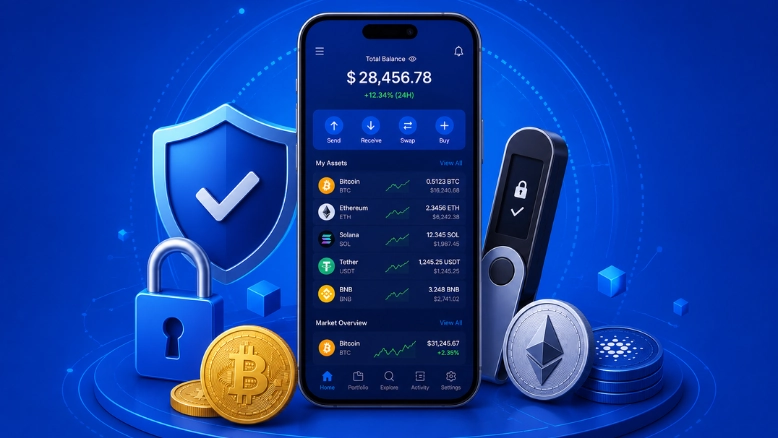
The best mobile crypto wallet begins its user experience before the first transaction: with an onboarding process that does not require users to understand blockchain concepts to complete it. The industry benchmark set by fintech apps like Cash App and Venmo, where account creation takes under 90 seconds, is the standard against which crypto wallet onboarding is now measured and typically found wanting. Leading mobile wallets in 2026 achieve this benchmark through social login options (email, Google, Apple) combined with passkey authentication that generates secure wallet credentials automatically without exposing users to seed phrases. The main dashboard of the best mobile crypto wallet presents a clean portfolio overview showing total asset value, individual asset balances, recent transaction history, and quick access to the most used functions: Send, Receive, Swap, and Buy. The user interface must perform equally on both flagship and mid-range smartphones, with responsive design that works flawlessly on screen sizes ranging from 5.5 to 6.9 inches. Transaction confirmation screens in the best mobile crypto wallet are readable by non-technical users, displaying the recipient name or address with clear formatting, the amount in both crypto and local fiat currency, the network being used, and the estimated fee, with a single large confirmation button that is difficult to accidentally tap. Accessible design including sufficient color contrast, scalable text, and screen reader compatibility extends the best mobile crypto wallet experience to users with visual impairments.
Advanced Security Features Every User Should Demand
Security is the non-negotiable foundation of any best mobile crypto wallet evaluation. The threat landscape for mobile wallets in 2026 includes increasingly sophisticated phishing attacks, clipboard hijacking malware, SIM swapping attacks against SMS-based 2FA, malicious dApp connections, and social engineering targeting seed phrase recovery. The best mobile crypto wallet addresses all of these threats through layered security architecture rather than any single mechanism. Biometric authentication using Face ID, fingerprint recognition, or iris scanning serves as the primary authentication factor, with the biometric template stored only in the device’s secure hardware and never transmitted anywhere. Hardware-backed private key storage in the Secure Enclave (iOS) or StrongBox (Android) ensures that key material cannot be extracted by malware even if the operating system is compromised. Multi-factor authentication for large transactions, passkey support for phishing-resistant passwordless login, and automatic session timeouts complete the authentication security stack. The best mobile crypto wallet also implements real-time malware scanning for installed applications, warning users when potentially malicious apps that could intercept clipboard content are detected, and provides transaction simulation that shows users exactly what a transaction will do before they sign it, preventing the approval of malicious contract interactions disguised as legitimate operations.
Security Features Stack of the Best Mobile Crypto Wallet in 2026
Authentication Layer
- Face ID / Fingerprint biometrics
- FIDO2 passkey support
- Hardware-backed key storage
- Anti-phishing domain binding
- Session timeout controls
Transaction Protection
- Transaction simulation preview
- Malicious contract detection
- Spending limit enforcement
- Clipboard hijack alerts
- Address verification prompts
Recovery Architecture
- Social guardian recovery
- Multi-device credential sync
- Backup hardware key option
- Seedless account creation
- Time-locked recovery flows
Multi-Chain and Multi-Currency Support
Managing assets across multiple blockchain networks is no longer an advanced feature of the best mobile crypto wallet; it is a baseline expectation that every user, from a beginner holding Bitcoin and Ethereum to a DeFi power user operating across eight chains simultaneously, now considers standard. Trust Wallet, consistently rated among the best mobile crypto wallets for multi-chain support, manages over 100 blockchains and 10 million digital assets from a single interface in 2026. The best mobile crypto wallet provides unified portfolio value displayed in the user’s local fiat currency across all supported chains simultaneously, network detection that automatically suggests the correct chain when interacting with dApps, seamless switching between networks without leaving the application, and cross-chain asset swapping powered by aggregator protocols that find the best exchange rates across decentralized exchanges. The networks that the best mobile crypto wallet must support as baseline in 2026 include Bitcoin (including Lightning Network for instant micropayments), Ethereum mainnet, major L2 networks (Polygon, Arbitrum, Optimism, Base), BNB Chain, Solana, TON, and Avalanche at minimum, with extensible architecture that allows new chain additions as the ecosystem evolves.
Fast, Low-Cost Transactions with Layer 2 Integration
Transaction cost and speed are the dimensions where mobile crypto wallets most directly compete with traditional payment systems for everyday use cases. The best mobile crypto wallet addresses this through deep Layer 2 network integration that makes near-zero-fee, near-instant transactions the default experience rather than requiring users to manually select networks and understand gas economics. Real-time gas fee estimation with multiple speed options (slow, standard, fast) helps users make informed fee decisions when gas costs are relevant. Automatic routing to the most cost-effective network for a given transaction type, integrated gas fee sponsorship through Paymaster contracts for applications that offer it, and transaction batching that combines multiple operations into single on-chain submissions all contribute to the low-cost fast transaction experience that the best mobile crypto wallet delivers in 2026.
Built-In Web3 and DeFi Access
The best mobile crypto wallet is not merely a storage and transfer tool but a comprehensive Web3 gateway. WalletConnect v2 integration enables secure connections to any WalletConnect-compatible dApp without requiring users to copy and paste credentials. The built-in dApp browser in the best mobile crypto wallet provides safe access to DeFi protocols, NFT marketplaces, and Web3 applications directly within the wallet interface with malicious site detection that warns before connecting to known phishing domains. Integrated swap functionality powered by DEX aggregators like 1inch or Paraswap enables direct token exchanges within the best mobile crypto wallet without navigating to external platforms, while staking interfaces connected to major protocols like Lido, Rocket Pool, and native chain staking allow users to earn yields on their holdings without complex DeFi navigation.
NFT Storage, Management, and AI-Powered Smart Features
NFT display and management has become a standard feature expectation for any best mobile crypto wallet serving the Web3 audience in 2026. Gallery-style display of NFT collections with high-resolution rendering, cross-chain NFT compatibility covering Ethereum, Solana, Polygon, and other supported networks, direct NFT transfer functionality, and connection to major marketplaces including OpenSea, Blur, and Magic Eden from within the wallet interface are all expected capabilities. AI-powered features are the category that most clearly differentiates leading best mobile crypto wallet implementations from adequate ones. Real-time fraud detection that analyzes transaction destinations, dApp requests, and approval requests against databases of known malicious actors and patterns alerts users before they confirm dangerous operations. Smart transaction suggestions that learn from user behavior, recommend optimal timing for DeFi operations based on gas price trends, and flag unusual activity that deviates from established patterns add intelligence that basic wallets lack. Portfolio analytics with spending categories, yield tracking, and tax estimation tools are moving from premium features to standard expectations in the best mobile crypto wallet products competing for sophisticated users.
Emerging Trends Shaping the Best Mobile Crypto Wallet in 2026
Account Abstraction, Embedded Wallets, and Privacy Features
Account abstraction (ERC-4337) is the architectural foundation that is most fundamentally changing what the best mobile crypto wallet can do for its users. By replacing traditional externally owned accounts with programmable smart accounts, account abstraction enables gasless transactions where applications sponsor fees on behalf of new users eliminating the native token requirement that has historically made new user onboarding so difficult. Session keys enable time-limited, scoped transaction permissions that allow gaming applications to execute automated in-game transactions without requiring user confirmation on every action. Social recovery built into the smart account layer eliminates seed phrases at the infrastructure level rather than as an add-on feature. The Alchemy Web3 Developer Report 2025 confirmed that 73% of new Web3 projects launched in 2025 incorporated ERC-4337 account abstraction, with mobile as the primary delivery platform for these implementations. Embedded wallet experiences represent the most significant distribution innovation for the best mobile crypto wallet in 2026: rather than requiring users to download, configure, and connect a separate wallet application, embedded wallets are integrated directly into consumer applications. A mobile game that includes a built-in wallet powered by Privy, Dynamic, or similar infrastructure can onboard players directly through their existing Google or social account, generate a smart account wallet automatically, and begin rewarding them with crypto assets immediately, all without the player ever encountering the word “wallet” in any interface element. Privacy features including zero-knowledge proof integration, anonymous transaction routing, and granular data controls over what transaction data is visible to which parties are maturing from technical experiments to practical best mobile crypto wallet features that privacy-conscious users are beginning to demand.
Four Emerging Trends Defining the Best Mobile Crypto Wallet in 2026
Account Abstraction
- Gasless transactions via Paymaster
- Session keys for automation
- Seedless social login
- Spending limit enforcement
- Programmable recovery rules
Embedded Wallets
- In-app wallet without download
- Social login account creation
- Invisible crypto UX
- Game and social integration
- Mainstream user onboarding
Privacy Features
- ZK proof integration
- Selective transaction disclosure
- Anonymous swap routing
- Data minimization controls
- Private DeFi access
AI and Automation
- Real-time fraud detection
- Smart transaction suggestions
- Portfolio analytics AI
- Gas price optimization
- Anomaly pattern detection
Challenges Mobile Crypto Wallets Still Face in 2026
Honest evaluation of the best mobile crypto wallet landscape requires acknowledging the persistent challenges that no wallet has fully resolved and that users must navigate with awareness rather than assuming the technology protects them completely.
⚠ Security Risks on Mobile Devices
Mobile devices running malware, connecting to compromised public Wi-Fi networks, or falling victim to SIM swapping attacks present ongoing security risks that even the best mobile crypto wallet cannot fully mitigate through software alone. Users must maintain device hygiene, use VPNs on public networks, avoid installing unverified apps, and use account-based 2FA rather than SMS-based authentication to minimize these exposure surfaces.
⚠ Convenience vs Decentralization
The features that make the best mobile crypto wallet convenient for mainstream users, social login, cloud backup, and embedded infrastructure, often introduce centralized dependencies that partially compromise the self-sovereignty principles that distinguish crypto from traditional finance. The industry has not yet achieved perfect solutions that deliver Web2-level convenience while maintaining pure Web3 decentralization.
⚠ Scalability and Network Congestion
Despite Layer 2 progress, peak network congestion events during major NFT launches or DeFi activity still produce gas fee spikes and transaction delays that affect mobile wallet user experiences. Multi-chain synchronization limitations mean that the best mobile crypto wallet may have slight delays in reflecting accurate balances during high-traffic periods across multiple networks.
How Businesses Benefit from Mobile Crypto Wallet Development
Opportunities for Startups and Enterprises Investing in Wallet Solutions
The business case for investing in the best mobile crypto wallet development is grounded in the convergence of a large and growing addressable market, multiple viable monetization models, and competitive advantages that compound over time through accumulated user data and loyalty. For consumer-facing businesses, a proprietary best mobile crypto wallet creates a direct relationship with users’ financial activity that generates transaction fee revenue, data insights, and cross-selling opportunities for premium features. Gaming companies that embed wallets into their applications benefit from in-game economies powered by real-value digital assets that increase player engagement and revenue per user. Payment platforms building on blockchain rails avoid the interchange fees and processing delays of traditional payment networks while offering global reach that legacy payment systems cannot match cost-effectively. DeFi protocols that provide a branded best mobile crypto wallet interface increase their TVL (total value locked) by creating a frictionless path from wallet onboarding directly to protocol interaction. Enterprise blockchain applications for supply chain, trade finance, and digital identity benefit from mobile wallet interfaces that make complex blockchain interactions accessible to non-technical employees and partners. The revenue opportunities available to businesses through wallet services include transaction fees (typically 0.1-0.5% of swap volume), premium subscription tiers with enhanced analytics and security features, fiat on-ramp referral fees, staking product referrals, NFT marketplace integration fees, and enterprise licensing for white-label wallet infrastructure.
3-Step Framework for Business Investment in Best Mobile Crypto Wallet Development
Define Your User Segment and Use Case
Determine whether your target is beginner consumers needing simplified onboarding, DeFi power users demanding advanced features, enterprise teams requiring compliance controls, or gaming audiences wanting embedded wallet experiences. Each segment demands different feature priorities, security architectures, and UX approaches that must be defined before technical decisions are made.
Choose Architecture and Technology Stack
Select ERC-4337 account abstraction for smart account capabilities, choose Bundler and Paymaster providers, determine your chain support scope, evaluate embedded wallet infrastructure providers (Privy, Dynamic, Web3Auth), and plan the integration architecture for existing backend systems before writing production code. Technology choices made here determine capability ceilings that are expensive to change post-launch.
Launch, Audit, and Continuously Improve
Complete third-party security audits covering all smart contract components before launch, establish monitoring for security anomalies and performance degradation, and implement a user feedback loop that continuously refines the mobile experience. The best mobile crypto wallet in a competitive market is never finished; it improves continuously based on user behavior data and emerging security research.
Choosing the Best Mobile Crypto Wallet in 2026
Key Evaluation Factors and Common Mistakes to Avoid
Selecting the best mobile crypto wallet for your specific needs requires evaluating multiple dimensions in a specific priority order. Security comes first and always: verify that the wallet has undergone independent third-party security audits, that private keys are stored in hardware-backed secure storage, and that the recovery mechanism provides genuine protection against device loss without requiring perfect seed phrase management. Supported cryptocurrencies and blockchains must match your intended usage: a wallet optimized for Ethereum DeFi may have limited Bitcoin Lightning Network support and vice versa, and the best mobile crypto wallet for your situation is the one that covers your actual asset portfolio without requiring multiple separate applications. User experience quality is more consequential than it might initially appear, as friction in the daily interaction with your wallet affects how frequently you check balances, how carefully you verify addresses before sending, and how likely you are to use the wallet’s security features consistently. Recovery and backup options determine what happens in the worst case: the best mobile crypto wallet provides multiple recovery paths including guardian-based social recovery, multi-device credential sync, and backup hardware key options. Common mistakes when choosing include prioritizing feature count over security audit history, selecting wallets based on UI aesthetics without verifying smart contract security, ignoring the recovery mechanism until recovery is actually needed, and using the same wallet application for both small daily transactions and large savings holdings that would benefit from different security configurations.
Best Mobile Crypto Wallet Evaluation Framework: Feature Comparison by User Type
| Evaluation Factor | Beginners | DeFi Users | Enterprise |
|---|---|---|---|
| Security Priority | Social recovery, biometrics | Transaction simulation, hardware | Multi-sig, audit records |
| Chain Support Needed | BTC, ETH, SOL basics | All EVM + L2 + Solana | Custom chain + compliance |
| UX Priority | Simple onboarding, seedless | Advanced analytics, speed | Role-based access, reporting |
| Recovery Mechanism | Guardian or cloud sync | Multiple hardware keys | Institutional guardian service |
| Top Wallet Examples | Coinbase Wallet, Argent | MetaMask, Trust Wallet | Safe, custom wallet build |
Future of Mobile Crypto Wallets: 2026 and Beyond
AI-Driven Experiences, Digital Identity Hubs, and Mainstream Adoption
The trajectory of the best mobile crypto wallet points toward three converging futures that will collectively define what mobile blockchain interaction looks like by 2028-2030. AI-driven wallet experiences will transform the best mobile crypto wallet from a tool that users actively manage into an intelligent agent that manages itself on the user’s behalf, optimizing yield strategies, timing DeFi operations based on gas and market conditions, identifying and acting on investment opportunities within the user’s defined risk parameters, and proactively resolving security issues before they materialize. The wallet as digital identity hub represents the second major trajectory: as Verifiable Credentials, DIDs, and self-sovereign identity systems mature, the best mobile crypto wallet will become the single application through which users manage not only their financial assets but their professional credentials, government identity documents, healthcare records, and social reputation, interacting with both Web3 applications and traditional services through the same cryptographic identity interface. Mainstream adoption supported by seamless cross-chain transaction infrastructure, invisible account abstraction, and AI-handled complexity will transform the wallet from a specialized tool for crypto-native users into the standard financial and identity interface for internet users globally, just as email clients went from specialized technical tools to universal communication infrastructure within a decade. The best mobile crypto wallet of 2030 will likely be invisible: users will transact, authenticate, and manage digital assets through experiences that feel like normal mobile applications, with all the blockchain complexity handled by intelligent infrastructure that the user never encounters directly.
Best Mobile Crypto Wallet: Future Feature Roadmap
| Feature | User Benefit | Timeline | Status |
|---|---|---|---|
| AI Portfolio Management | Automated yield optimization | Active 2026 | Production |
| Digital Identity Hub | Assets + credentials in one app | 2026-2027 | Emerging |
| Universal Cross-Chain Swaps | Any asset, any chain, instantly | Active 2026 | Production |
| Invisible Wallet UX | No visible crypto complexity | 2027-2028 | Research |
| Billion-User Mass Adoption | Web3 as mainstream digital finance | 2028-2030 | Projected |
Authoritative Principles for Building the Best Mobile Crypto Wallet in 2026
Principle 1: Security architecture must be designed before UI design; the best mobile crypto wallet that looks beautiful but stores keys in vulnerable software storage provides worse real-world protection than a plain wallet with hardware-backed secure key storage.
Principle 2: Onboarding completion rate is the most important launch metric for any best mobile crypto wallet targeting mainstream users; a wallet that achieves 30% onboarding completion serves far fewer users than one with 80% completion regardless of feature richness post-onboarding.
Principle 3: Recovery mechanism design is the highest-stakes product decision in mobile wallet development; a wallet with no practical recovery path for device loss will generate permanent fund loss incidents that destroy user trust and generate severe reputational damage.
Principle 4: Transaction simulation that shows users exactly what approving a wallet interaction will do on-chain is not an optional feature; it is a mandatory consumer protection that any best mobile crypto wallet serving mainstream users must implement before accepting dApp connections.
Principle 5: Multi-chain support must include real synchronization of balances and transaction history, not merely the ability to add network configurations; a best mobile crypto wallet that shows stale balances creates financial decision-making errors that users rightfully blame on the wallet.
Principle 6: AI fraud detection in the best mobile crypto wallet must operate in real time at the point of transaction confirmation, not as a post-incident notification; warnings that arrive after the user has confirmed a malicious transaction provide no protective value.
Principle 7: Performance on mid-range smartphones is as important as performance on flagships for any best mobile crypto wallet targeting global markets where mid-range devices represent the majority of the user base, particularly in high-growth markets across Southeast Asia, Africa, and Latin America.
Principle 8: Third-party security audits of the best mobile crypto wallet must cover both smart contract components and mobile application code security; vulnerabilities in either layer can result in user fund loss, and self-assessment is insufficient for any wallet storing significant user asset values.
Conclusion: The Best Mobile Crypto Wallet Is the Gateway to Web3’s Billion-User Future
The competition to build the best mobile crypto wallet in 2026 is ultimately competition to be the interface through which the next several hundred million people experience blockchain technology for the first time. This makes mobile wallet design one of the highest-stakes product disciplines in the entire Web3 ecosystem: the wallets that get it right will become the Safaris and Chromes of the decentralized web, default applications that users trust with their financial lives and digital identities for years. The wallets that get it wrong will generate the horror stories of lost funds, confusing interfaces, and security failures that slow mainstream adoption for everyone. Getting it right means delivering biometric security that hardware-backs every key operation, multi-chain coverage that follows users wherever blockchain-based value flows, account abstraction that makes gasless seedless onboarding the default experience, AI intelligence that protects against the increasingly sophisticated threats targeting crypto users, and social recovery that ensures device loss is never fund loss. It means embedded wallet experiences that bring Web3 to users who will never consciously use a crypto wallet but will benefit from its infrastructure daily through games, social platforms, and payment applications that use blockchain rails invisibly.
For users choosing a best mobile crypto wallet today, the message is equally clear: security architecture and recovery planning are not features to evaluate last; they are the foundation that determines whether the best mobile crypto wallet that works wonderfully today will still be protecting your assets reliably in five years. Prioritize wallets with independent security audits, hardware-backed key storage, and practical recovery options over those with impressive feature lists but unverified security foundations. For businesses investing in mobile crypto wallet development, the window to establish market position in this rapidly maturing category is open now and will close as the market consolidates around the solutions that best serve the mainstream user expectation of Web2 simplicity combined with Web3 sovereignty.
Key Summary: What Makes the Best Mobile Crypto Wallet in 2026
- Security foundation: Hardware-backed biometric authentication with transaction simulation is the non-negotiable baseline for any best mobile crypto wallet recommendation
- Onboarding quality: Seedless social login with account abstraction achieving 90-second wallet creation defines the best mobile crypto wallet onboarding standard in 2026
- Multi-chain depth: Real-time synchronized balances across 10+ blockchain networks with unified portfolio view separates leading implementations from adequate ones
- AI intelligence: Real-time fraud detection, transaction simulation, and portfolio analytics are differentiating features of the best mobile crypto wallet in a competitive 2026 market
- Recovery assurance: Social recovery guardians, multi-device sync, and backup hardware key options ensure device loss never equals fund loss in the best mobile crypto wallet
- Future readiness: Account abstraction integration, embedded wallet support, and AI-driven automation position the best mobile crypto wallet to serve the billion-user Web3 market approaching by 2028-2030
Frequently Asked Questions (FAQs)
Q1.What is a mobile crypto wallet?
A mobile crypto wallet is a smartphone application that allows users to store, manage, send, and receive cryptocurrencies securely. These wallets also provide access to Web3 services such as DeFi platforms, NFT marketplaces, blockchain games, and crypto payments. Modern mobile wallets are designed for convenience, security, and multi-chain asset management.
Q2.Which features make the best mobile crypto wallet in 2026?
The best mobile crypto wallet in 2026 includes features like biometric authentication, multi-chain support, AI-powered security alerts, NFT management, DeFi integration, fast transactions, and social recovery options. Users also expect a clean user interface and seamless connectivity with decentralized applications.
Q3.Are mobile crypto wallets safe to use?
Yes, mobile crypto wallets can be very secure when they use advanced protection features such as encryption, biometric login, multi-factor authentication, and secure private key storage. However, users should still avoid phishing links, unsafe public Wi-Fi networks, and unofficial wallet apps to reduce security risks.
Q4.What is the difference between custodial and non-custodial mobile wallets?
Custodial wallets store private keys on behalf of users through a third party, while non-custodial wallets give users full control over their private keys and digital assets. Non-custodial wallets offer greater ownership and privacy, but users are responsible for managing recovery phrases and wallet security themselves.
Q5.Why is multi-chain support important in mobile crypto wallets?
Multi-chain support allows users to manage cryptocurrencies from different blockchain networks within a single wallet app. This improves convenience and eliminates the need to switch between multiple wallets for Bitcoin, Ethereum, Solana, TON, and other digital assets. It also enhances access to cross-chain DeFi and Web3 applications.
Q6.How do biometric security features improve mobile crypto wallets?
Biometric security features such as fingerprint scanning and facial recognition add an extra layer of protection to mobile crypto wallets. These authentication methods help prevent unauthorized access while making the login process faster and more user-friendly compared to traditional passwords or PIN codes.
Q7.Can mobile crypto wallets store NFTs?
Yes, most modern mobile crypto wallets support NFT storage and management. Users can securely hold, view, transfer, and sometimes trade NFTs directly from their wallet applications. Many wallets also support NFTs across multiple blockchain networks, making digital asset management easier.
Q8.What role does AI play in modern mobile crypto wallets?
AI is increasingly used in mobile crypto wallets for fraud detection, transaction analysis, portfolio insights, and automated security monitoring. Some advanced wallets also use AI assistants to help users manage assets, track spending patterns, and identify suspicious wallet activity in real time.
Q9.What should users check before choosing a mobile crypto wallet?
Before choosing a mobile crypto wallet, users should evaluate security features, supported cryptocurrencies, backup and recovery options, app performance, user reviews, and Web3 compatibility. It is also important to verify whether the wallet supports DeFi, NFTs, staking, and cross-chain transactions.
Q10.What is the future of mobile crypto wallets?
The future of mobile crypto wallets will focus on AI automation, account abstraction, embedded finance, and passwordless authentication. Wallets are expected to become more user-friendly, interoperable, and secure while serving as digital identity hubs for Web3 applications, payments, NFTs, and decentralized services.
Explore Services
Related Services
Reviewed by

Aman Vaths
Founder of Nadcab Labs
Aman Vaths is the Founder & CTO of Nadcab Labs, a global digital engineering company delivering enterprise-grade solutions across AI, Web3, Blockchain, Big Data, Cloud, Cybersecurity, and Modern Application Development. With deep technical leadership and product innovation experience, Aman has positioned Nadcab Labs as one of the most advanced engineering companies driving the next era of intelligent, secure, and scalable software systems. Under his leadership, Nadcab Labs has built 2,000+ global projects across sectors including fintech, banking, healthcare, real estate, logistics, gaming, manufacturing, and next-generation DePIN networks. Aman’s strength lies in architecting high-performance systems, end-to-end platform engineering, and designing enterprise solutions that operate at global scale.