Ai Overview
Before digging into the numbers, it helps to define what we mean when we talk about staking and farming fees. On the Ethereum mainnet, a single farming transaction can cost $20 to $100 or more when the network is congested. 5% annual rewards on that TVL, the revenue generated is substantial. The same staking or farming activity on a Layer 2 can cost 90% to 99% less in gas fees.
Key Takeaways
- DeFi’s Total Value Locked hit a record $237 billion in Q3 2025, with Ethereum commanding over 49% of the sector’s value, showing how much capital is now flowing through protocols where staking and farming fees directly affect user returns.[1]
- Lido, the largest liquid staking protocol, charges a 10% fee on staking rewards, splitting it evenly between node operators and the DAO treasury, while Rocket Pool charges 14% of staking rewards, all directed to node operators.
- Ethereum gas fees dropped by 95% after the Dencun upgrade, with the average gas price falling from 72 gwei to roughly 2.7 gwei by October 2025, making staking transactions far cheaper than in previous years.[2]
- On Ethereum mainnet, a single yield farming transaction can cost $20 to $100 or more during busy periods, meaning a farmer with just $500 could lose 40% of their position to gas fees across four standard transactions (deposit, claim, compound, withdraw).[3]
- Uniswap V3 introduced multiple fee tiers (0.05%, 0.30%, and 1%) for each token pair, allowing liquidity providers to choose fee levels that match asset volatility and risk profile.[5]
- PancakeSwap charges a swap fee of 0.20%, which is below the industry standard of 0.30%, and in its V2 model, 0.17% of the 0.25% trading fee goes back to liquidity providers
- Coinbase charges a 35% commission on ETH staking rewards through its cbETH liquid staking token, making it one of the most expensive centralized staking options compared to the 10% charged by protocols like Lido and Binance.[4]
- Layer 2 networks like Arbitrum, Optimism, and Polygon offer 90% to 99% reductions in gas costs while maintaining Ethereum’s security, and Arbitrum alone surpassed $10.4 billion in TVL by mid 2025.[5]
- Service fees across major staking platforms range from 8% to 23% of staking rewards, with Bedrock (RockX) charging the highest at 20% commission on fee rewards, while StakeWise and Ankr maintain 10% fee structures.
- Liquid staking protocols now represent 27% of total DeFi TVL, with Lido alone managing $34.8 billion, meaning fees charged by these protocols affect more than a quarter of all capital locked in decentralized finance.[6]
If you have been putting your crypto to work through staking or yield farming, you have almost certainly noticed that the returns you actually pocket are never quite what was advertised. Even with the growing range of DeFi solutions available today, the gap between the shiny APY numbers on a protocol’s homepage and what ends up in your wallet usually comes down to one thing: fees.
Staking and farming fees are the tolls you pay every time you interact with a DeFi protocol. Some are obvious, like the gas you burn when you submit a transaction on Ethereum. Others are less visible, such as the percentage a staking platform quietly takes from your rewards, or the performance fee a yield aggregator charges for auto-compounding your returns. And then there are the hidden costs that most guides don’t talk about, like the slippage you absorb when entering or exiting a liquidity pool, or the opportunity cost of a lock-up period.
This blog is built for anyone who wants to know exactly where their money goes when they stake tokens or farm yields in DeFi. We will walk through every type of fee you will encounter, compare what major protocols charge, explain how gas costs differ across blockchains, and share practical ways to keep more of your earnings. Whether you are a newcomer trying to make sense of your first staking dashboard or a seasoned farmer optimizing across multiple chains, understanding these costs is the difference between profitable participation and quietly bleeding money.
What Are Staking and Farming Fees?
Before digging into the numbers, it helps to define what we mean when we talk about staking and farming fees. These are the costs that users incur when they participate in DeFi protocols that offer rewards for locking up or providing crypto assets. The fees vary depending on the activity (staking versus farming), the platform, the blockchain network, and the specific smart contract design of the protocol.
At the broadest level, staking fees in DeFi are the charges associated with locking your tokens into a Proof of Stake blockchain or a liquid staking protocol. You might pay a network gas fee to execute the staking transaction, and the protocol itself might take a cut of the rewards you earn. Some platforms also charge withdrawal fees or impose penalties for early unstaking.
Yield farming fees operate in a similar orbit but tend to be more layered. When you provide liquidity to a decentralized exchange or deposit tokens into a lending protocol, you encounter swap fees, deposit and withdrawal gas costs, performance fees (if you are using a yield aggregator), and sometimes management fees on top of that. The fee stack in yield farming can be surprisingly tall, and each layer chips away at your net return.
Understanding these DeFi staking costs and platform fees for yield farming is not optional if you want to be profitable. A protocol offering 15% APY sounds great until you realize that between the 10% reward commission, the gas you spent entering and exiting, and the slippage on your trades, your actual return is closer to 8% or even less.
Types of Fees in DeFi Staking
DeFi staking involves several categories of fees. Some are charged by the blockchain network itself, others by the staking platform, and a few only show up under specific circumstances. Let’s go through each one.
1. Network Gas Fees (Transaction Fees in Staking)
Every time you send a staking transaction on a blockchain, you pay a gas fee. This is the cost of getting your transaction processed and confirmed by the network’s validators. On Ethereum, gas fees have historically been one of the biggest pain points for stakers. During the 2021 bull run, it was common to pay $50 to $200 just to interact with a staking smart contract.
The situation improved dramatically after Ethereum’s Dencun upgrade in March 2024. Average gas prices on Ethereum fell from around 72 gwei before the upgrade to roughly 2.7 gwei by October 2025. A simple swap that once cost $86 now averages just $0.39. For stakers, this means the cost of entering and exiting staking positions on the Ethereum mainnet has dropped to a fraction of what it used to be.
On other blockchains, gas fees have always been lower. Solana transactions cost fractions of a cent. Binance Smart Chain transactions typically run a few cents. Polygon charges around $0.0075 per transaction. These low gas environments make it far more practical to stake smaller amounts without the fees eating into your returns.
2. Platform Commission Fees
Most staking platforms take a percentage of the rewards you earn. This is how the protocol funds its operations, pays node operators, and fills its treasury. The commission rate varies significantly between platforms.
Lido, the largest liquid staking protocol for Ethereum, charges a 10% fee on staking rewards. This fee is split between the node operators who actually run the validators and the Lido DAO treasury. Rocket Pool, the second-largest Ethereum staking protocol, charges 14% of staking rewards, with all of it going to node operators. Binance’s standard service fee for ETH staking is also 10%. Coinbase, on the other hand, takes a much larger cut, charging a 35% commission on staking rewards through its cbETH liquid staking token.
These commission differences add up substantially over time. If you stake $10,000 worth of ETH, earning a base reward of 3.5% per year, a 10% commission means you lose about $35 per year. A 35% commission on the same position would cost you roughly $122.50 per year. Over five years, that gap becomes hundreds of dollars on a relatively modest position.
3. Validator Commission Fees
If you are staking on a delegated Proof of Stake network like Solana, Cosmos, or Polkadot, you typically delegate your tokens to a validator who charges a commission on the rewards they distribute. These commissions are set by each individual validator and can range from 0% (promotional rates) to 20% or more. Solana itself does not charge staking fees, but validators commonly take a commission on the rewards they pass along to delegators.
4. Withdrawal and Unstaking Fees
Some platforms charge a fee when you withdraw your staked tokens. Jito, a popular Solana liquid staking protocol, charges a 0.1% fee on the total withdrawal value in addition to its 4% annual management fee on rewards. Other platforms may impose early withdrawal penalties if you unstake before a specified lock-up period ends. These fees are designed to discourage rapid fund movements that could destabilize the protocol’s operations.
5. Slashing Penalties
While not technically a “fee,” slashing is a risk that can reduce your staked balance. If the validator you delegate to misbehaves or goes offline, the network may slash a portion of the staked tokens. This is more of a risk than a fee, but it is a cost that stakers need to factor in. Choosing a reputable staking provider with strong uptime and anti-slashing measures is one way to minimize this risk.
Recommended Reading:
Types of Fees in Yield Farming
Yield farming fees tend to be more complex than staking fees because the activity itself involves more moving parts. You are not just locking a token and waiting. You are often providing liquidity with token pairs, claiming rewards in governance tokens, reinvesting those rewards, and sometimes interacting with multiple protocols in a single farming strategy. Each step carries its own costs.
1. Swap Fees (Trading Fees)
When you provide liquidity to a decentralized exchange, traders pay a swap fee every time they trade through the pool you funded. A portion of that fee goes to you as the liquidity provider. But if you need to swap one token for another before entering a farming position (which is common since most pools require two tokens of equal value), you pay that swap fee yourself.
Uniswap V2 charges a flat 0.3% swap fee per trade, all of which goes to liquidity providers. Uniswap V3 introduced tiered fee structures where pool creators and LPs can choose between 0.05%, 0.30%, and 1% fee levels depending on the token pair’s volatility. PancakeSwap operates with a 0.20% swap fee in its V3 model, with different fee tiers available ranging from 0.01% up to 1%. In PancakeSwap V2, the swap fee is 0.25%, of which 0.17% goes back to liquidity providers and 0.03% goes to the PancakeSwap Treasury.
2. Gas Fees for Farming Transactions
Yield farming typically involves more transactions than simple staking. You need to approve token spending, deposit into the pool, claim rewards periodically, compound those rewards (if the protocol does not auto-compound), and eventually withdraw. Each of these steps costs gas.
On the Ethereum mainnet, a single farming transaction can cost $20 to $100 or more when the network is congested. If you run through the full cycle of deposit, claim, compound, and withdraw, that is four transactions. At $200 in total gas costs on a $500 farming position, you have already surrendered 40% of your capital to fees before earning a single dollar. This is why experienced farmers often set minimum position sizes. On the Ethereum mainnet, you generally need at least $2,000 in a farming position for the economics to work. On Layer 2 networks like Arbitrum and Optimism, that threshold drops to around $500 because gas costs are 90% to 99% lower.
3. Performance Fees (Yield Aggregator Fees)
If you use a yield aggregator like Yearn Finance or Beefy Finance to auto-compound your farming rewards, you will pay a performance fee. These aggregators take a percentage of the profits they generate for you. Yearn Finance, for example, uses vault-specific performance and management fees that vary by strategy. These fees cover the cost of gas for compounding (which the aggregator pays on your behalf) and the development work behind the strategy.
The trade-off here is that the aggregator’s auto-compounding often produces better net returns than manual farming, even after fees, because it compounds more frequently and efficiently than most individual farmers can.
4. Deposit and Withdrawal Fees
Some farming protocols charge a small fee when you deposit or withdraw tokens. These are separate from gas fees and go directly to the protocol. They are often designed to protect existing liquidity providers from flash deposit exploits, where someone deposits a large amount just before a reward distribution and withdraws immediately after, diluting the rewards for long-term participants.
5. Impermanent Loss (The Hidden Cost)
Impermanent loss is not a fee charged by any protocol, but it is a very real cost that yield farmers absorb. When you provide liquidity to an automated market maker pool with two tokens, and the price of one token changes significantly relative to the other, you end up with less value than if you had simply held both tokens. The trading fees you earn as a liquidity provider may or may not compensate for this loss, depending on the pool’s volume and the magnitude of the price change.
This is why stablecoin pools (like USDC/USDT on Curve) are popular among risk-averse farmers. The minimal price fluctuation between stablecoins means impermanent loss is negligible, even though the APYs are typically lower than volatile token pools.
Staking Fee Comparison Across Major DeFi Platforms
| Platform | Commission on Rewards | Key Details |
|---|---|---|
| Lido | 10% of staking rewards | Split between node operators and DAO treasury; no minimum stake; issues stETH |
| Rocket Pool | 14% of staking rewards | All goes to node operators; minimum stake 0.01 ETH; issues rETH; emphasizes decentralization |
| Coinbase (cbETH) | 35% of staking rewards | Centralized; no wrapping fee; requires KYC for direct staking |
| Binance (WBETH) | 10% of staking rewards | Centralized; requires KYC; governed entirely by Binance |
| StakeWise | 10% of staking rewards | Split between protocol and node operators; dual token model (sETH2 and rETH2) |
| Jito (Solana) | 4% annual management fee | Plus 0.1% withdrawal fee; JTO token governance; issues JitoSOL |
| mETH Protocol | 10% of rewards | Minimum 0.02 ETH; shared with node operators; governed by COOK token |
How Gas Fees Vary Across Blockchains
Transaction fees in staking and farming are heavily influenced by which blockchain you are using. The cost difference between networks can be enormous, and choosing the right chain for your activity level and position size can save you a significant amount of money over time.
Ethereum remains the dominant blockchain for DeFi, hosting over 63% of all DeFi protocols and more than $78.1 billion in TVL as of mid 2025. But despite the post-Dencun fee reduction, the Ethereum mainnet is still the most expensive option for routine transactions. When the network gets busy, gas fees can still spike from a few cents to several dollars in minutes.
Layer 2 networks built on top of Ethereum offer dramatic savings. Arbitrum surpassed $10.4 billion in TVL by mid 2025, accounting for 8.4% of all DeFi liquidity. Transactions on Arbitrum typically cost pennies. Optimism and Base (Coinbase’s Layer 2) offer similarly low fees while inheriting Ethereum’s security guarantees.
Outside the Ethereum ecosystem, Solana’s transaction fees are among the lowest, averaging around $0.00025 per transaction as of mid 2025. Binance Smart Chain runs about $0.05 to $0.20 per transaction. Polygon sits around $0.0075, and Avalanche ranges from $0.01 to $0.10.
For stakers and farmers who make frequent transactions (claiming rewards weekly, rebalancing positions, compounding), these differences are not trivial. Someone farming on Ethereum mainnet who makes 20 transactions a month at $2 each spends $40 monthly on gas. The same activity on Solana might cost less than a penny total.
Recommended Reading:
DeFi Protocol Fees: How Platforms Make Money
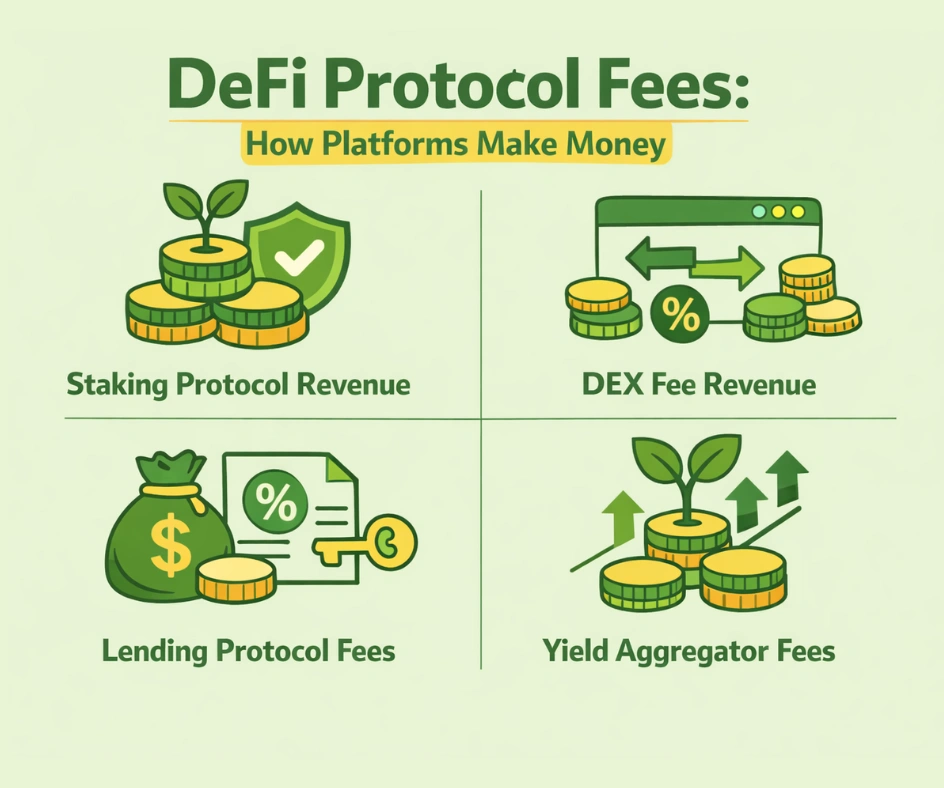
DeFi protocol fees are the revenue model behind every staking and farming platform. Understanding how these protocols make money helps you evaluate whether the fees you pay are reasonable and where your money actually goes.
1. Staking Protocol Revenue
Staking protocols like Lido, Rocket Pool, and StakeWise generate revenue by taking a percentage of the staking rewards earned by users. Lido’s 10% commission, for example, funds both its network of professional node operators and its DAO treasury, which finances protocol development, audits, and community initiatives. This model works because the protocol is providing a genuine service: running validator infrastructure that individual users either cannot or do not want to manage themselves.
Liquid staking protocols now represent 27% of total DeFi TVL, making it the largest single category in decentralized finance by locked value. Lido alone manages $34.8 billion in TVL. At a 10% fee on roughly 3% to 3.5% annual rewards on that TVL, the revenue generated is substantial. This explains why the liquid staking sector attracted significant competition in 2025, with new entrants on Solana and other chains chipping away at Lido’s historically dominant position.
2. DEX Fee Revenue (For Yield Farmers)
Decentralized exchanges earn revenue from the swap fees paid by traders. The exact split depends on the protocol. In Uniswap V2, 100% of the 0.3% swap fee goes to liquidity providers. Uniswap’s governance could activate a protocol fee of up to 0.05% (taken from the LP’s share, not added on top), but this has not been turned on for most pools as of late 2025. In October 2023, Uniswap Labs implemented a separate 0.15% swap fee on trades made through its main web interface for selected tokens, which funds the company’s operations.
PancakeSwap’s V2 fee split sends 0.17% of each 0.25% trade to liquidity providers, with 0.03% going to the protocol treasury. This difference between what traders pay and what LPs receive is the protocol’s margin.
3. Lending Protocol Fees
For farmers who earn yield through lending protocols like Aave and Compound, the platform fees are embedded in the spread between borrowing and lending rates. Aave, with approximately $40.3 billion in TVL, takes a portion of the interest paid by borrowers before distributing the rest to lenders. This spread is the protocol’s revenue, and it fluctuates based on market demand for borrowing.
4. Yield Aggregator Fees
Yield aggregators add another fee layer. These protocols automatically move your funds between different farming strategies to chase the highest yields and compound your returns. In exchange, they charge performance fees (a percentage of profits), management fees (a percentage of deposited assets), and sometimes withdrawal fees. The logic is that the aggregator’s optimization and auto-compounding produce better net returns than what you would achieve manually, even after their fees.
Staking Fees vs. Yield Farming Fees: Key Differences
While staking and yield farming are both ways to earn passive income in DeFi, the fee structures differ in important ways. Understanding these differences helps you choose the approach that best matches your risk tolerance, capital size, and willingness to actively manage positions.
Staking is simpler. You lock a single token, and you earn rewards. The fee structure is usually straightforward: gas to enter and exit, plus a platform commission on rewards. There is no impermanent loss because you are not holding a token pair. The total fee burden is lower and more predictable.
Yield farming is more complex and involves more fee touchpoints. You often need to swap tokens to form a pair, deposit that pair into a liquidity pool, claim rewards periodically, and potentially compound those rewards through additional transactions. Each step costs gas. You also face impermanent loss, which acts as an ongoing hidden cost. And if you use a yield aggregator, you pay performance and management fees on top of everything else.
The trade-off is that yield farming typically offers higher raw APYs than staking, partly because those higher returns compensate for the additional risks and costs. Staking ETH through Lido currently offers around 3% to 3.5% APR. Meanwhile, yield farming on some volatile token pairs can offer 20%, 50%, or even higher, but those headline numbers do not account for fees, impermanent loss, or the risk that the reward token plummets in value.
For smaller portfolios, staking usually makes more financial sense because the fee burden is lighter. Farming becomes more viable as your capital increases and the fixed gas costs represent a smaller percentage of your position.
How DeFi’s Record Growth Is Shaping Fee Dynamics
The DeFi sector’s explosive growth in 2025 has had a direct impact on fee structures and competition among protocols. In Q3 2025, DeFi reached a record $237 billion in Total Value Locked, the highest ever recorded. Ethereum maintained its lead with $119 billion in TVL, while the broader ecosystem saw increasing activity on alternative chains and Layer 2 networks.
This growth has intensified competition, which is generally good news for users. On the liquid staking side, Lido’s historical dominance (nearly 80% market share in 2024) started to erode as new protocols on Solana and other chains offered competitive rates with lower fees. More competition means protocols are pressured to keep their commissions attractive.
On the DEX and farming side, the landscape shifted dramatically. A market once dominated by two or three platforms capturing 80% of fees is now far more balanced. Uniswap’s share of DEX fees fell from around 50% to approximately 18% in a year, as platforms like Meteora, PumpSwap, Aerodrome, and Hyperliquid Spot introduced better fee structures and routing.
For stakers and farmers, the takeaway is that fee competition is alive and well. Protocols that charge too much are losing market share to more efficient alternatives. This competitive pressure benefits everyone who participates in DeFi.
Yield Farming Fee Structures on Major DEXs
| DEX Platform | Swap/Trading Fee | LP Revenue Share & Notes |
|---|---|---|
| Uniswap V2 | 0.30% per trade | 100% to liquidity providers; protocol fee switch exists, but is not activated for most pools |
| Uniswap V3 | 0.05%, 0.30%, or 1% (tiered) | LPs choose a fee tier matching asset volatility; concentrated liquidity for capital efficiency |
| PancakeSwap V2 | 0.25% per trade | 0.17% to LPs, 0.03% to treasury; runs on BNB Chain with lower gas costs |
| PancakeSwap V3 | 0.01% to 1% (tiered) | LPs receive approximately 66% to 67% of collected fees; concentrated liquidity model |
| Curve Finance | 0.04% (stablecoin pools) | Designed for low-slippage stablecoin swaps; LPs earn trading fees plus CRV token rewards |
| Aave (Lending) | Interest rate spread | Borrower pays interest; lender receives portion after protocol takes; $40.3B TVL; variable and stable rate options |
| Balancer | Custom (pool creator sets fee) | Supports weighted, stable, and boosted pool designs; $1.05B TVL; flexible pool configurations |
Practical Strategies to Reduce Your DeFi Fees
Knowing what fees exist is one thing. Knowing how to minimize them is what actually improves your bottom line. Here are actionable approaches to reduce the cost of staking and farming in DeFi.
1. Use Layer 2 Networks Wherever Possible
If the protocol you want to use is available on a Layer 2 like Arbitrum, Optimism, or Base, use it there instead of the Ethereum mainnet. The same staking or farming activity on a Layer 2 can cost 90% to 99% less in gas fees. Most major DeFi protocols now support Layer 2 operations, and the security guarantees are inherited from Ethereum.
2. Time Your Transactions
Gas fees fluctuate based on network demand. On Ethereum, weekends and late-night hours (UTC) tend to have lower gas prices. Tools like Etherscan’s Gas Tracker, GasNow, and the Blocknative Gas Estimator show real-time gas prices and historical patterns. Setting a maximum gas fee in your wallet and waiting for a low traffic window can save you 20% to 30% on transaction costs.
3. Batch Transactions When Possible
Advanced users can batch multiple operations into a single transaction using smart contracts or protocols that support batching. Some wallets and aggregators offer this feature, combining approvals, swaps, and deposits into one transaction. This reduces the number of separate gas payments.
4. Compare Platform Commissions Before Committing
The difference between a 10% and a 35% commission on staking rewards is massive over time. Before choosing a staking platform, compare the fee structures. A platform offering a slightly lower APR but with much lower fees might deliver better net returns than a higher APR platform with steep commissions.
5. Use Yield Aggregators for Small Positions
If your farming position is too small to justify the gas costs of manual compounding, a yield aggregator can be more efficient. The aggregator batches compounding transactions across thousands of users, spreading the gas cost thinly. Even with the aggregator’s performance fee, the net result is often better than infrequent manual compounding.
6. Farm on Lower Fee Chains for Smaller Portfolios
If you are working with less than $1,000, farming on the Ethereum mainnet is hard to justify. Consider chains like Solana, BNB Smart Chain, Polygon, or Avalanche, where gas fees are negligible. The yields may be different, but your actual take-home profit could be higher because you are not burning a chunk of it on fees.
7. Set Minimum Position Sizes
Establish a personal rule for minimum position sizes based on the chain’s gas costs. On the Ethereum mainnet, $2,000 or more per position is a reasonable floor. On Layer 2s, $500 might work. On Solana or BSC, you can go much smaller. This discipline prevents situations where fees consume a disproportionate share of your returns.
Recommended Reading:
The Tax Implications of Staking and Farming Fees
Fees do not just affect your returns. They also have tax implications that are worth understanding. In many jurisdictions, the gas fees you pay to claim staking rewards or farming yields can be added to your cost basis for those tokens. This means when you eventually sell the tokens, your taxable capital gain is reduced by the amount you spent on gas.
For example, if you claim 100 tokens at $2 each (recognizing $200 of income), and the gas fee for that claim transaction was $15, your cost basis becomes $215. If you later sell those tokens at $3 each, your capital gain is $85 per 100 tokens rather than $100. Every gas receipt matters.
Keep records of every staking and farming transaction: the transaction hash, the gas fee in both the native token and USD, the date, and the purpose of the transaction. Tax tracking tools designed for crypto (like TokenTax, CoinTracker, or Koinly) can automate much of this, pulling data directly from your wallet addresses.
Common Mistakes That Increase Your Fee Costs
Many stakers and farmers pay more in fees than they need to, simply because of avoidable mistakes. Here are the most common ones.
1. Farming With Too Little Capital on Expensive Chains
Opening a $300 farming position on the Ethereum mainnet is almost always a losing proposition. The gas costs for entering, claiming, compounding, and exiting will eat a huge portion of your returns. Always match your chain to your capital.
2. Ignoring Compounding Frequency
Compounding too frequently on gas-expensive chains wastes money. If your daily farming yield is $2 but a compound transaction costs $5, you are losing money every time you compound. Calculate the optimal compounding frequency where the additional yield from compounding exceeds the gas cost of the transaction.
3. Chasing High APY Without Checking Fees
A 200% APY sounds incredible, but if the protocol charges a 20% performance fee and the reward token drops 80% in value, your actual return could be negative. Always look at the net APY after all fees, not just the headline number.
4. Not Comparing Staking Providers
The difference between an 8% and a 23% commission on staking rewards (the real range across major platforms) is significant. Spending 10 minutes comparing platforms before staking can save you meaningful amounts over a year.
5. Transacting During Peak Hours
Submitting transactions when the network is congested means paying premium gas prices. A little patience and timing awareness can reduce your gas costs by 20% to 30%.
Reduce Your DeFi Staking and Farming Costs Today:
We bring 8+ years of blockchain expertise to DeFi platform development. Our specialized team handles everything from smart contract creation to multi-chain integration, helping you build staking and farming solutions with optimized fee structures, gas efficiency, and user-friendly dashboards. Whether you need a liquid staking protocol or a yield aggregator, we build solutions that put more returns in your users’ wallets.
Final Thoughts
Staking and farming fees are an unavoidable part of participating in DeFi, but they do not have to be a mystery. From network gas fees and platform commissions to swap costs, performance fees, and the hidden drag of impermanent loss, every layer of the DeFi stack takes a bite out of your returns. The users who do well in this space are the ones who understand exactly where their money goes and take deliberate steps to minimize unnecessary costs.
The good news is that the fee landscape has improved enormously. Ethereum’s gas fees have plummeted since the Dencun upgrade. Layer 2 networks offer nearly free transactions with full Ethereum security. Competition among staking protocols and DEXs is driving commissions downward. And the tools available for tracking, comparing, and optimizing fees are better than ever.
What matters most is matching your strategy to your circumstances. If you have a smaller portfolio, stick to low-fee chains and simple staking. If you have more capital and experience, yield farming across multiple protocols can produce higher returns, but only if you account for every fee along the way. Keep records for tax purposes, compare platforms before committing, time your transactions during low traffic windows, and always calculate the net return after all costs.
DeFi staking and farming can be genuinely profitable ways to grow your crypto holdings. But profitability starts with knowing the cost of participation, and that knowledge puts you ahead of the vast majority of users who never bother to look.
Frequently Asked Questions
Q1.What are staking and farming fees in DeFi?
Staking and farming fees are the costs users pay when they participate in DeFi protocols. These include network gas fees for processing transactions, platform commissions taken from your rewards, swap fees when trading tokens, and sometimes withdrawal or performance fees charged by aggregators. Every interaction with a DeFi smart contract involves at least one fee, and most staking or farming activities involve several.
Q2.How much do DeFi staking platforms charge in fees?
Commission rates on staking rewards vary widely between platforms. Lido and Binance both charge 10% of staking rewards. Rocket Pool charges 14%. Coinbase takes 35%. StakeWise charges 10%. Service fees across the industry range from 8% to 23% of staking rewards. On top of commissions, you also pay blockchain gas fees for staking and unstaking transactions.
Q3.Why are yield farming fees higher than staking fees?
Yield farming involves more transactions than staking. You typically need to swap tokens, deposit into liquidity pools, claim rewards, compound those rewards, and eventually withdraw. Each step costs gas. You may also pay swap fees, performance fees to aggregators, and bear the hidden cost of impermanent loss. Staking usually requires just two transactions (enter and exit) and a single platform commission.
Q4.What is the minimum amount needed to make staking or farming profitable after fees?
It depends on the blockchain. On the Ethereum mainnet, yield farming generally requires at least $2,000 per position for the gas costs to be a small fraction of returns. On Layer 2 networks like Arbitrum or Optimism, $500 can be sufficient. On very low-fee chains like Solana or BNB Smart Chain, you can work with much smaller amounts because gas fees are negligible.
Q5.How can I reduce my staking and farming fees?
Use Layer 2 networks or low-fee blockchains whenever possible. Time your transactions during off-peak hours for lower gas prices. Compare platform commission rates before choosing where to stake. Use yield aggregators to handle compounding efficiently. Set minimum position sizes so that fees never consume a large share of your returns. Batch transactions when available.
Q6.Are DeFi staking and farming fees tax deductible?
In many jurisdictions, gas fees paid to claim staking or farming rewards can be added to your cost basis for those tokens, which reduces your taxable capital gain when you sell. The rules vary by country, so consult a tax professional. Regardless of local rules, always save your transaction hashes and fee records, as they may reduce your tax liability.
Explore Services
Related Services
Reviewed by

Aman Vaths
Founder of Nadcab Labs
Aman Vaths is the Founder & CTO of Nadcab Labs, a global digital engineering company delivering enterprise-grade solutions across AI, Web3, Blockchain, Big Data, Cloud, Cybersecurity, and Modern Application Development. With deep technical leadership and product innovation experience, Aman has positioned Nadcab Labs as one of the most advanced engineering companies driving the next era of intelligent, secure, and scalable software systems. Under his leadership, Nadcab Labs has built 2,000+ global projects across sectors including fintech, banking, healthcare, real estate, logistics, gaming, manufacturing, and next-generation DePIN networks. Aman’s strength lies in architecting high-performance systems, end-to-end platform engineering, and designing enterprise solutions that operate at global scale.