
Isolated Money Markets for a Safer DeFi Lending Layer
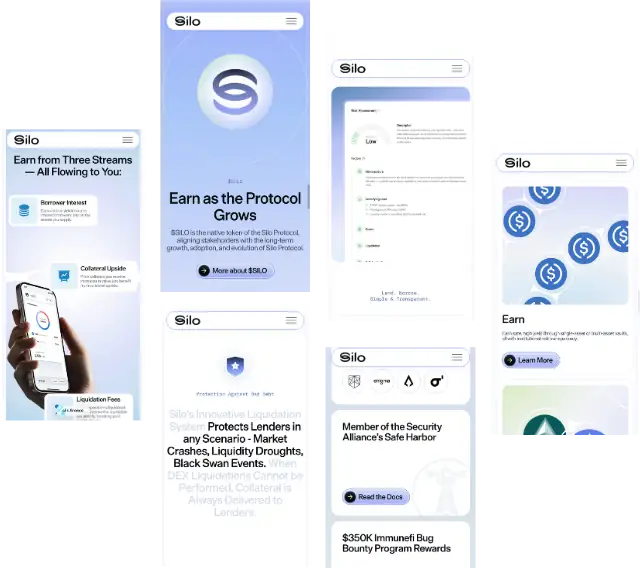
Silo Finance is a non-custodial DeFi lending protocol that replaces the shared-pool lending model with a network of independent, two-asset lending markets called Silos. Instead of pooling all assets into a single risk environment, every token on Silo gets its own isolated market. This means a failure in one lending market cannot spread to any other, making it one of the most structurally secure DeFi lending and borrowing platforms built to date.
Get Started with Silo Finance
Every token on Silo Finance exists in its own independent lending market a “Silo” containing exactly two assets: the unique token and a bridge asset like ETH or USDC. Risk stays inside each Silo, meaning a failure or exploit in one market has zero impact on any other market in the protocol.
Any developer or project team can deploy a new Silo for any ERC-20 token without governance approval. The permissionless Silo Factory contract handles deployment. Because each market is isolated, even high-risk or experimental tokens can be listed without introducing systemic danger to the rest of the protocol.
ETH and USDC function as bridge assets, shared assets that appear across all Silos, connecting isolated markets indirectly. Depositors of bridge assets earn yield from aggregate borrowing demand across every Silo in the network, providing strong capital efficiency despite the isolated design.
Each Silo is built on two ERC-4626 tokenized vaults, one per asset. When users deposit, they receive vault shares representing their position. Depositors can choose whether their funds are available for borrowing (earning interest) or held non-borrowably, giving each lender precise control over their own risk exposure.
Core Silo contracts are immutable after deployment. No governance vote, no admin key, and no upgrade mechanism can change a Silo’s parameters once it is live. This eliminates the upgrade-based attack vector that has been exploited in other DeFi lending protocols.
Silo v2 introduced a programmable Hooks system that allows developers to attach custom logic, liquidation engines, yield strategies, and custom oracle configurations to any Silo market. This transforms Silo from a fixed lending product into a flexible, programmable credit layer that builders can extend without modifying core contracts.
Silo v3 (launched March 2026) introduces a two-pathway solvency model. When DEX liquidity is sufficient, standard market liquidations execute normally. When DEX liquidity is fragmented or unavailable, the protocol activates a Collateral-Debt Swap, repaying lenders directly by swapping collateral into the loan asset at a discount, maintaining solvency without relying on external market conditions.
DeFi lending protocols built on a shared-pool model carried a structural vulnerability that the industry had accepted as unavoidable: one bad asset in the pool could endanger every lender in the protocol. Every time a new token was added to a shared-pool protocol, it introduced tail risk for all existing depositors even those who never touched that token.
This created two compounding problems. First, governance had to carefully gatekeep every new asset listing, keeping thousands of legitimate tokens out of lending markets entirely. Second, even protocols with strong governance records remained one oracle failure or liquidity crisis away from a protocol-wide insolvency event.
Silo Finance was built to eliminate both constraints simultaneously. The protocol needed to support permissionless listing of any ERC-20 token, including long-tail, governance, and LP tokens while ensuring that the failure of any single token could never propagate across the system. It also needed to solve a deeper problem: DeFi lending protocols’ dependence on live DEX liquidity for solvency during liquidations, a dependency that quietly created hidden risk in every money market, regardless of isolation model.
The result had to be modular enough for developers to build on, transparent enough for lenders to evaluate their actual risk exposure per market, and architecturally sound enough to support assets with thin on-chain liquidity a category that represents the vast majority of the EVM token universe.

Each Silo contains exactly one unique token and one bridge asset. Lenders in any given Silo are exposed only to the risk of those two assets, never to any other token in the protocol. If the unique token is exploited or suffers an oracle failure, only that Silo is affected. All other Silos continue operating without interruption.
Silo uses a dynamic interest rate model with an 80% utilization target per Silo. When borrowing demand pushes utilization above target, rates rise to attract more supply. When utilization falls below a configured lower bound, rates drop to stimulate borrowing. This model keeps liquidity reliably available while maximizing lender yield across market conditions.
Silo v3 defines two liquidation thresholds per market. Above the DEX Liquidation Threshold, positions are liquidated through decentralized exchanges in the standard way. Above the Collateral-Debt Swap Threshold, triggered when DEX liquidation is uneconomical or impossible, the protocol swaps the collateral asset directly into the loan asset at a fixed discount, fully covering lenders without requiring external market liquidity. Lenders also receive a portion of the liquidation fee, making liquidation events a secondary yield source rather than purely a risk event.
Silo’s smart contracts have been independently audited by ABDK, Quantstamp, Certora, and Immunefi across v1 and v2 codebases. Active bug bounty programs run continuously alongside each version. The protocol’s immutable-by-default deployment model means audited code cannot be modified after launch what you audit is what runs in production.
Visual identity and design elements
Primary font family and usage
Brand colors
#0d0d0d
#4ade80
#ffffff
Project Approach
Rather than competing directly with established DeFi lending protocols on liquidity scale, Silo Finance focused on a structural gap, the shared-pool model’s inability to safely onboard long-tail assets and its hidden dependence on DEX liquidity for solvency. The approach combined strict market isolation with permissionless deployment a combination that made risk containment the protocol’s foundational property rather than a governance-managed afterthought.
The team prioritized developer extensibility alongside user security. The Hooks system in v2, built on the ERC-4626 standard, was specifically designed to allow third-party builders to extend Silo markets without modifying core contracts, positioning the protocol as a composable credit primitive rather than a finished product. The v3 architecture went further, decoupling solvency from external market conditions to enable lending markets for asset categories that were previously excluded from DeFi yield farming and credit infrastructure entirely.
Project Results
As of 2026, Silo Finance tracks over 559 active lending markets across Ethereum, Arbitrum, and Avalanche, with an average APY of approximately 27% across pools. The protocol launched Silo v3 in March 2026, introducing the Collateral-Debt Swap mechanism a structural first in DeFi lending that removes the dependency on DEX liquidity for market solvency.
Silo v2’s Hooks system has been integrated by external developers to build custom liquidation engines, structured yield products, and lending markets for asset types including Curve LP tokens and Pendle PT tokens that are unsupported on shared-pool protocols. The protocol’s multi-chain expansion has been driven by organic developer demand rather than incentive-heavy growth programs, consistent with its architecture-first positioning as a DeFi development infrastructure layer.

Liquidity Fragmentation Across Silos
Because each Silo is an independent market, total TVL is distributed across hundreds of pools rather than concentrated in one deep pool. Individual Silos, particularly newly created ones, may carry thinner liquidity than a comparable shared-pool protocol would for the same asset, requiring active vault participation and market-maker interest to maintain healthy depth.
Oracle Dependency Per Market
Every Silo’s liquidation logic depends on the accuracy and uptime of its configured oracle. Markets referencing price feeds for newer or less-liquid tokens carry higher oracle risk than those using well-established Chainlink feeds. Silo’s v3 risk disclosure layer surfaces this dependency explicitly, but it remains a per-market risk that lenders must evaluate individually.
Long-Tail Asset Quality
Permissionless market creation allows any token to have a Silo deployed, including low-quality or fraudulent assets. Silo’s isolation model ensures these assets cannot damage other markets, but lenders who deposit into poorly configured or low-quality Silos face asset-specific risk that the protocol does not screen or prevent by design.
Complexity for Retail Users
Silo’s per-market risk model, dynamic rate structure, and two-pathway liquidation system are powerful for sophisticated lenders and developers, but meaningfully harder to evaluate than the simplified interfaces of single-pool protocols. Near-term retail adoption is naturally constrained by this complexity ceiling.
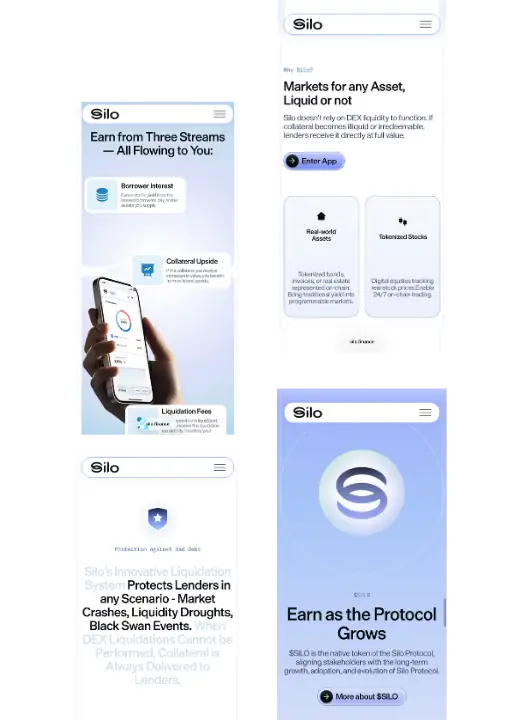
Silo Finance is built on Ethereum (primary), Arbitrum (Layer 2), and Avalanche (C-Chain), using Solidity smart contracts for its core isolated lending logic, ERC-4626 vaults for standardized position management, Chainlink and protocol-configured oracles for price feeds and liquidation triggers, and a permissionless Silo Factory contract for deploying new isolated markets without governance approval.