Service Mesh Security Mutual TLS (mTLS)
Service Mesh Security Mutual TLS (mTLS) encryption between all service instances, automatic certificate rotation,…
We build distributed, fault-tolerant, and event-driven microservices designed for extreme scalability.









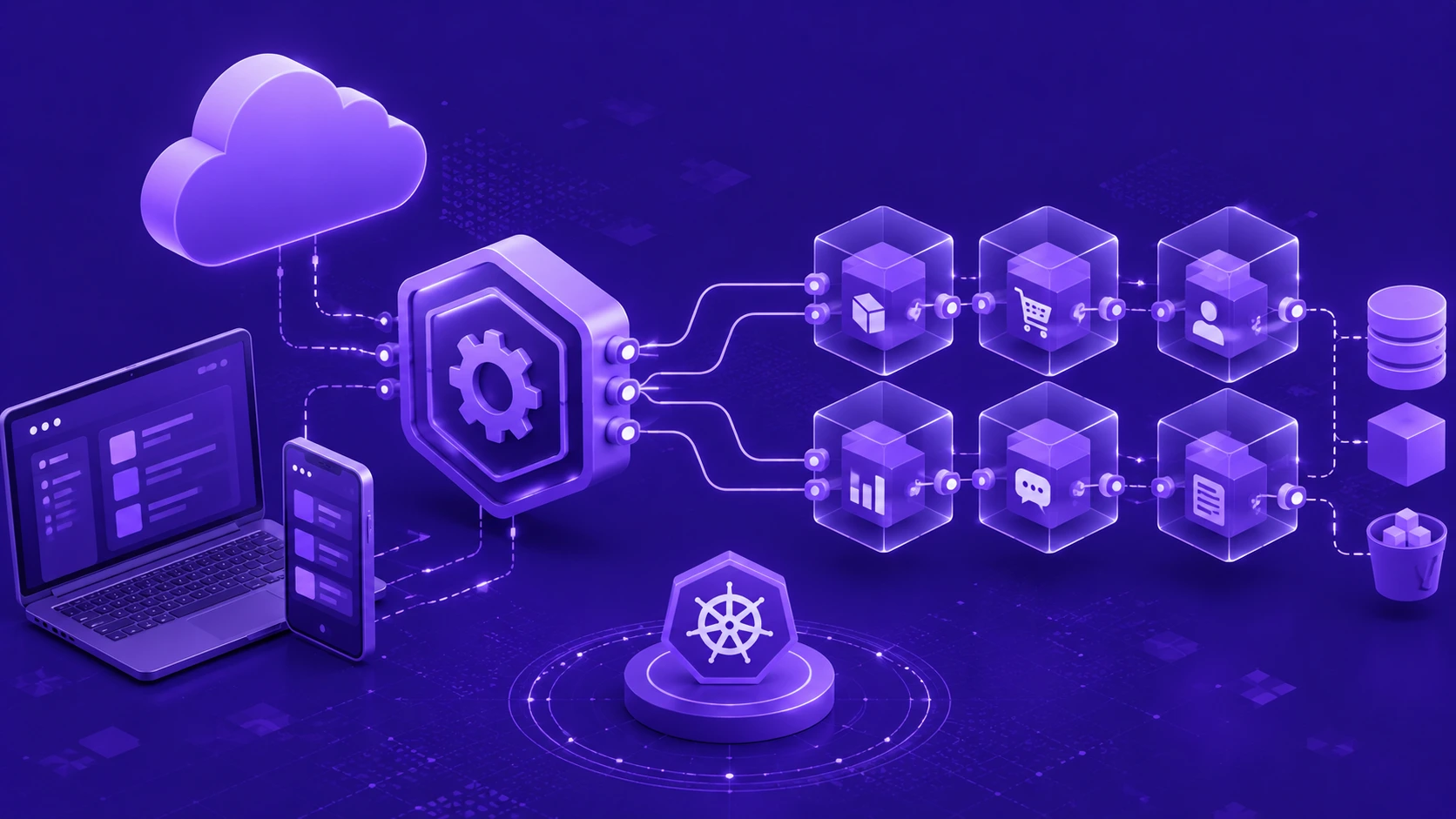
We design, develop, deploy, and optimize microservices architectures built for mission-critical workloads. From service decomposition to API contracts, DevOps pipelines, service mesh integration, and observability systems — every microservice is engineered for autonomy, resilience, and cloud-native performance.
Microservice architectures deployed across enterprise platforms
Average system uptime achieved post-migration to microservices
Typical deployment cycle reduction with containerized services
Combined expertise in distributed systems and service-oriented design

From faster deployments to resilient architecture, our microservices solutions deliver measurable benefits, optimized performance, and seamless integration for your business.

Our microservices can grow independently, letting your system handle higher demand efficiently, optimize resources, and maintain consistent performance across all business operations.

Our solution enables fast and seamless updates, empowering your business to quickly adapt to changing market demands and evolving requirements without disruption.

Each microservice in our solution can be deployed individually, allowing seamless updates and feature releases without affecting the rest of the system, ensuring continuous operation and faster innovation.

With our microservices architecture, the failure of one service does not affect the rest, as each service runs independently, ensuring your platform stays fully operational, reliable, and smooth at all times.

With multiple teams working concurrently on different microservices, development cycles become faster, enabling quicker feature releases, seamless improvements, and a more agile approach to evolving business needs.

We select the ideal technology for each microservice, combining the right languages, frameworks, and databases to deliver high performance, flexibility, and long-term scalability.

With a modular microservices architecture, our solution simplifies testing, debugging, and ongoing maintenance. Each service works independently, reducing system complexity, minimizing errors, and making long-term management faster, smoother, and more cost-effective.

We design services to run across multiple instances, ensuring high availability, fault tolerance, and uninterrupted operations, so your system remains stable, responsive, and accessible even during traffic spikes or unexpected failures.

Our microservices solution ensures intelligent resource allocation, optimizing infrastructure usage to reduce operational costs while maintaining high performance, seamless scalability, and consistent system reliability as your business grows.
Microservices introduce distributed security challenges requiring service-to-service authentication, API gateway protection, and encrypted inter-process communication. Nadcab Labs implements defense-in-depth strategies tailored to your service topology.
Service Mesh Security Mutual TLS (mTLS) encryption between all service instances, automatic certificate rotation,…
API Gateway & Rate Limiting Centralized authentication, token validation, DDoS mitigation, and per-service rate…

Automated vulnerability scanning of Docker images, signed container registries, and runtime policy enforcement to…
Distributed Tracing & Audit Logging End-to-end request tracing across service boundaries with immutable audit…

Secrets Management & Configuration Isolation Centralized secrets rotation using HashiCorp Vault or cloud-native solutions,…
Microservice success depends on architecture clarity, operational maturity, and team enablement—not just code. We combine design patterns, infrastructure expertise, and organizational alignment to ensure your services scale with your business.
We map your business domains to service boundaries using Event Storming and DDD principles, ensuring cohesion and loose coupling that survive organizational change.
Native Kubernetes deployments with automated scaling, self-healing, and GitOps workflows eliminate operational friction and enable your team to focus on business logic.
Distributed tracing, structured logging, and metrics instrumentation built into every service from day one, reducing debugging time and enabling proactive incident response.
Safely decompose monoliths using the Strangler Fig pattern, with zero-downtime cutover strategies and rollback capabilities that protect revenue during transition.
API Gateway Security
Role-Based Access Control (RBAC)
OAuth 2.0 & JWT Authentication
End-to-End Data Encryption
Service-to-Service Authentication
Container Security
Kubernetes Security Policies
API Rate Limiting & Throttling
Distributed Tracing & Logging
Real-Time Monitoring & Alerts
Circuit Breaker Implementation
Load Balancing & Auto Scaling
Secrets & Configuration Management
Disaster Recovery & Backup Strategies
Zero-Downtime Deployment
CI/CD Pipeline Security
Explore our Microservices development solutions through detailed case studies, highlighting projects where we enhanced application scalability, reduced deployment time, and improved system reliability, delivering measurable results and real business impact for our clients.

See how Nadcab Labs built O3 Swap, a DeFi platform offering secure, fast, and user-friendly token swapping solutions. Read full case study.
ViewOur verified client reviews reflect the trust businesses place in our microservices development solutions. They highlight our ability to deliver scalable, high-performance applications, maintain long-term partnerships, and drive measurable business growth.
Expertise You Can Verify
Service Expert

Co-Founder & CEO, Nadcab Labs
Technical lead for Microservices Development Services engagements at Nadcab Labs.
Since 2017, our architects, auditors, and delivery leads have shipped blockchain, Web3, AI, and enterprise software for startups and global enterprises.
We deliver tailored microservices solutions across multiple industries, helping businesses improve scalability, performance, and flexibility while meeting industry-specific challenges and operational needs.

Microservices enable e-commerce platforms to handle high traffic, frequent feature updates, and peak-time sales efficiently. By separating catalog, cart, payment, and order services, businesses achieve faster scaling, smoother checkouts, and a consistently responsive user experience.

In BFSI, microservices ensure secure, compliant, and reliable operations under heavy transaction loads. Independent services for payments, account management, and fraud detection improve system stability, enhance security, and reduce risk during high-volume financial activities.

Microservices support healthcare systems by securely managing sensitive data while ensuring high availability and accuracy. Isolated services for patient records, appointments, and billing improve data protection, system uptime, and seamless care delivery.

Telecom providers use microservices to efficiently manage large user bases and real-time operations. Independent billing, CRM, and network management services allow seamless scaling, faster issue resolution, and uninterrupted service for millions of users.

Microservices help travel platforms handle seasonal traffic spikes and real-time bookings smoothly. Separate booking, pricing, and payment services ensure faster responses, accurate availability, and reliable transactions during peak demand.

In media platforms, microservices manage high content delivery and concurrent users effectively. Streaming, content management, and recommendation engines scale independently to deliver uninterrupted viewing and personalized experiences.

Microservices improve logistics operations by enabling real-time tracking and better process control. Independent inventory, shipment tracking, and order management services ensure faster updates, operational efficiency, and system flexibility.

For SaaS platforms, microservices support multi-tenant architectures and continuous innovation. Modular services enable rapid feature releases, easy client customization, and smooth scalability as user demand grows.
2025: eBPF-based observability and service mesh optimization becomes standard, reducing sidecar overhead and enabling sub-millisecond latency SLOs across service boundaries.
2026: AI-driven anomaly detection in distributed systems gains adoption, automating root cause analysis and enabling self-healing microservices without manual intervention.
2027–2028: Edge microservices and serverless-native patterns converge, allowing organizations to deploy business logic closer to users while maintaining consistency and observability across global deployments.
2029–2030: Platform engineering teams become standard, abstracting Kubernetes complexity through internal developer platforms (IDPs) that democratize microservice deployment and reduce cognitive load on engineers.

Successful microservice implementations unlock independent deployment cycles, technology heterogeneity, and granular scalability. We measure success by your team’s ability to own, iterate, and operate services autonomously.

Independent Service Deployment & Release Velocity

& Blast Radius Containment

Service
Integration

Team Autonomy & Reduced Cross-Service Dependencies
We use trusted and up-to-date technologies to develop microservices that are fast, secure, and easy to scale. This approach ensures stable performance, seamless service communication, and future-ready systems aligned with your business goals.
 React
React Angular JS
 Vue.js
 Spring Boot
 Node.js
 Express.js
 NestJS
 FastAPI
 Flask
Flask PostgreSQL
 MySQL
MySQL MongoDB
 Cassandra
 Redis
Redis REST APIs
 Kafka
Kafka Docker
 Kubernetes
 Jenkins
 Prometheus
 Grafana
 ElasticSearch
By integrating AI into microservices development solutions, we create smarter, adaptive systems that optimize performance, enhance scalability, and deliver personalized, reliable experiences for your business.
AI enables microservices to automatically process data, make decisions, and trigger actions without manual intervention.
Microservices can collect data from multiple services, and AI can analyze it in real-time for trends, insights, and predictions.
AI can optimize communication and workflows between microservices, reducing latency and improving efficiency.
AI helps monitor microservices health and predict failures before they happen, ensuring high availability and minimal downtime.
AI-powered microservices can deliver personalized experiences to users based on behavior, preferences, and history.
AI can detect anomalies, suspicious patterns, or potential threats across microservices and trigger alerts automatically.

We develop microservices through a clear, step-by-step process, ensuring your business can adapt quickly, scale easily, and respond to changing needs without any hassle.
We begin by analyzing your business requirements, workflows, and key functionalities. Using Domain-Driven Design (DDD), we identify distinct domains and define clear boundaries for each microservice. This ensures modularity and reduces complexity in large systems.
Pricing Begins At
Microservices MVP / Basic Architecture
Premium Plans Starting At
Enterprise-Grade Microservices Platform
The cost of microservices development varies depending on the scope and complexity of your project. Factors such as the number of services, API integrations, containerization requirements, cloud infrastructure, orchestration tools, monitoring solutions, and security implementations all influence the final investment. The level of scalability, fault tolerance, and customization required also plays a key role in determining development costs.
Deployment environments and operational requirements can further impact pricing, as infrastructure choices and compliance standards differ across industries. We deliver tailored microservices development solutions designed to align with your business objectives while ensuring performance, flexibility, reliability, and long-term scalability.
Pricing Begins At
Microservices MVP / Basic Architecture
Premium Plans Starting At
Enterprise-Grade Microservices Platform
Our microservices development solutions have earned industry awards and recognitions for delivering scalable, high-performance applications. These accolades validate our commitment to innovation, quality, and long-term value for clients across industries.






Looking for a solution that fits your business perfectly? Share your requirements, and we’ll craft a custom microservices strategy designed to maximize efficiency, scalability, and security.
Domain-Driven Design
Independent Data Management
Performance Optimization
API Strategy
CI/CD Automation
Monitoring & Optimization

Microservices development is a modern software approach where applications are split into small, independent services, each performing a specific function. Unlike monolithic systems, these services can operate, update, and scale independently while working together seamlessly. This method enhances flexibility, reliability, and maintainability, enabling faster updates and efficient handling of growing user demands. APIs, messaging systems, and orchestration tools ensure smooth communication across services.
Microservices consulting services guide businesses in designing and building flexible, scalable, and manageable applications. Experts assess existing systems, identify improvements, and help break complex applications into independent services that work seamlessly. With the right guidance, you can minimize development risks, accelerate releases, scale specific features independently, and achieve better performance, reliability, and faster adaptation to evolving business needs.
The time to develop a microservices architecture depends on application size and complexity. Small to medium projects may take a few weeks, while large enterprise systems can require several months. Factors like existing infrastructure, number of services, integrations, and security needs affect timelines. Fortunately, microservices enable phased development, allowing parts of the system to go live sooner while other services continue to evolve.
At Nadcab Labs, we ensure microservices quality through strict development standards and continuous improvement. Each service is designed, tested, and monitored for consistent performance, security, and reliability. Using automated testing, code reviews, and performance monitoring, we quickly detect and resolve issues. Continuous updates and optimizations keep your applications stable, scalable, and high-performing as your system grows.
The cost of developing a microservices-based application depends on application size, number of services, and customization requirements. Simple setups with fewer services cost less, while complex enterprise systems with advanced integrations and security demand higher investment. Factors like cloud infrastructure, third-party integrations, and maintenance also affect costs. With clear requirements, microservices are built to match your needs, budget, and future growth plans.
Businesses prefer microservices over monolithic architecture because they simplify management and scalability. Instead of modifying an entire system, microservices let you update or scale individual components. This enables faster updates, minimal disruptions, and greater flexibility. As your business grows, whether adding features or handling increased users, microservices allow seamless adaptation without impacting the rest of the application.”
Ready to build a microservices architecture that truly supports your business growth? Connect with our experts to discuss your goals, explore the right approach, and take the next step toward a scalable and future-ready system.
Begin Your Microservices Project
Insights
Fresh expert guides matched to this service — updated as we publish
Explore Services