
Building the On-Chain Funding Rate Market
Pendle has developed Boros, a yield trading module that allows institutional and retail traders to trade on-chain financial derivatives for perpetual futures funding rates, which were previously unhedged and an off-chain cost. Boros does this by using a new instrument called Yield Units (YU), which enables all parties to lock in a fixed rate, speculate on the direction of perpetual future funding rates or arbitrage across different platforms.
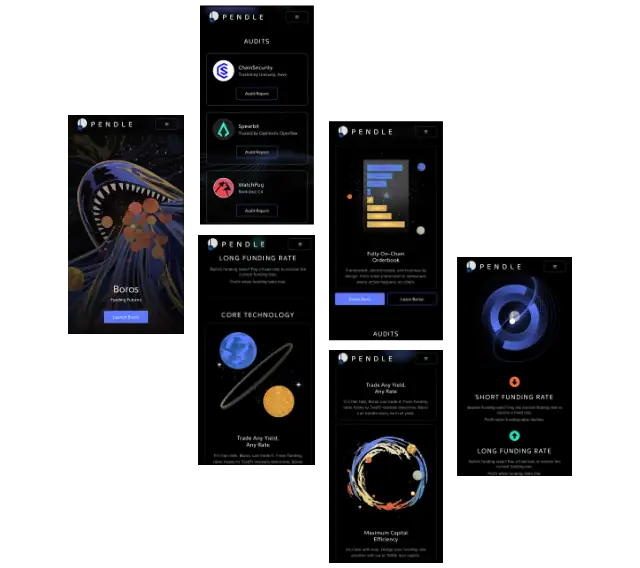
Get Started with Pendle — Boros
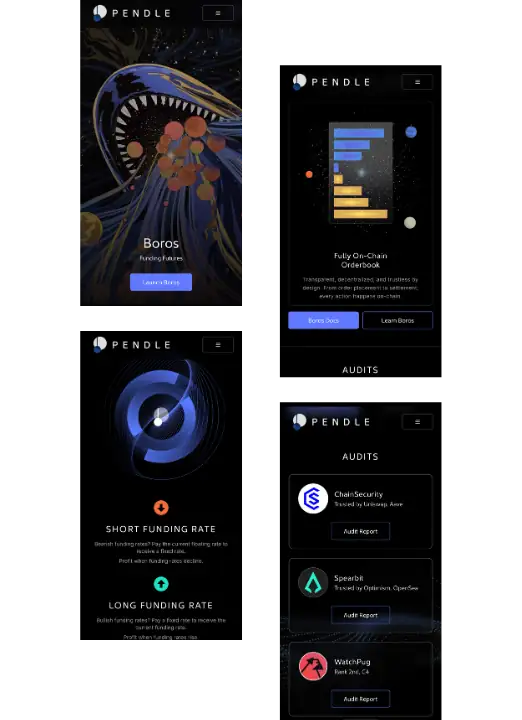
Each YU represents the funding-rate cash flow tied to one unit of collateral up to a fixed maturity date. Long YU receives the floating funding stream; short YU pays it in exchange for a fixed rate structurally similar to an interest rate swap.
Unlike a typical AMM, Boros quotes are expressed directly as an implied annual percentage rate, making the rate market more intuitive to price and trade for professional desks.
Each YU market has a dedicated vault that acts as a standing counterparty to market orders, while capturing protocol incentives, swap fees, and yield from the underlying collateral.
Every market draws its live funding rate from an oracle referencing a centralized venue (initially Binance, later expanding to include Hyperliquid), which anchors on-chain pricing to real market conditions.
Boros operates as a margin yield-trading platform, allowing leveraged exposure to funding-rate movements rather than requiring full collateralization for every position.
Because funding rates diverge across perpetual platforms, Boros is structured to let traders short the higher-funding market and long the lower one, capturing the spread on-chain.
Boros runs alongside Pendle’s existing V2 product rather than replacing it V2 continues serving fixed-rate yield tokenization, while Boros expands into the funding-rate category.
Boros had the task of finding a way to turn an off-chain funding rate (used by some DEXs) that does not have on-chain trading activity with respect to the pricing of that rate into an on-chain price/market. To do this required the design of a whole new pricing model that could support the professional trading flows needed to hedge large perpetual positions; run basis trades; and arbitrage funding spread between multiple venues – it must therefore be constructed to behave like a real interest-rate market, not just like a standard token swap with no real price discovery process.
Reliability of the underlying rate feed was very important as each YU market is referencing the pricing of the analogue off-chain to the reference rate used in that YU market and must be provided by accurate, frequently updated oracles from the exchange being referenced. In addition, all of this must work alongside Pendle’s current V2 product in such a manner as to not fragment liquidity and/or cause disruption to existing users.
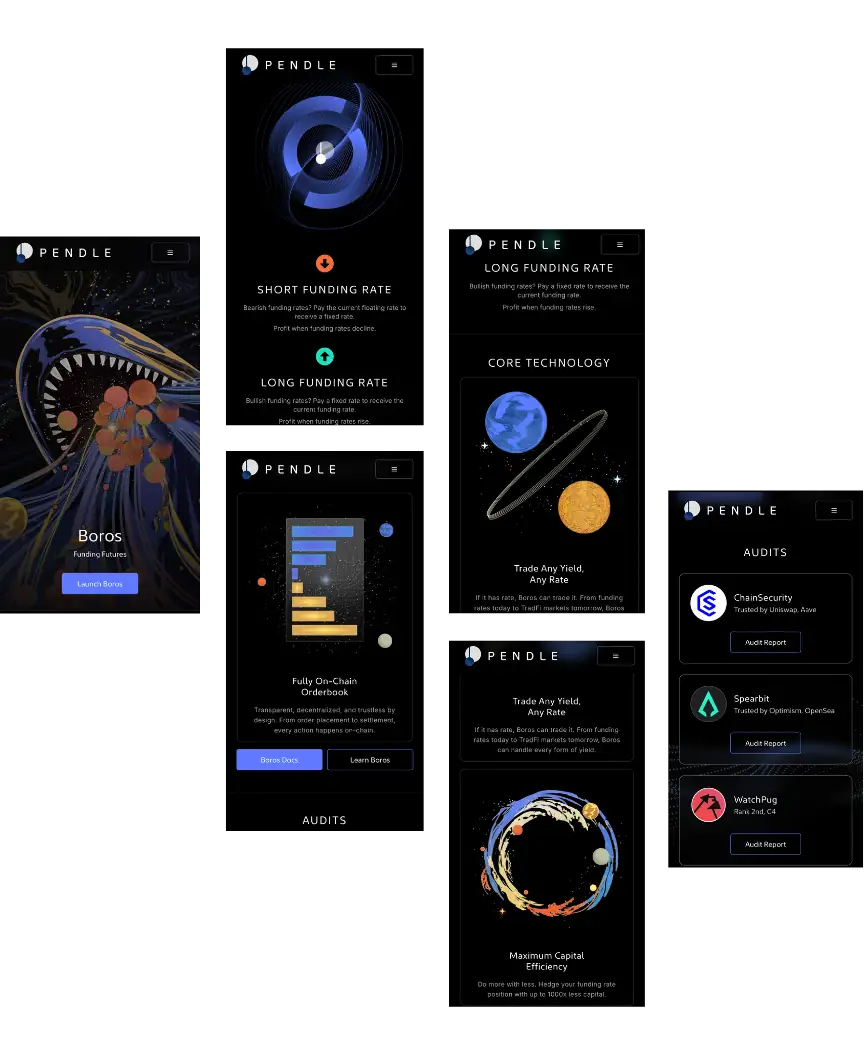
Live funding rates are pulled from reference venues such as Binance and Hyperliquid through oracle feeds, forming the “underlying yield” that every YU market prices against.
Traders choose between locking in a fixed yield (short YU) or staying exposed to the floating funding stream (long YU), mirroring how interest rate swaps function in traditional finance.
Each YU market settles at a defined maturity date, after which positions are closed out based on the accumulated funding-rate cash flows over the period.
Dedicated vaults backstop each market, stepping in as counterparties when order book depth is thin a hybrid approach designed to avoid the liquidity problems of a pure order book in a new market category.
Visual identity and design elements
Primary font family and usage
Brand colors
#0b1118
#a7d94b
Project Approach
Rather than building a standalone perpetuals exchange, Pendle’s team focused Boros on a narrower, underserved problem: making funding rate exposure itself tradable. The approach combined an order book priced in implied APR with dedicated vaults per market, addressing the core weakness of both pure-AMM and pure-order-book designs in a fast-moving rate market.
The team prioritized professional and institutional use cases over retail simplicity margin trading, hedging, and cross-venue arbitrage were treated as the primary workflows, which shaped decisions from the pricing format down to the oracle design. Boros was also deliberately positioned as an additive module to Pendle’s existing V2 product, avoiding a disruptive migration for existing liquidity providers and users.
Project Results
Within 48 hours of its initial launch, Boros attracted approximately $1.85 million in BTC and ETH deposits, with a measurable lift in Pendle’s broader on-chain activity on Arbitrum during the same period.
By late 2025, Boros had grown to account for a majority of on-chain yield-trading volume within the Pendle ecosystem, with funding-rate markets reportedly seeing tens of millions of dollars in cumulative trading volume within weeks of launch. The protocol has since expanded its listed markets to include rates referenced from Hyperliquid.
It’s worth noting the broader context honestly: Pendle’s total value locked across all products has been cyclical, peaking above $8 billion during 2025 before contracting significantly in 2026 as large fixed-maturity positions matured a normal pattern in this category of DeFi product rather than a directional decline. As a fee- and volume-driven product, Boros is somewhat insulated from this specific TVL cycle, which appears to be part of why Pendle has invested in it as a second growth engine alongside its core yield-tokenization business.
Oracle Dependency
Every YU market’s pricing ultimately traces back to an off-chain funding-rate feed, which concentrates trust in oracle reliability and uptime.
Narrow User Base
The product’s complexity and margin-based design make it more suited to professional trading desks than retail users, which naturally caps near-term volume growth.
Liquidity Depth in New Markets
As with any order-book-based design, newly listed YU markets depend on active vault participation and market-maker interest to avoid wide spreads.
Cross-Venue Basis Risk
Arbitrage strategies that lean on spreads between Boros and centralized funding rates assume reasonable correlation between venues, which is not guaranteed during periods of market stress.
Boros is built on Arbitrum (Layer 2), using Solidity smart contracts for its core margin and settlement logic, oracle integrations for live funding-rate feeds from venues including Binance and Hyperliquid, and an order-book-plus-vault matching engine to price and settle Yield Unit (YU) positions.