

Key Takeaways
- Consensus mechanisms are an essential infrastructure that enable blockchain networks to function without central authorities by allowing thousands of independent computers to agree on the same data
- There is no one-size-fits-all consensus mechanism because different blockchains prioritize different goals like maximum security (Bitcoin), energy efficiency (Ethereum 2.0), transaction speed (Solana), or democratic governance (EOS)
- Proof of Work pioneered blockchain consensus in 2009 with Bitcoin, requiring miners to solve computational puzzles, but it consumes enormous amounts of electricity, comparable to entire countries
- Proof of Stake revolutionized consensus by using cryptocurrency stakes as collateral instead of computational power, reducing energy consumption by 99 percent while enabling faster transactions
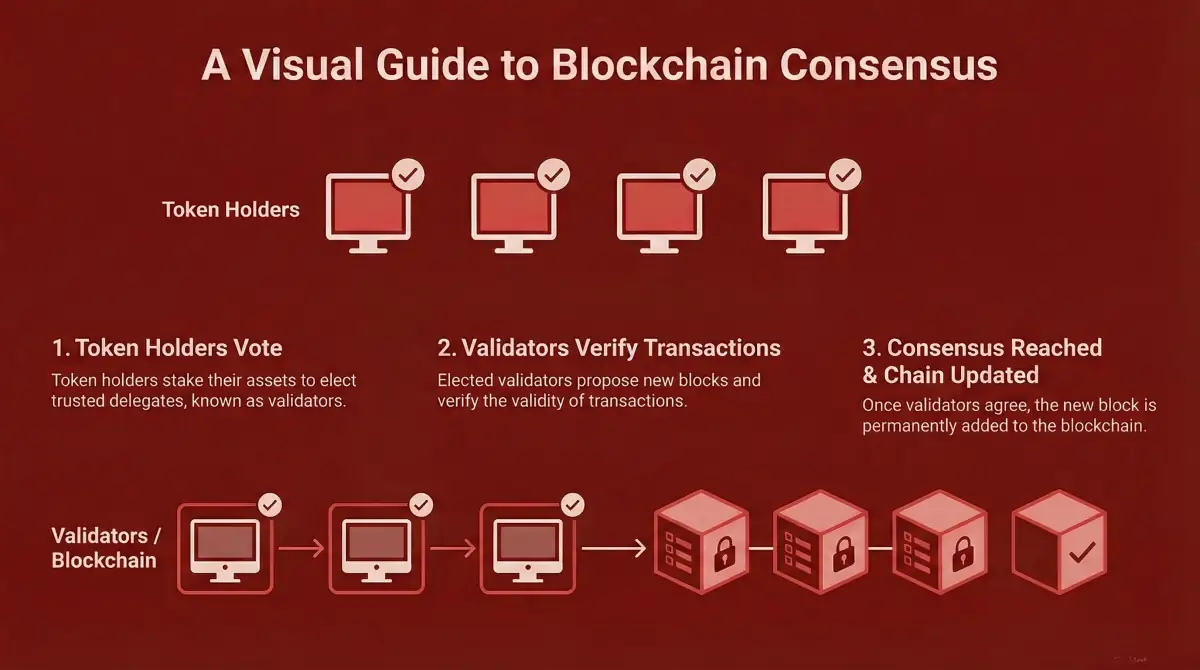
- Delegated Proof of Stake combines efficiency with democracy by allowing token holders to vote for delegates who validate blocks, enabling very high transaction throughput while maintaining community control
- Byzantine Fault Tolerance enables private blockchains to reach consensus even when some nodes are faulty or malicious, making it ideal for enterprise and consortium implementations
- Proof of Authority trades decentralization for speed and simplicity by using validator reputation and identity as the primary security mechanism, suitable for known-validator networks
Blockchain often sounds complex, but at its core, it is simply a shared system where many independent computers must agree on the same data. Since there is no central authority controlling a blockchain network, every update, transaction, or block needs collective approval. This is where blockchain consensus mechanisms become essential. They act as the decision-making backbone that keeps decentralized networks reliable and trustworthy.
Think about a global ledger that is copied across thousands of nodes. If even a few nodes record different information, the system would fall apart. Consensus in blockchain ensures that all participants follow the same rules and accept only one agreed-upon version of the truth. Without a proper consensus mechanism in blockchain, issues like double-spending, data manipulation, or network forks would be impossible to control.
Different blockchain networks use different consensus blockchain models based on their goals. Some prioritize security, others focus on speed, scalability, or energy efficiency. We already have dedicated pages explaining each type in detail, so here we will keep things simple and focus on helping readers understand what a blockchain consensus algorithm is and why it matters, before we explore deeper.
What is a Consensus Algorithm in Blockchain?
Definition
A consensus mechanism is a set of rules and protocols that enable distributed computers (nodes) in a blockchain network to independently agree on the current state of the ledger without requiring a central authority.
Consensus mechanism in blockchain is a rule-based system that helps all nodes in a decentralized network agree on a single version of truth. It decides which transactions are valid and which block should be added next to the blockchain.
Since blockchain networks do not have a central controller, consensus ensures trust through mathematics, cryptography, and network rules rather than human authority. This is why consensus blockchain models are considered the backbone of blockchain technology.
In simple terms, a consensus mechanism in blockchain serves three critical functions:
- Verifies that transactions are legitimate and have not been tampered with
- Ensures all network participants have the same version of the truth about account balances and transaction history
- Protects the network against fraud, double-spending, and malicious attacks
Without consensus mechanisms, a decentralized blockchain network would descend into chaos. Different blockchain nodes would maintain conflicting versions of the ledger, making the system unreliable and vulnerable to manipulation.
Why Are Consensus Mechanisms Critical for Blockchain?
Consensus mechanisms are the foundation that makes blockchain technology work. In centralized systems like traditional banks, a single authority maintains the official ledger, and customers must trust that institution to keep accurate records. Blockchain removes this requirement for trust in a central authority by allowing the network itself to maintain the ledger through consensus.
Consensus mechanisms accomplish this through several key objectives:
Agreement on Truth: All nodes must agree on the current state of the ledger and the order in which transactions occurred. This prevents conflicting versions of the blockchain from existing simultaneously.
Security Against Attacks: By requiring significant computational work, financial stake, or reputation risk, consensus mechanisms make it economically unfeasible for malicious actors to manipulate the blockchain. A successful attack would cost more than any potential reward.
Decentralization: Consensus mechanisms eliminate the need for any single entity to control the network. Instead, decision-making power is distributed across many independent nodes, preventing any individual or organization from censoring transactions or manipulating the ledger.
Fault Tolerance: Networks can continue operating correctly even when some nodes are offline, malfunctioning, or acting maliciously. This resilience is essential for critical financial systems.
Trustlessness: Network participants don’t need to trust each other or any central authority. Instead, they trust the mathematics and cryptography embedded in the consensus mechanism.
Types of Blockchain Consensus Mechanisms
There are many different consensus mechanisms, each with distinct advantages and disadvantages. Understanding the differences between them is essential for selecting the right blockchain platform for specific applications.
Some of the following consensus mechanisms work in blockchain networks:
- Proof of Work
- Proof of Stake
- Proof of Authority
- Delegated Proof of Stake
- Practical Byzantine Fault Tolerance
- Proof of Space
- Proof of History
- Proof of Importance
- Proof of Elapsed Time
Let us take an overview of each type of consensus mechanism, including how it works, its benefits, and drawbacks.
Proof of Work (PoW)
Proof of Work was the first major consensus mechanism, introduced by Bitcoin in 2009. It remains the most established and proven mechanism for securing large blockchain networks.
In Proof of Work, network participants, called miners, compete to solve complex mathematical puzzles. The first miner to solve the puzzle gets to add the next block of transactions to the blockchain and receives a reward in cryptocurrency. All other nodes quickly verify that the solution is correct and accept the new block.
How it works:
- Miners collect pending transactions into a memory pool
- Each miner works on solving a difficult computational puzzle (finding a valid nonce)
- The puzzle difficulty adjusts automatically based on mining power in the network
- The first miner to find a valid solution broadcasts the new block to the network
- Other nodes verify the solution and accept the block
- The winning miner receives cryptocurrency rewards
Benefits/Advantages:
- Highly secure and decentralized due to computational difficulty
- Well-established and proven over time (Bitcoin, Ethereum Classic)
- Resistant to 51% attacks due to massive computational requirements
- Transparent and verifiable by all participants
- No pre-existing stake is needed to participate
Disadvantages:
- Extremely energy-intensive and environmentally harmful
- High hardware costs and specialized equipment (ASICs) are needed
- Slower transaction speeds due to complex computations
- Leads to centralization through mining pools
Important Notes:
- Used by: Bitcoin, Ethereum (until 2022), Litecoin, Dogecoin
- Environmental impact is a major concern for modern applications
- Requires continuous hardware upgrades to stay competitive
Real-world analogy: Imagine a puzzle tournament where increasing numbers of competitors force organizers to make puzzles progressively harder. Participants spend money on better equipment (mining rigs) to solve puzzles faster. Whoever solves it first wins the prize, and everyone else immediately verifies the solution.
Proof of Stake (PoS)
Overview: Proof of Stake was developed as an energy-efficient alternative to Proof of Work. Instead of requiring miners to solve computational puzzles, PoS selects validators based on the cryptocurrency they “stake” as collateral.
In Proof of Stake, validators lock up (stake) a certain amount of cryptocurrency as a guarantee of their honest behavior. The network randomly selects validators to propose new blocks, weighted by the size of their stake. If validators act dishonestly, they lose part or all of their staked cryptocurrency, creating a strong financial incentive for honest participation.
How it works:
- Validators deposit cryptocurrency into a smart contract as a stake
- The network uses various selection methods to choose validators for the block proposal
- Chosen validators propose new blocks and earn transaction fees as rewards
- Other validators attest that the block is valid
- After sufficient attestations, the block is finalized
- Validators who acted dishonestly have their stake slashed (partially or fully confiscated)
Benefits/Advantages:
- Energy-efficient compared to PoW (99.95% less energy)
- Lower barrier to entry for validators
- Faster transaction finality and scalability
- Rewards are predictable based on stake amount
- Reduced centralization risks
Disadvantages:
- Rich get richer problem: wealthy participants have more influence
- Nothing-at-stake problem in some implementations (validators can vote on multiple chains)
- Requires substantial initial capital to participate meaningfully
- New validators find it difficult to establish themselves
Important Notes:
- Used by: Ethereum 2.0, Cardano, Polkadot, Solana
- Validator penalties (slashing) discourage malicious behavior
- Annual staking rewards typically range from 4-15%
Real-world analogy: Similar to a security deposit for a rental apartment. You deposit money as a guarantee of good behavior. If you damage the property (act dishonestly), you lose your deposit. If you behave well, you get the deposit back along with a small reward for being a good tenant.
Proof of Authority (PoA)
Overview: Proof of Authority uses reputation and identity as the stake. Validators publicly reveal their identities and stake their reputation (and often financial capital) on honest behavior.
This consensus mechanism is commonly used in private and consortium blockchains where validators are known and vetted organizations.
How it works:
- Approved validators publicly identify themselves
- Validators stake financial capital and their reputation
- Validators take turns creating blocks in a round robin pattern
- If a validator acts dishonestly, they can be legally prosecuted and lose their reputation
- Public identification makes validators accountable
Benefits/Advantages:
- Extremely fast transaction speeds
- Very energy-efficient (minimal computational power needed)
- Suitable for private and consortium blockchains
- Clear accountability as validators are known entities
- Predictable block times
Disadvantages:
- Highly centralized (only designated validators can create blocks)
- Requires trust in authorities (single point of failure risk)
- Not suitable for truly decentralized systems
- Reputation-based security can be compromised if the authority is hacked
Important Notes:
- Used by: VeChain, Polygon (historical use), Ethereum test networks
- Best for: Private enterprise blockchains, supply chain tracking
- Works well when validators want to maintain their reputation
Delegated Proof of Stake (DPoS)
Overview: Delegated Proof of Stake improves upon traditional Proof of Stake by introducing a democratic voting element. Instead of all token holders becoming validators, they vote for a smaller set of delegates who validate blocks on their behalf.
This approach combines the energy efficiency of Proof of Stake with improved governance and higher transaction throughput.
How it works:
- Token holders vote for a small number of delegates (commonly 20 to 100)
- Delegates take turns validating blocks and earning rewards
- Token holders can remove delegates by voting them out
- Delegates have a strong incentive to act honestly (voters will remove them)
- Significantly fewer validators means faster consensus and higher throughput
Benefits/Advantages:
- Token holders can delegate voting power without running nodes
- More democratic than pure PoS
- Lower computational requirements than PoW
- Encourages community participation and governance
- Faster block confirmation times
Disadvantages:
- Potential voter apathy leading to centralization
- Delegates can be voted out, creating instability
- Requires active token holder participation
- Complex voting mechanisms may confuse users
Important Notes:
- Used by: Cosmos, Tezos, EOS, Polkadot (partial)
- Typical delegation: token holders vote for 21-101 delegates
- Delegates earn rewards and may charge commission
- Staking rewards: 5-20% annually depending on network
Practical Byzantine Fault Tolerance (pBFT)
Overview: Practical Byzantine Fault Tolerance solves the “Byzantine Generals Problem” in distributed systems. It enables consensus even when some nodes are faulty, offline, or intentionally malicious.
The algorithm divides nodes into primary (leader) and secondary (backup) roles. Nodes communicate extensively to reach consensus and can tolerate up to one-third of nodes being faulty.
How it works:
- Primary node proposes a new block
- All nodes receive and validate the block
- Nodes communicate with each other to verify block validity
- Consensus is reached when 2/3 or more nodes agree
- Block is finalized and added to the chain
- If the primary node misbehaves, a view change elects a new primary
Benefits/Advantages:
- Can tolerate up to one-third malicious nodes (Byzantine fault tolerance)
- Instant transaction finality without forks
- Energy-efficient
- No mining/staking computational overhead
- Very secure against attacks
Disadvantages:
- Does not scale well beyond 100-150 nodes
- High communication complexity between validators
- Requires synchronous network assumptions
- Difficult to implement correctly (technical complexity)
Important Notes:
- Used by: Hyperledger Fabric, some permissioned blockchains
- Best for: Small-scale, high-security networks
- Requires fewer than 4f+1 malicious nodes (f = number of faults)
- Communication overhead grows quadratically with node count
Other Important Consensus Mechanisms
Proof of Space (PoSpace): Validators prove they control a certain amount of hard drive storage space. More energy efficient than Proof of Work, but requires significant storage infrastructure. Used by Chia Network.
Proof of History (PoH): Solana’s unique mechanism that cryptographically proves events occurred at specific moments. Enables extremely fast consensus by reducing validator communication requirements.
Proof of Importance (PoI): Rates validators based on three factors: amount of cryptocurrency held, transaction frequency, and transaction volume. Used bythe NEM blockchain. Encourages active network participation rather than hoarding.
Proof of Elapsed Time (PoET): In Proof of Elapsed Time, the network assigns a random waiting time to each validator. The validator whose waiting time expires first earns the right to validate and add the next block. This mechanism is commonly used in permissioned blockchain networks.
Comparison of Blockchain Consensus Mechanisms – Overview
This table compares popular blockchain consensus mechanisms based on key factors such as energy efficiency, transaction speed, decentralization, scalability, security, and hardware requirements, helping you understand their strengths and tradeoffs at a glance.
| Mechanism | Energy | Speed | Decentralization | Scalability | Security | Hardware |
|---|---|---|---|---|---|---|
| PoW | Very Low | Slow | Medium | Low | Very High | Specialized (ASIC) |
| PoS | Very High | Fast | Medium-High | Medium-High | High | Commodity |
| PoA | Very High | Very Fast | Very Low | High | Medium | Commodity |
| DPoS | High | Very Fast | Medium | High | High | Commodity |
| PBFT | High | Fast | Very Low | Very Low | Very High | Commodity |
| PoSpace | Medium | Medium | Medium | Medium | Medium | Commodity (HDD) |
| PoH | High | Very Fast | Medium | Very High | Medium-High | Commodity |
| PoI | High | Fast | Medium-High | Medium | Medium | Commodity |
| PoET | High | Fast | Low-Medium | Medium | Medium-High | Commodity (TEE) |
How Do Consensus Mechanisms Work?
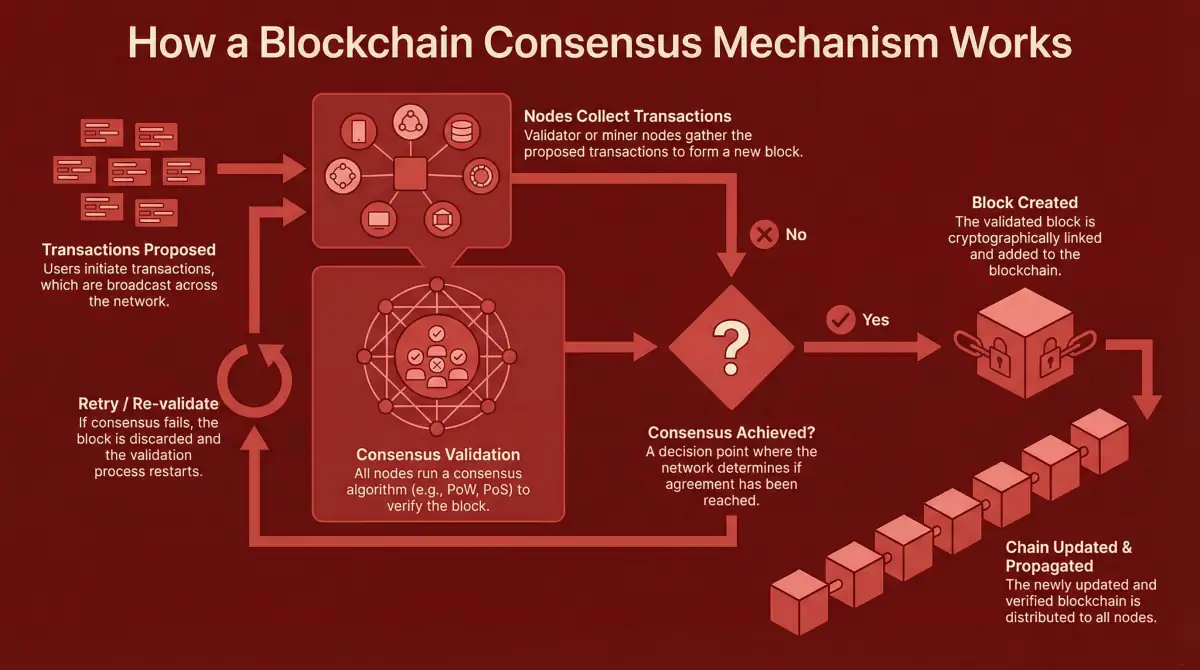
All consensus mechanisms follow a similar general process, though the specific details vary significantly between different algorithms:
Step 1: A participant or designated leader proposes a new transaction or block to the network. This transaction must comply with the network’s protocol rules (proper signatures, correct amounts, etc.).
Step 2: The proposed transaction is distributed to other nodes in the network so they can verify and validate it. The network becomes aware of the proposed change to the ledger.
Step 3: Independent nodes verify the transaction against predefined rules. They check that the sender has sufficient funds, that the digital signature is valid, and that the transaction hasn’t been double-spent. This validation happens in parallel across many nodes simultaneously.
Step 4: Nodes communicate with each other to reach an agreement on whether to accept the proposed transaction or block. The specific voting method varies dramatically depending on which consensus algorithm is used. In Proof of Work, miners compete to solve puzzles. In Proof of Stake, validators are chosen based on their stake. In Byzantine Fault Tolerance, nodes exchange messages to verify agreement.
Step 5: Once a sufficient number of nodes agree on the proposed transaction or block, it is officially added to the blockchain. The transaction is now immutable and permanent.
Step 6: Propagation The updated ledger, including the new block, is distributed to all nodes in the network. Every node updates its local copy of the blockchain to include the new transaction, ensuring all participants have an identical view of the ledger.
Also Read: How Blockchain Consensus Fails and Its Impact on Blockchain Development
What Are the Two Types of Consensus?
When categorizing consensus mechanisms broadly, they generally fall into two main categories:
- Proof-Based Consensus (Resource Intensive)
These mechanisms require validators to prove they control certain resources. The most common form is Proof of Work, where miners prove they have invested computational power. Other forms include Proof of Space (proving storage control) and Proof of Capacity (proving storage capacity).
The resource investment creates a financial barrier to attack. An attacker would need to acquire more resources than the entire legitimate network, making attacks uneconomical.
- Stake-Based Consensus (Economic Stake)
These mechanisms require validators to prove they have financial “skin in the game” by staking cryptocurrency. Proof of Stake and Delegated Proof of Stake are the primary examples.
If validators act dishonestly, they lose their stake through slashing. This creates financial incentive for honest behavior without requiring massive resource investments.
Hybrid mechanisms combining elements of both categories have also emerged, such as Proof of Weight and various custom implementations used by specific blockchains.
Conclusion
Consensus mechanisms are the fundamental technology enabling blockchain’s revolutionary properties. They replace trust in central authorities with cryptographic verification and economic incentives.
Different consensus mechanisms offer different tradeoffs between decentralization, scalability, energy efficiency, and security. Understanding these tradeoffs is essential for selecting the right blockchain for specific applications.
The evolution of consensus mechanisms over Bitcoin’s 16-year history demonstrates ongoing innovation in this field. What began with Proof of Work has expanded to include Proof of Stake, Delegated Proof of Stake, Practical Byzantine Fault Tolerance, Proof of Authority, and numerous specialized mechanisms optimized for specific use cases.
Frequently Asked Questions
A consensus mechanism in blockchain is a protocol that enables distributed network participants to reach agreement on the current state of the ledger without requiring a central authority. It verifies transactions, prevents fraud, and ensures all nodes maintain an identical version of the blockchain.
Proof of Work is a consensus mechanism where miners compete to solve complex mathematical puzzles. The first miner to find a valid solution gets to add the next block of transactions and earns cryptocurrency rewards.
The puzzle difficulty adjusts automatically to maintain consistent block creation time (approximately 10 minutes for Bitcoin). Other nodes quickly verify the solution and accept the new block.
Proof of Work prioritizes security and decentralization over energy efficiency and speed. It remains the most proven consensus mechanism, with Bitcoin operating securely using Proof of Work for 16 years without successful attacks.
Major blockchain consensus mechanism types include:
- Proof of Work: Miners compete to solve computational puzzles
- Proof of Stake: Validators are chosen based on staked cryptocurrency
- Delegated Proof of Stake: Token holders vote for delegates to validate blocks
- Practical Byzantine Fault Tolerance: Nodes communicate to reach consensus even with faulty participants
- Proof of Authority: Approved validators stake their reputation and identity
- Proof of Space: Validators prove control of storage capacity
- Proof of History: Cryptographically proves event timing
- Proof of Importance: Rates validators on network participation
Different blockchains choose different mechanisms based on their priorities regarding decentralization, scalability, energy efficiency, and security.
The right consensus mechanism depends on your project requirements:
- Choose Proof of Work if: You prioritize maximum security and true decentralization. Accept high energy consumption and slower transactions. Example use cases: store of value, digital gold.
- Choose Proof of Stake if: You want energy efficiency, fast transactions, and good decentralization. Accept slightly higher centralization risk than Proof of Work. Example use cases: smart contracts, DeFi applications.
- Choose Delegated Proof of Stake if: You need very high transaction throughput and want democratic governance. Accept reduced decentralization from fewer validators. Example use cases: social media dApps, gaming platforms.
- Choose Proof of Authority if: You operate a private consortium blockchain with known validators. Accept lack of decentralization for speed and simplicity. Example use cases: enterprise blockchains, supply chain tracking.
- Choose Practical Byzantine Fault Tolerance if: You need a permissioned system with immediate finality and fault tolerance. Accept scalability limitations. Example use cases: enterprise networks, banking consortiums.
For guidance on selecting the optimal consensus mechanism for your specific use case, consult with Blockchain Consulting Services.
Reviewed & Edited By

Aman Vaths
Founder of Nadcab Labs
Aman Vaths is the Founder & CTO of Nadcab Labs, a global digital engineering company delivering enterprise-grade solutions across AI, Web3, Blockchain, Big Data, Cloud, Cybersecurity, and Modern Application Development. With deep technical leadership and product innovation experience, Aman has positioned Nadcab Labs as one of the most advanced engineering companies driving the next era of intelligent, secure, and scalable software systems. Under his leadership, Nadcab Labs has built 2,000+ global projects across sectors including fintech, banking, healthcare, real estate, logistics, gaming, manufacturing, and next-generation DePIN networks. Aman’s strength lies in architecting high-performance systems, end-to-end platform engineering, and designing enterprise solutions that operate at global scale.